Prompt Versioning and Rollback Workflows in Production Agents
Treat prompts like application code to catch behavior regressions before they reach users.
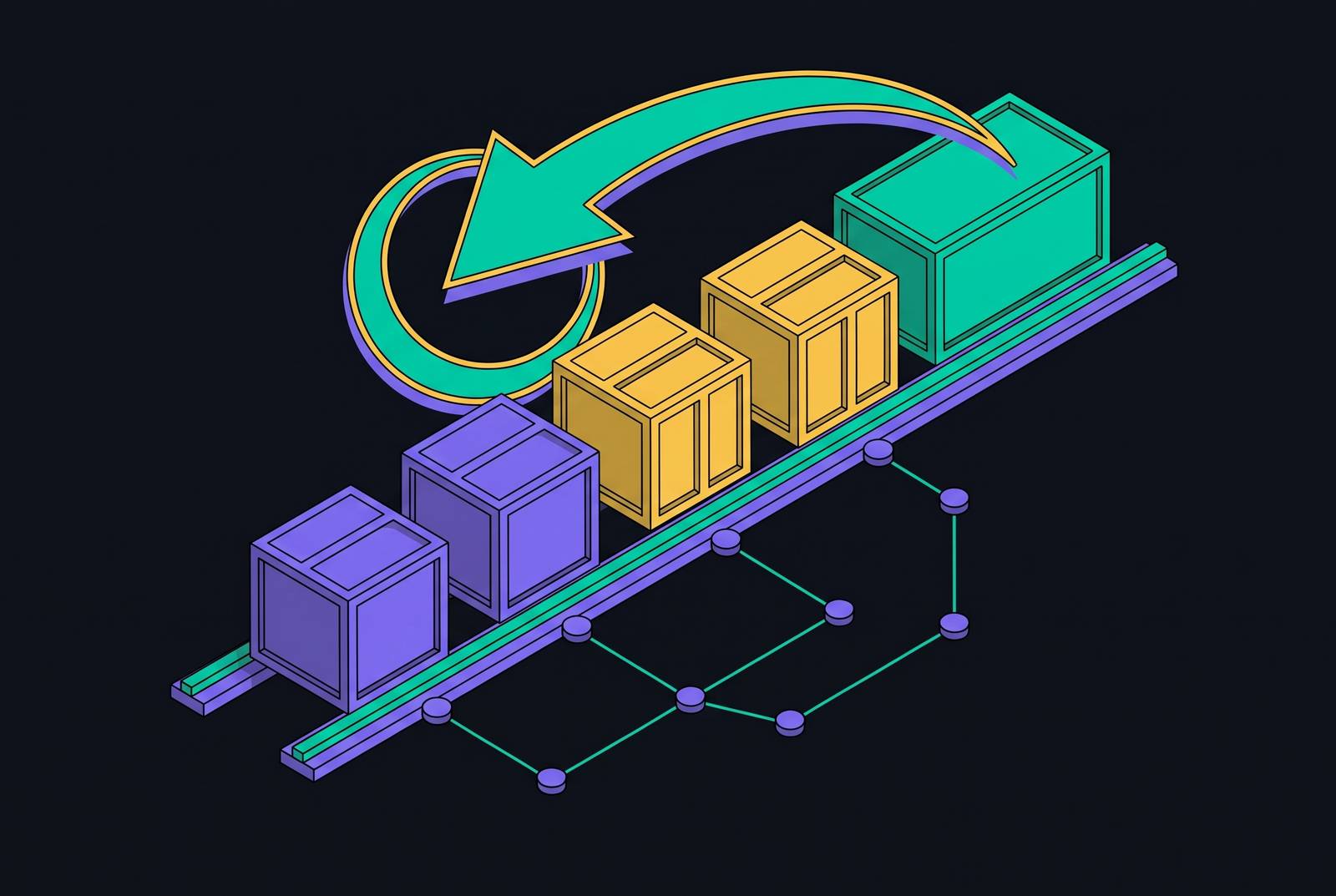
Prompt versioning and rollback workflows address a leading failure mode in production agents, namely silent regressions in behavior. Treat prompts with the same release discipline as application code. Immutable artifacts, pinned environments, eval-gated promotion, and traceable rollout make behavioral changes testable and reversible in seconds without a service redeployment.
Why prompts in production agents are infrastructure, not configuration
Changing one word in a prompt can change how the model interprets an instruction, even when the diff looks harmless in code review. The agent still responds, but its answers get worse. No exception announces the regression to standard error-rate monitoring. The failure is in output quality, so a service can appear healthy while users receive wrong answers.
That disconnect makes prompts a load-bearing layer of agent behavior. Hardcoded prompts create four related problems, including untracked changes, coupled deploy cycles, silent divergence between environments, and no isolated testing path outside the full agent stack. A small wording change can therefore reach users without a clear behavioral comparison or an independent way back. Code review alone cannot resolve that operational gap.
What a versioned prompt artifact actually contains
Rollback requires a preserved record of the behavior being restored. A reliable prompt artifact includes the prompt text, model identifier, model parameters, tool definitions, and retrieval configuration. The artifact needs to include generation parameters as well. Changing temperature changes behavior, so restoring text while leaving temperature unpinned does not bring back the execution context that users experienced.
The artifact also needs a stable identity. That identity is the prompt ID plus its version number, and a published version is immutable. Every change creates a new version and leaves the existing one intact. Metadata records the author, timestamp, change rationale, parent version, and any evaluation results attached to that version. Together, these fields distinguish what changed from why it changed and what evidence supported the release.
In Respan, a prompt object has a version history, per-environment deployment pointers, and traffic-split configuration. The artifact stays fixed while deployment references can move. However, changes to the artifact’s input schema require special treatment because a renamed variable or new required field is a breaking change. Such a change demands an explicit major version bump.
Storing prompts outside application code and fetching them at runtime
An external prompt registry separates those deployment references from application releases. Instead of embedding the active prompt in service code, the agent fetches it by reference at runtime. That indirection is the mechanical foundation of independent promotion and rollback. The application can continue running while the reference resolves to a different published version.
SDK-layer caching keeps the fetch from adding meaningful latency to every request. This preserves runtime access without making registry retrieval the repeated cost of each interaction. The separation also broadens who can contribute to behavioral changes. Product managers and customer success teams can change prompts through a management UI without changing application code, and versioning keeps a record of those changes.
A registry replaces direct edits without a diff or review with identifiable candidates that can be tested before release. It also removes the requirement to deploy the full service for every prompt revision. Without this separation, promotion and rollback remain tied to application deployment even if the prompt text has a version number.
Environment pinning: why "latest" is not a production strategy
Each environment needs an explicit pointer to a selected version. Development points to the newest candidate chosen for experimentation, staging points to a release candidate under validation, and production points to a reviewed stable version. The distinction is between deliberate selection and automatic adoption of whatever was published most recently.
A floating “latest” pointer defeats that distinction in production. Publishing a version intended only for development can then change live behavior without a promotion decision. Respan’s deployment map makes the alternative concrete, with dev pointing to version 23, staging to version 22, and prod to version 18. Promotion changes that map while application code stays fixed. Rollback changes the same map to point back to the earlier version.
Model selection must follow the same discipline. The model identifier belongs to the execution context defined by the artifact, so an alias such as “claude-latest” is not a pin. A specific versioned model identifier keeps that part of the context explicit. Otherwise, a stable prompt reference can conceal a change in the model interpreting it, weakening both evaluation comparisons and the meaning of a rollback.
Eval-gated promotion: how a prompt version earns its way to production
A candidate earns promotion when it passes a regression gate that uses data from production. Reviewers’ impressions are not an adequate release criterion. The gate replays historical inputs against the candidate and tests whether it meets concrete requirements without degrading established behavior. Its result is binary pass or fail, even when the underlying evaluation uses rubric scores.
The dataset determines what that decision can support. Real customer interactions captured in production traces provide cases that hand-picked or synthetic examples cannot substitute for. A golden set curates those traces with expected outputs or rubric scores, giving each candidate a stable basis for comparison. Known failures are added to that set as new cases. The candidate must therefore do better on the failure being fixed and still pass the historical cases.
The requirements depend on the agent’s function. RAG routes can gate on groundedness and context adherence, customer-facing routes on refusal accuracy, and compliance routes on citation validity. Each floor is set using a pinned baseline dataset, without relying on what reviewers think is good enough. This ties the promotion decision to the behavior the route is expected to preserve. A good answer on one example cannot make up for a failed required check elsewhere.
Automation makes that gate part of release control. In the CI integration pattern, every change to a file under the prompt directory triggers the regression suite automatically. The suite is a required check before promotion. Running the golden set on every candidate or on a schedule also provides an ongoing drift signal. A drop that lasts needs to be looked into before it becomes a production incident.
Canary and shadow rollout as the final check before full traffic
Passing the golden set does not prove that a candidate will hold up across the live distribution. Curated cases cannot anticipate every production input. Gradual rollout therefore extends validation beyond the pre-release gate while limiting exposure to regressions that the dataset missed. The previous stable version remains live and available as the fallback throughout that window.
A canary release routes a small percentage of real production traffic to the candidate and increases exposure only if behavior holds. Shadow mode instead runs the candidate against real inputs without showing its responses to users. Its outputs can be compared offline without exposing users to the candidate’s answers. The two patterns answer a related question under different exposure conditions, namely whether the candidate remains reliable on unpredictable production traffic.
Traffic-split configuration makes canary exposure a routing change that leaves code unchanged. During A/B exposure, sticky routing by user ID prevents a user mid-conversation from oscillating between versions, which would distort both the experience and the quality signal. Error rate alone remains insufficient here. The canary must be assessed on the output-quality dimensions used by the eval gate, now applied to live traffic as well as to the golden set.
Rollback in seconds: repointing the environment tag, not redeploying the service
When a candidate degrades behavior, rollback repoints the production environment tag to the prior stable version. The registry retains that immutable artifact, so restoring it does not require rebuilding or redeploying the application. Agents resolve the restored reference when they get their next request. The speed comes from changing the selection of an existing artifact rather than reconstructing a previous service release.
A drop in a canary metric or an alert can trigger the tag change while root-cause analysis proceeds in parallel. This separates the immediate need to stop degraded responses from the slower work of explaining them. The prior version is still available during rollout, so the fallback is ready before the pressure of an incident.
A changed tag, however, is not proof that serving behavior changed. Runtime caching and reference resolution make the version actually used by each request the decisive evidence. Each request must have a record of the exact prompt version, model, parameters, and tool configuration it used. That linkage lets the team establish whether the degraded version stopped serving and whether the restored version produced subsequent outputs.
What traces must capture to make versioning and rollback auditable
The trace record connects deployment intent to executed behavior. It links a particular output to the artifact and execution settings that produced it, making a reported failure attributable to a specific version. Without that link, version history and production evidence are separate records. The audit chain breaks precisely where the team needs to explain what reached the user.
Tail-based sampling keeps failed, expensive, or anomalous traces in full while keeping only a small sample of the happy path. The team can use those traces to find what went wrong and build evaluation cases. Continuous production trace sampling also complements unit evals on discrete steps and regression suites for output quality. It detects real-world drift that neither of those earlier layers anticipated.
Attribution must go deeper than the observation that a run failed. The responsible layer may be the prompt, a tool, the workflow, the model, or the retrieval configuration. Distinguishing these possibilities prevents a prompt rollback from being mistaken for a complete diagnosis. Although rollback can contain the symptom, identifying the responsible layer is what allows the next candidate to address the cause. The same evidence then becomes the input to the improvement loop.
The improvement loop: turning production failures into the next validated version
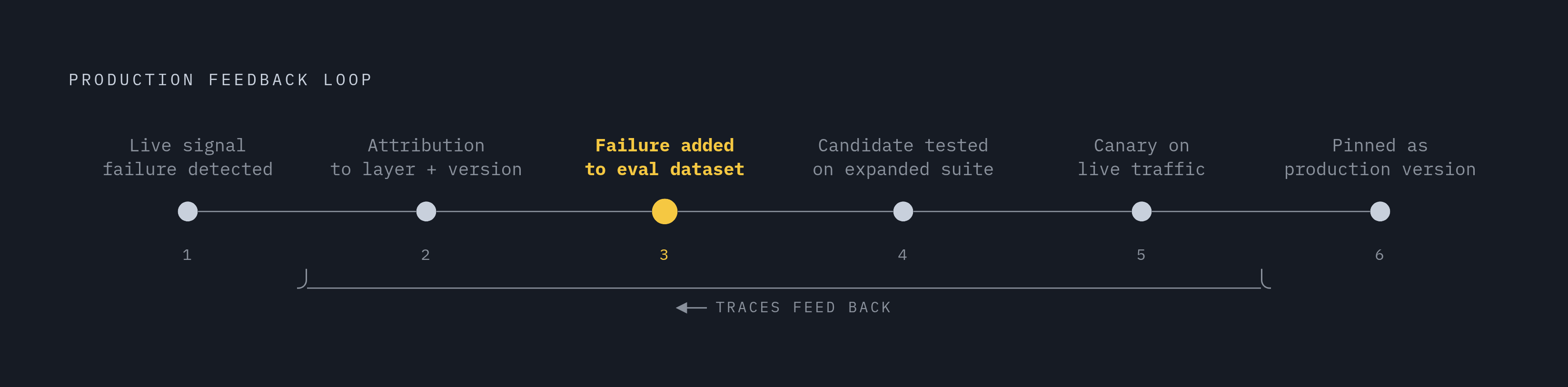
A production failure becomes useful engineering evidence when it changes the next validation decision. The loop begins with a failure or quality drop in live signals, followed by attribution to the responsible layer and version. The identified failure becomes a case in the eval dataset. A candidate is then tested against that expanded dataset, so the correction is assessed together with the behavior already protected by the regression suite.
Passing that gate makes the candidate eligible for rollout. Canary exposure tests it on live inputs before it becomes the new pinned production version. Later traces can show more failures that start the cycle again. Each release therefore inherits concrete tests from earlier production experience rather than relying on the same small collection of favorable examples.