Replay Eval Platforms for Production Agent Validation
Testing agent changes against real production failures catches what synthetic tests miss.

Agent failures don't look like software failures. They don't throw stack traces or trip a server error. They hide inside long, language-heavy trajectories where nothing crashes but everything still goes wrong, and by the time the output reaches a user, the actual point of failure might be six steps back. Replay eval platforms exist to catch this before it ships: they run candidate changes against real traces from actual production failures, not synthetic test cases, before the change ever touches a live user. That single requirement, testing against what actually broke rather than what a team guessed might break, is what separates a useful platform from one that just adds another dashboard to check.
The stakes here are not abstract. A fintech agent running transaction reconciliation entered a runaway loop and kept running, undetected, racking up meaningful cost before anyone caught it. Infrastructure monitoring wouldn't have flagged this: uptime was fine, latency was fine, no error rate spiked. The agent was doing what it was told, just wrongly, over and over. Industry analysts have raised concerns that a significant share of agentic AI projects may be abandoned, and a recurring reason is that teams lack the evaluation infrastructure to catch this class of failure before it reaches production. What kind of evaluation actually catches something real is what matters here. It's what kind of evaluation actually catches something real.
What replay eval means, and why it is different from tracing
Tracing tells you what happened. Evaluation tells you whether what happened was correct. That distinction sounds small until you notice that almost every observability tool on the market can already do the first part, capture a trace, and the entire competitive question has moved to what happens after the trace lands.
Replay eval, specifically, means running a candidate change, a prompt edit, a new tool schema, a reworked workflow step, against a recorded real-world failure before that change goes live. Simple to say, hard to do, because agent behavior isn't reproducible in the way a unit test expects. LLM responses aren't bitwise-repeatable, tools read state that keeps changing underneath them, and a multi-step trajectory almost never plays out the same way twice on a naive re-run.
One research approach, Chronicle, tackles this head-on by recording an agent run at its non-deterministic decision points as immutable "envelopes." From there it uses what the paper calls cut-point replay: serve a chosen subset of those recorded points back to the agent, and let the complementary subset run live against new code. That turns a single recorded incident into something closer to a regression test that can run inside CI, rather than a one-off postmortem nobody revisits.
A separate line of work explores intervention-based replay, where a specific step in a recorded trajectory is forced to a different outcome and the trajectory is re-executed forward to measure how that change propagates. The value of this is specific: it separates the step that decided on a failure from the step that merely carried it out. Those are often different steps, and conflating them is how teams end up patching the wrong thing.
The takeaway carries through the rest of this piece. A platform that only scores final outputs, or scores individual spans in isolation without testing how a change ripples forward through the rest of the trajectory, is doing observability with a score attached. It's doing observability with a score attached.
The harness layer where most agent failures originate
The agent harness is the machinery surrounding the base model: everything that governs how it observes its environment, takes action, stores memory, checks its own work, and improves over time. It's distinct from the model itself, and it's usually where things actually break.
Research on agent architecture commonly identifies six components, though the exact taxonomy varies across frameworks: prompts, tools, memory, and others detailed below. Prompts carry the standing behavioral rules and task policies. Tools expose external services and define the schemas and validation rules for calling them. Memory stores prior observations and outcomes for later retrieval. Additional components package reusable procedures and implement the orchestration logic that ties it together. And evals, the external checks and approval loops, operate on everything the agent produces.
The MAST taxonomy, from Cemri et al. (2025), found that failures in multi-agent LLM systems tend to trace back to specification flaws, misalignment between agents, and weak verification, categories that relate closely to harness-level concerns rather than raw model capability. Across a multi-step agent workflow, context management becomes an increasing concern, and extended trajectories can strain the model's ability to reason reliably over the full task history.
This has a direct implication for what a replay platform needs to do. Knowing a run failed is close to useless without knowing which layer caused it. Was the prompt ambiguous? Did a tool schema drift out of sync with what the model expected? Did memory retrieval surface stale context instead of current state? A platform that can't attribute failure to a specific layer just tells you something went wrong, which you already knew.
The step that executes a harmful action is usually not the step that decided on it. That makes LLM-judge attribution, where a model looks at a trace and guesses what went wrong, correlational at best. The original paper puts baseline step-level attribution accuracy at introduction around 14.2% on the Who&When benchmark, though later methods in the literature have pushed well past that mark. Either way, the number underscores why intervention-based replay, actually testing what happens when you change a specific step, reveals what a judge model reading a transcript and offering an opinion cannot.
The three-layer eval architecture that production replay platforms must support
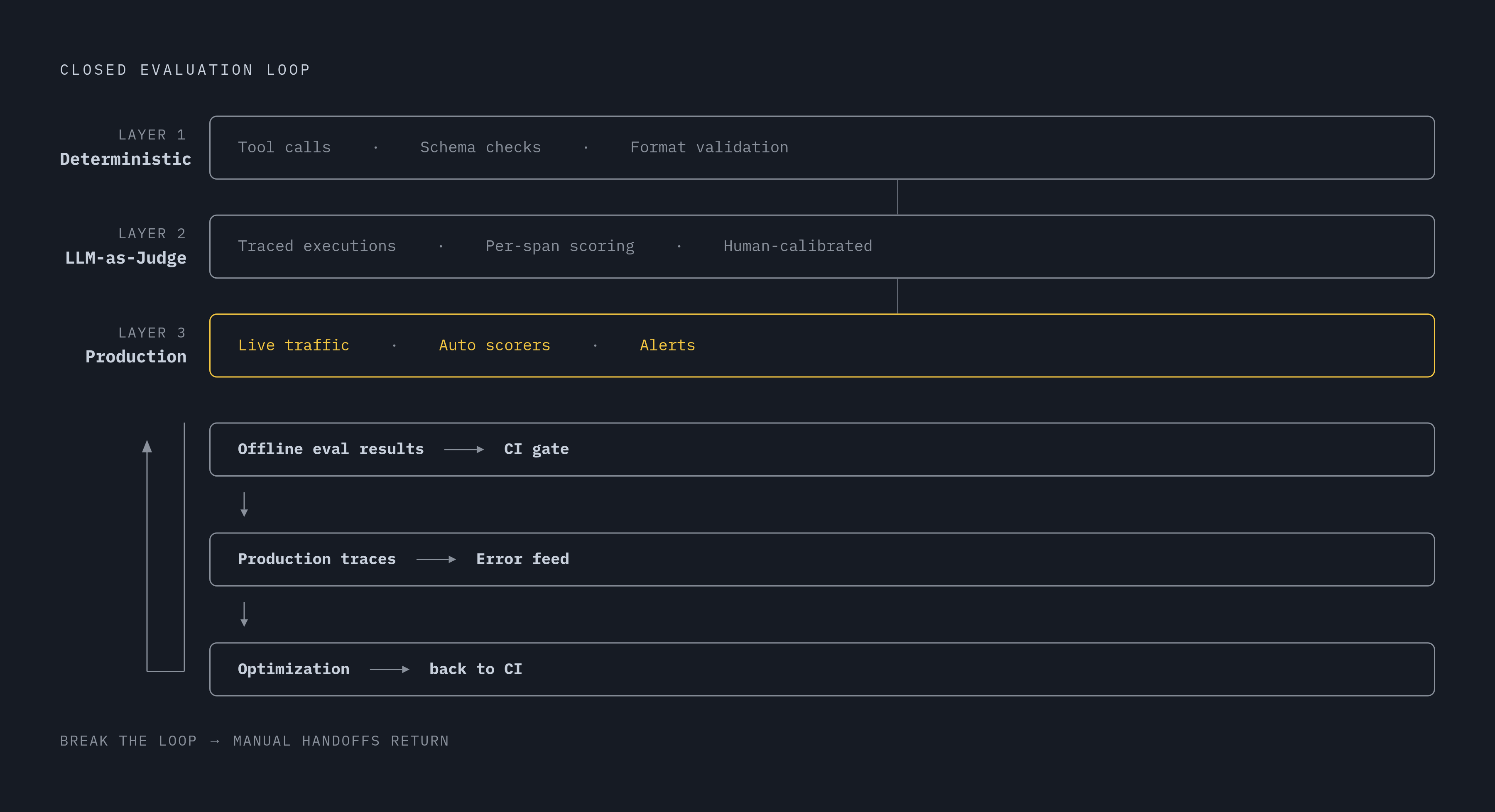
A common structural pattern has emerged across production eval practices, organized around three layers of agent evaluation.
Layer 1 covers fast, deterministic checks on individual tool calls, schema compliance, and output format, good at blocking obvious regressions before they reach CI. Layer 2 applies LLM-as-judge scoring to traced executions, a scalable approach to evaluating agent behavior at volume, though it requires calibration against human-labeled examples to be trustworthy. Done properly, this means scoring each span in a trace on its own terms. Layer 3 involves continuous evaluation against live production traffic, where scorers run automatically on incoming traces, turning production failures into standing quality checks that can trigger alerts or feed a regression suite without requiring manual transcript review.
These layers only work as a system if they close the loop. Offline eval results feed the CI gate. The CI gate feeds production trace evaluation. Trace evaluation feeds an error feed. The error feed feeds optimization work. Optimization ships back through CI, and the cycle starts again. Break that loop anywhere, and a team ends up managing the handoffs by hand, which is exactly the manual overhead a replay platform is supposed to remove.
Building the eval dataset itself matters just as much as the architecture around it. Mining real production traces gives the highest ecological validity, since it captures how the agent actually behaves rather than how someone imagined it would. A small anchor set of hand-written golden cases, covering the handful of scenarios that absolutely cannot fail, rounds it out. Auto-generating new eval cases from annotated production failures builds a regression suite shaped by what actually went wrong in the field, not by what a test-writer guessed on day one.
The metrics a platform needs to surface are task completion, step efficiency, argument correctness, tool correctness, plan adherence, plan quality, reasoning quality, answer relevancy, faithfulness, safety, latency, and cost. None of that is useful without tracing that ties each number back to the exact span that produced it. And the judges doing this scoring have a known failure mode of their own: the Continual Search framework describes LLM judges settling on a plausible-sounding root cause before they've actually worked through the full evidence trail. Guarding against this takes iterative nudging across turns, pushing the judge back toward unresolved evidence instead of letting it stop at the first explanation that sounds right.
Platform comparison: what the leading options do
Judged against everything above, a handful of criteria separate the platforms that matter: genuine multi-turn agent support, causal or replay-based attribution rather than plain scoring, auto-generated evals pulled from real production failures, continuous production monitoring, CI/CD integration, and pricing that a team can actually plan around.
Confident AI positions itself around enterprise-wide standardization: one platform team defines a single evaluation and monitoring standard, and product teams apply it consistently across different frameworks and stacks. It evaluates at the span level, scoring individual tool calls, reasoning steps, and retrieval decisions rather than grading only the final output, and it ships more than 50 metrics purpose-built for agentic work: tool selection accuracy, planning quality, step-level faithfulness, reasoning coherence. A graph visualization renders the full execution tree, which helps when debugging cascading failures across parallel branches and retry loops. It also runs multi-turn simulation, CI/CD regression detection, and security testing for prompt injection and unauthorized tool use, plus collaboration tooling built for product and QA staff who aren't going to open a codebase to check a result. Named customers include Panasonic, Toshiba, Amdocs, BCG, and CircleCI, and a free plan is available.
Maxim AI frames itself as an end-to-end simulation, evaluation, and observability platform for teams shipping agents into production. Its agent simulation runs interactions across defined user personas and scenarios, evaluating the full trajectory rather than a single output, and lets a team re-run a simulation from any specific step to reproduce and fix a failure directly. Evaluators can be configured at the session, trace, or span level, mixing deterministic checks, statistical methods, and LLM-as-judge scoring, with human annotation queues for the judgment calls that still need a person. On the observability side it offers node-level visibility, OpenTelemetry compatibility, and real-time alerts through Slack and PagerDuty, with support for frameworks including LangGraph, the OpenAI Agents SDK, and Crew AI. Maxim reports, in its own published materials, that teams using the platform ship agents more than five times faster, a vendor figure worth reading as exactly that.
An observability and evaluation tool built specifically for one particular agent framework rounds out the comparison from the framework-specific end. It offers visual trace inspection for debugging reasoning chains, a prompt playground with trace replay, and dataset management for bulk evaluation runs, all tightly integrated with LangChain and LangGraph. Multi-turn support is tightly coupled to LangChain agents, with integration effort increasing for anything outside that ecosystem, and its free tier imposes trace volume limits. The tradeoff is straightforward: deep, low-friction integration if a team already builds on LangChain, and real friction if it doesn't. One 2026 industry report on the state of AI agents found 57% of organizations now running agents in production, with quality cited by roughly a third of respondents as the top barrier to deployment, showing why that ecosystem reach matters. That's the exact gap replay eval is built to close.
Across all three, the pattern holds: none of them is simply logging traces and hoping a dashboard catches the next runaway loop. Each is trying, in its own way, to answer the harder question this piece keeps returning to: not whether a run failed, but which layer of the harness decided it would fail, and whether a fix holds once it's replayed against the failure that exposed it.
Sources
- Top 5 AI Agent Evaluation Platforms in 2026
- Best LLM Evaluation Tools for AI Agents in 2026 - Confident AI
- LLM Agent Evaluation Metrics in 2026: Tool Calling, Task Completion, Reasoning, and Trace-Based Evals - Confident AI
- 2026 Guide: Evaluate AI Agents in Production (3 Levels)
- lilianweng.github.io
- AlphaEval: Evaluating Agents in Production
- Catching One in Five: LLM-as-Judge Blind Spots in Production Multi-Turn Transaction Agents
- getmaxim.ai