Stakeholder Sign-Off Workflows for Agent Releases
Rigorous sign-off requires tracing failures to their actual cause, not guessing from logs.
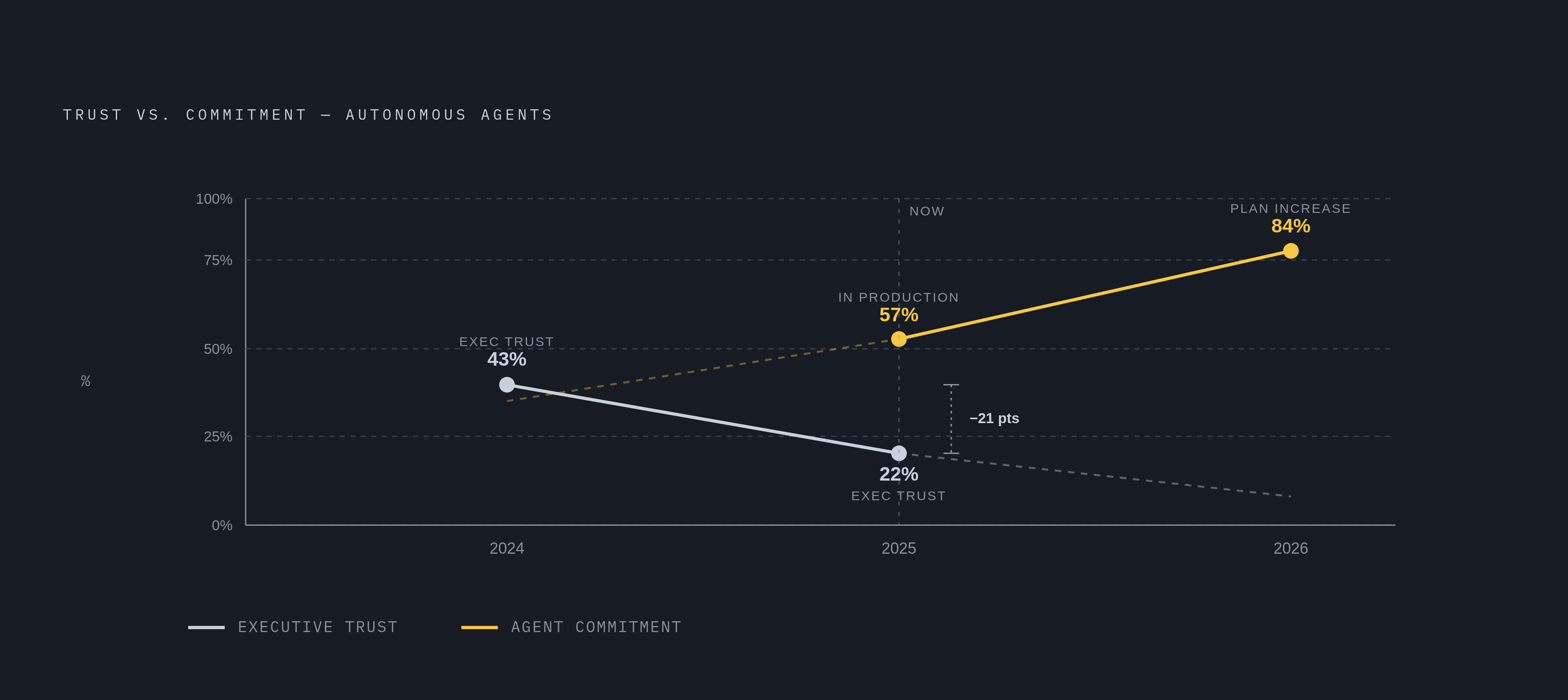
Stakeholder sign-off on an agent release is supposed to be a checkpoint, a moment where someone with authority looks at a change and decides whether it's safe to ship. In practice, it's often a trust exercise dressed up as governance: a demo, a dashboard, a verbal assurance that "it was tested." That's no longer good enough. Executive confidence in autonomous agents actually fell, from 43% in 2024 to 22% in 2025, and 60% of executives say they don't fully trust agents to manage tasks on their own. That drop is happening at the exact moment deployment is speeding up: 84% of enterprises plan to increase agent investment in 2026, and per one industry report on the state of AI agents, 57% of organizations already have agents running in production.
The mismatch isn't irrational. An agent that loops, calls the wrong tool, or hallucinates an answer can still return a healthy HTTP response inside normal latency. The mismatch means traditional monitoring can report that everything's fine while an agent that loops, calls the wrong tool, or hallucinates an answer still returns a healthy HTTP response inside normal latency, even as the actual output quality falls apart. That same report names quality as the top barrier to further deployment, which means trust and quality are the same problem wearing two names. The instinct, when trust drops, is to add more process: more meetings, more sign-off layers, more people in the room. Process without evidence doesn't reduce risk; it just spreads the responsibility for that risk across more people, none of whom have anything solid to look at. It just spreads the responsibility for that risk across more people, none of whom have anything solid to look at. What follows is an argument for sign-off as a structured review of concrete, trace-backed evidence.
What stakeholders are being asked to approve when an agent ships
An agent release is a change to one or more layers of what's increasingly called the harness. It's a change to one or more layers of what's increasingly called the harness: the prompt, a tool schema, a workflow step, a memory configuration, a retrieval strategy, or the orchestration logic tying all of it together. One widely referenced breakdown of the harness identifies six components: prompts (behavioral rules, task policies, reasoning procedures), tools (action schemas, invocation formats, validation rules), memory (prior observations, facts, reusable strategies), skills (reusable callable modules), control flow (retries, error handling, timeouts, stop conditions), and safety and observability (guardrails, permission checks, approval gates, logging).
Harness engineering got formally named in February 2026, and the idea behind the name has since taken hold: the harness, not the underlying model, is the primary object of engineering effort, and it's also the primary source of failure. When a stakeholder signs off on a release, they're approving one specific configuration of a harness, not a model. They're approving one specific configuration of a harness, and a change to any single component of it can ripple across an entire workflow in ways that aren't obvious from the diff alone.
The real question at sign-off, then, isn't "does this model work?" It's whether this specific harness configuration produces acceptable behavior across the range of inputs the agent will actually encounter once it's live. The stakes of getting that wrong are visible in how often teams have had to revisit their own harnesses. Vercel removed 80% of the tools available to one of its agents and saw fewer steps, fewer tokens burned, and faster responses as a result. Manus rebuilt its harness five separate times over six months. A widely cited "Open Deep Research" agent went through three full re-architectures in a single year. Each of those changes required someone, somewhere, to decide it was safe to ship. The open question is what evidence, if any, backed that decision.
Where agent failures originate, and why it matters for what reviewers need to see
The MAST failure taxonomy, developed and applied across more than 1,600 annotated execution traces (with validation on roughly 150 of them) and presented at NeurIPS 2025, sorts agent failures into 14 modes that collapse into three root categories: specification ambiguity, coordination breakdowns, and verification gaps. None of those are failures of the model's weights. They're failures of design, of handoffs, of missing checks, which is precisely why fixing them requires looking at the harness rather than the model.
Attribution itself turns out to be harder than it sounds. A two-year postmortem study at a major retailer found roughly a 10% error rate in how failures got attributed, with models blaming a technology simply because it was mentioned somewhere in the incident thread, not because it actually caused anything. The Who&When Pro benchmark, built on more than 12,000 labeled trajectories spanning multiple agent frameworks, domains, and modalities, tests whether a system can name both the agent responsible for a failure and the exact step where things went wrong. Even strong models struggle with this task, which says something uncomfortable about how confident anyone should be in a quick read of the logs.
AgentDebugX's DeepDebug component, described in July 2026, tackles this with multi-turn root-cause diagnosis grounded in a global view of the trajectory rather than a single pass through it. On a 9B-parameter backbone, it reaches 28.8% exact accuracy on agent-and-step attribution, against 21.7% for the strongest single-pass baseline. That gap is the whole argument for why step-by-step scoring alone isn't enough: a failure that appears at step 7 may have been seeded by a prompt ambiguity at step 2, and fixing step 7 without tracing back to step 2 leaves the actual defect sitting there, waiting to resurface.
Decoupled self-correction, applying a fix at the point where a failure was observed without a grounded diagnosis of its cause, fails systematically once the real cause sits several steps upstream. Research on this problem argues that attribution should be treated as a hypothesis, tested through a targeted edit and a rerun, rather than a conclusion drawn from staring at logs. For sign-off, that means the review artifact has to show more than "a failure happened and here's the patch." It has to show which layer got blamed, why, and how that blame was actually tested.
Why production traces are the only honest evidence base for a sign-off decision
Agent observability isn't the same animal as traditional application monitoring, and treating it as an extension of APM is where a lot of the current blind spots come from. Agent observability has to track output quality, faithfulness, safety, and behavioral drift across an entire workflow: LLM calls, tool invocations, retrieval steps, planning decisions, sub-agent handoffs. Latency and status codes don't capture any of that.
An agent that loops pointlessly, hallucinates a fact, or calls the wrong tool can still finish with a 200 response inside its normal latency window. APM says the system is healthy. Only trace-level visibility, the kind that captures the semantic content of what actually happened at each step, catches the quiet degradation in quality that occurs beneath a healthy-looking 200 response. The OpenTelemetry GenAI conventions are emerging as the vendor-neutral standard for collecting this kind of trace data, defining span types for agents, workflows, tools, and chat inference calls. As of version 1.41, though, the spec is still marked Development stability, which means attribute names can shift without a major version bump. Teams building against it should plan for that instability rather than treat the schema as settled.
Production traces aren't just a diagnostic afterthought, useful only once something breaks. They're the dataset against which harness improvements should be validated in the first place, because trajectories pulled from real production runs encode the edge cases and failure patterns that synthetic benchmarks simply don't capture. The measurement problem for agent quality remains ahead of the tooling built to solve it, which means the choice of evidence at sign-off time is still largely left to individual teams. That gap makes the choice of evidence at sign-off time more consequential, not less. Synthetic tests can confirm an agent passed a fixed scenario someone wrote in advance. Production traces show how the agent behaved across the actual range of things real users threw at it. Only the second kind of evidence is honest evidence for a release decision. AI-native observability platforms built around this idea treat the trace, not the log line or the dashboard metric, as the primary object: nested spans across agents, retrievers, and tools, with evaluation scores attached directly to production traffic.
What a trace-backed evidence package for stakeholder review contains
A dashboard screenshot is not an evidence package. A real one is a structured artifact that tells reviewers a specific story: what changed, which layer of the harness it touched, what failure pattern prompted the change, how the attribution was established, and what happened when the fix got replayed against real history.
A handful of components make that story reviewable rather than just asserted. The changed artifact needs to be diffed in a human-readable form: the actual before-and-after of the prompt, tool schema, workflow configuration, or memory structure. Alongside that sits a representative sample of the failure traces that motivated the change, with step-level attribution pointing at exactly which span or layer was implicated. The attribution itself needs a rationale attached: which layer got named as the root cause, by what method, and whether that attribution was tested through a targeted edit and rerun rather than just asserted from reading logs.
Replay results belong in the package too, showing the modified harness run against the same historical traces that surfaced the original failure, and showing whether any previously passing runs now fail as a side effect. Where it applies, a failure taxonomy label (specification ambiguity, coordination breakdown, verification gap, as MAST defines them) gives reviewers a shared vocabulary, tying the fix to a known class of problem instead of treating every incident as a one-off. And the package should state which downstream steps, tools, or sub-agents the changed layer actually touches, so reviewers can judge blast radius rather than guess at it.
As execution logs grow larger and more distributed across steps, there is a documented tendency for root-cause analysis to settle on a plausible-looking explanation before the evidence space has actually been explored. A serious evidence package should show that the attribution process considered more than one candidate cause. Reviewers should be able to open every piece of this package and challenge it. What they should never be handed instead is a synthetic pass rate, an unexplained vendor confidence score, or someone's word that the fix "was tested."
How to structure the sign-off workflow around the evidence package
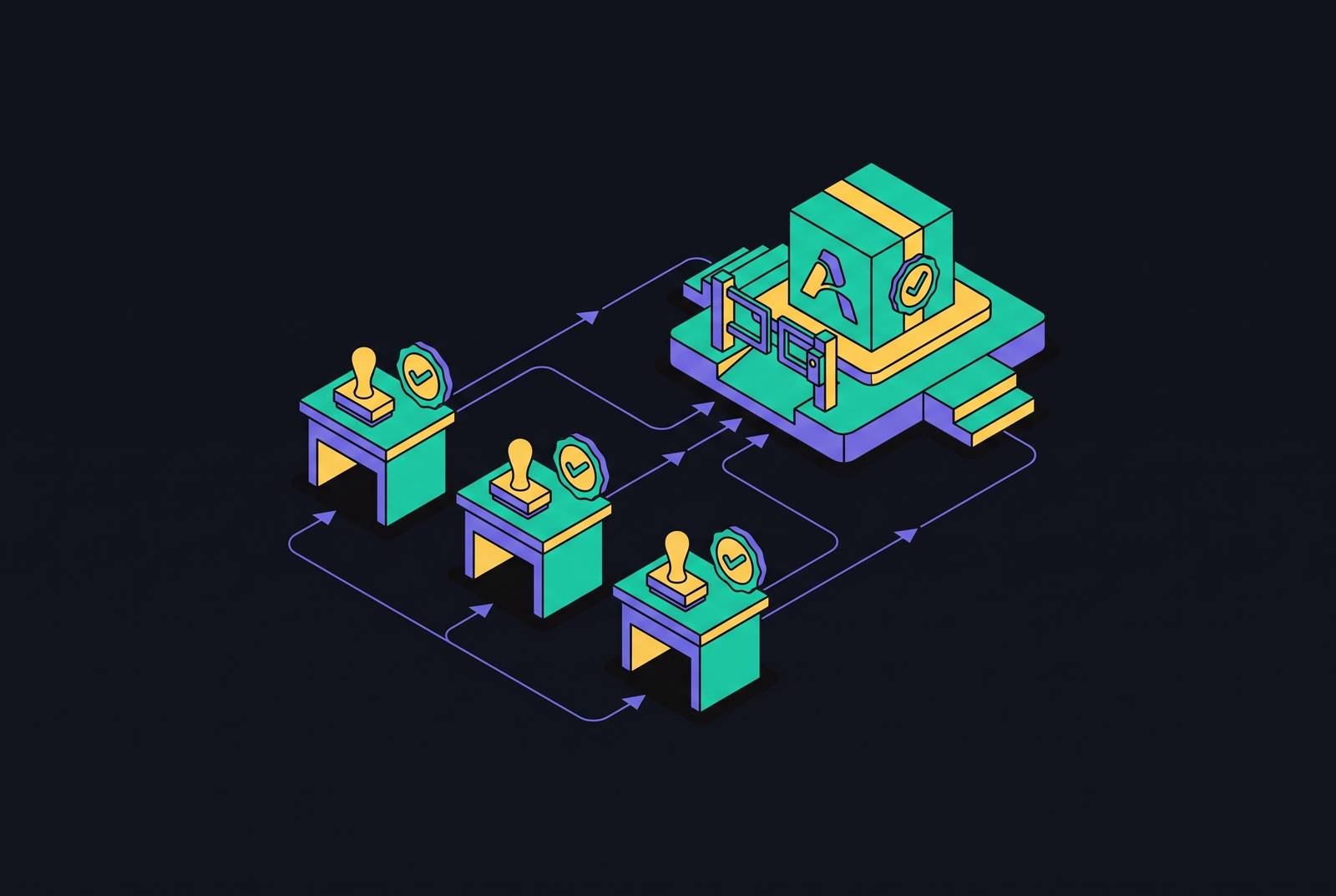
A review meeting without the evidence package in hand is a trust exercise with a calendar invite attached. It's a trust exercise with a calendar invite attached. The workflow has to be built around the package itself, and different reviewers are equipped to judge different parts of it.
Engineering review is where the changed artifact diff, the attribution rationale, and the replay results get scrutinized, because engineers are the ones positioned to judge whether a fix is actually targeted at the right layer and whether the replay coverage is adequate. Product and domain review looks at the failure traces and the scope of impact, since that's where business context lives: whether the failures being fixed represent real harm to real users, not just a technically interesting edge case. Where compliance or risk obligations apply, that review layer needs the audit trail itself, the decision logging, the reasoning explanations, the record of what changed and why, which is what satisfies accountability requirements once agents are making decisions that touch customers, money, or regulated processes.
Human-in-the-loop review shouldn't function as a fallback bolted on when something looks risky. It should be a structured gate, an explicit approval step tied directly to the evidence package, required before any high-stakes or high-blast-radius change ships. The three MAST root categories, specification ambiguity, coordination breakdowns, and verification gaps, map directly onto the concerns a reviewer should probe in every change. Approval gates should scale with blast radius rather than apply uniformly: a narrow prompt tweak affecting one skill doesn't need the same scrutiny as a workflow restructuring touching several tools and sub-agents at once. And whatever gets decided should be written down as part of the audit trail: who reviewed it, what evidence they saw, what questions got raised, what conditions got attached to the approval. That record is what makes agent operations accountable rather than just fast. Since enterprises with agents already in production are managing continuous harness iteration rather than a single launch event, the whole workflow needs to be light enough to run over and over.
Replay validation as the step that separates a reviewable change from a shipped guess
An attribution that hasn't been tested by execution is still just a hypothesis. Research on attribution in multi-step agent systems holds that a targeted edit applied at the layer identified as the root cause needs to be rerun before that attribution can be treated as confirmed. Reading the logs and feeling confident isn't the same thing as demonstrating it.
The performance difference backs this up concretely. Closed-loop recovery, which grounds a repair in the attributed root cause and then validates that repair by rerunning the system, fixed more than twice as many failed tasks in a single rerun compared to decoupled self-correction baselines on the GAIA benchmark. That gap is a direct, quantified argument for replaying before shipping rather than after.
Replay produces things a static review simply cannot. It confirms whether the fix resolves the whole class of failure, not just the one logged instance someone happened to catch. It catches regressions: runs that used to pass and now don't, under the new configuration. It generates an actual success rate across a historical trace set instead of a binary pass or fail on a single curated scenario. And it shows whether the fix generalizes to the real range of inputs the agent will meet in production, rather than just the narrow slice someone thought to test.
Replay also does something quieter but just as valuable: it catches wrong attributions before they ship. If the replayed fix doesn't actually resolve the failure, that outcome means the attribution producing it needs revisiting, full stop. That's the mechanism. Replay results deserve a place as a first-class artifact in the evidence package presented at sign-off, visible by default, not something a reviewer has to request. Shipping without that step means approving a change on the strength of a plausible story about what went wrong, not on demonstrated proof that the fix actually works.
Building a repeatable sign-off process that gets faster as evidence accumulates
The first evidence package built for a given class of failure is always the expensive one. Every failure after that in the same class gets cheaper to diagnose, attribute, and validate, because the prior traces, the taxonomy labels, and the replay results already sitting on file become a reusable baseline rather than a blank page.
A failure pattern that keeps recurring in production traces is a signal that the harness has a structural gap somewhere. It's a signal that the harness has a structural gap somewhere, and the sign-off process should create pressure to close that gap outright rather than rubber-stamp the same patch every few weeks. The harness, in this sense, is the dataset: every production trace, including every failure captured in it, is evidence that sharpens the next version of the harness. Teams that treat trace collection and replay as an ongoing engineering discipline, not a launch-day formality, build up an advantage that compounds. Teams that treat sign-off as a box to check once at launch don't.
The tooling for this keeps improving, which lowers the cost of doing it properly. Research presented at ICSE 2025 found that incorporating code-level knowledge into root cause localization improved accuracy by 28.3% over the previous leading method, a meaningful jump for a task that's historically been slow and manual. As diagnosis gets faster and more accurate, producing a credible, trace-backed evidence package stops being the bottleneck it is today.
None of this is really about adding more paperwork to the release process. Step-level tracing, per-failure taxonomy labels, replay before shipping, auditable diffs of every change: these are the same disciplines that separate a team that can say, with evidence, why a release is safe from a team that's still asking stakeholders to take their word for it.