Evidence Thresholds for Shipping Prompt Changes
Prompt changes need the same rigorous testing as any other code before shipping.

A prompt change is a code change. It touches behavior, touches output, and can break something a customer depends on, so it needs the same evidence burden any other code change gets before merge, including defined coverage, a scoring threshold, and a regression gate proving nothing that used to work has stopped working. Most teams skip that burden. They test manually, watch a demo go well, and tell themselves production monitoring will catch whatever slips through. That's a hope with a dashboard bolted onto it. That's a hope with a dashboard bolted onto it, and the teams relying on it are the ones who get blindsided.
Large language models aren't stable the way a function is stable, which is why this matters more for prompts than for almost any other kind of code. The same input can produce a different output across two runs, and a phrasing tweak that looks cosmetic in a test session can change behavior in ways nobody sees until real traffic hits it. Traditional software testing assumes input X produces output Y, and you write an assertion against that. That model breaks here: two responses can both look correct and still differ in structure, emphasis, or the one detail that mattered to the one user who needed it right. In a chained, multi-agent system the problem compounds, because a prompt change at one layer propagates downstream, and a root error at one step tends to trigger multiple further violations rather than staying contained. Demos record happy paths. Production finds every edge case the demo never had to answer for, and there are a lot more of those than anyone budgets for before ship.
What can actually go wrong when an unvalidated prompt change ships
The dominant risk is a silent quality regression: no HTTP error, no tripped alert, nothing an APM dashboard built for status codes was ever designed to see. It appears in hallucinations that read as confident, in drift once the agent meets domain data it wasn't tuned on, in a tool call that fails quietly, and in a prompt injection nobody wrote a check for.
Worse, the failure is rarely visible where it started. Root causes tend to sit well upstream of the step where a user actually notices something's wrong, sometimes many steps upstream, which means a team chasing the symptom is looking in the wrong file. The MAST taxonomy, developed by Cemri and colleagues and validated against a large body of execution traces, maps this out directly: a large share of agent failures trace back to harness-level issues. Specification ambiguity, coordination breakdowns between agents, missing verification steps: these account for the bulk of it. Multi-agent systems in production fail at rates ranging from 41 to 86.7 percent, and the dominant contributor, accounting for roughly 79 percent of production breakdowns, is specification ambiguity and unstructured coordination protocols.
There's a subtler failure mode that only becomes visible in longer runs. Context degrades as an agent works through multiple steps, a small amount lost at each turn, and by several cycles in, a meaningful share of the original context is no longer reliably accessible to the model. A prompt change that looks completely sound in a five-turn test can quietly fall apart by turn twenty, and nothing in a short test session would ever reveal that.
Put the two failure modes together and you get a common pattern in production: a prompt change ships without triggering any alerts, and the failure only surfaces when a customer notices it. An automated judge checking outputs at ship time would have caught that far earlier. The customer is the most expensive place for anyone to catch anything.
What production traces capture that pre-ship testing cannot
Old-school APM watched deterministic HTTP paths: request in, response out, status code, done. Agent systems don't work that way. A single user request might trigger several LLM calls, a handful of tool invocations, a vector lookup, and a handoff between agents, and each one is a place something can go wrong invisibly to a monitoring stack built for a simpler world.
Because failures appear as causal chains across steps rather than at any single call, catching them requires full-session trace capture, with per-request metrics sampled after the fact falling short of that. A complete trace needs the user's input, every tool call and its response, every LLM output, latency, cost, a session ID, the model version in use, the tools available at the time, the authenticated user, and whatever runtime policies were active. Leave any of that out and the trace becomes un-replayable, useless for debugging anything but the most obvious failures.
Context drift causes a version of this problem too. A production evaluation flags a bad response, an engineer sits down to debug it the next day, and by then the context the agent actually ran against has already shifted: different retrieved documents, a different data state, maybe a different model version behind the same endpoint. Capturing the exact snapshot of what the agent saw at the moment it acted, not just the input and the answer, is what makes a failure reproducible instead of a mystery nobody can reopen.
Agentic observability needs signal types traditional monitoring never had to track. These include intermediate reasoning steps, which tool got picked and why, the handoff between agents, a per-trace score for hallucination and faithfulness, and detection for prompt injection attempts. OpenTelemetry's GenAI conventions are becoming the shared vocabulary here, though as of recent releases the schema still carries a development-stability label, meaning attribute names can shift without the usual major-version warning. Teams building on it should treat it as ground still settling. None of this works, though, without a baseline that produces it: structured JSON logging for every agent interaction, and spans tracing the full arc of a multi-step run.
The three distinct questions an evidence threshold must answer before a prompt change ships
"We tested it manually" is not evidence. Neither is "the demo went well," and neither is "we'll keep an eye on it once it's live." None of those are things engineering can automate or governance can sign off on, and all three tend to be exactly what teams say right before a quiet regression hits customers.
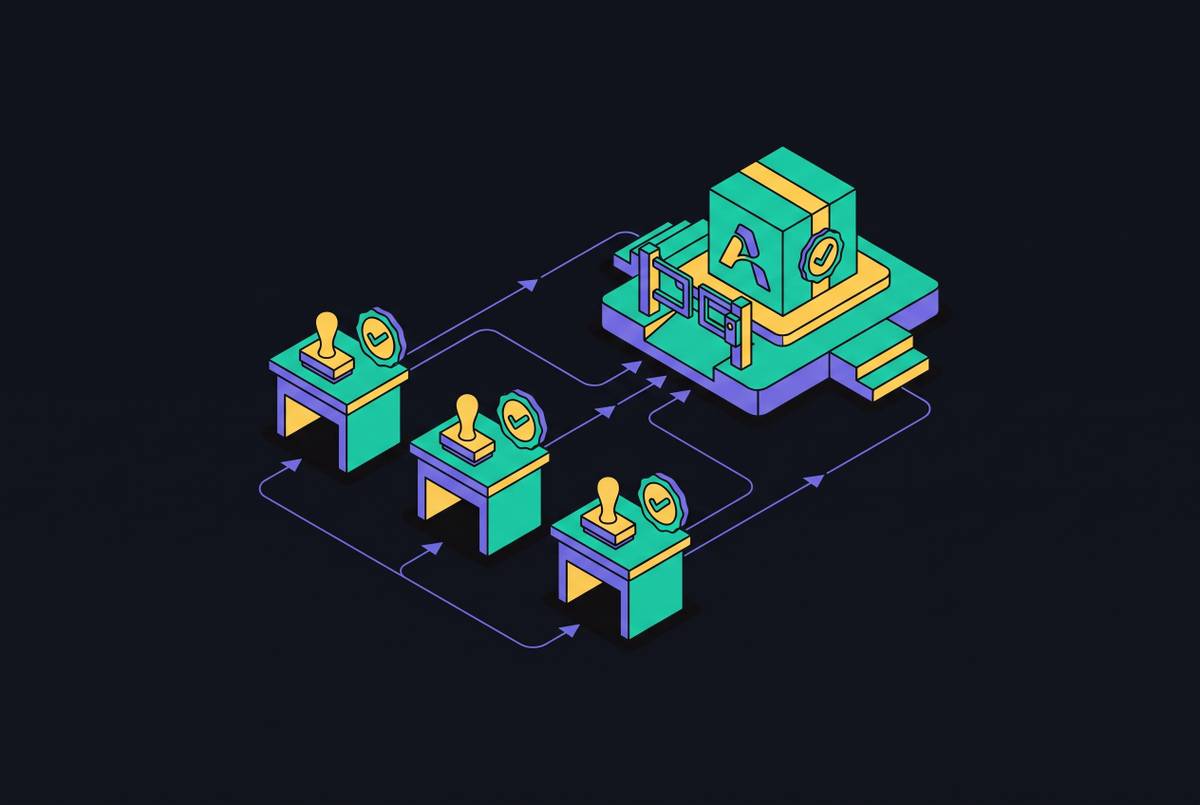
A real gate answers three separate questions, and each needs a different kind of evaluation. First: is the routing or task decomposition still correct, meaning does a query still get handled by the right agent or the right sub-step? That's behavioral, a trajectory-level question. Second: are the outputs actually good, across the dimensions that matter for this particular agent's job? That's scored, usually by an LLM acting as judge against defined criteria. Third: does the change break anything that used to work? That's a replay question, answered by running the new prompt against historical production traces and comparing.
What counts as "good" differs by agent, and that distinction gets skipped more often than it should. A fast agent handling simple factual lookups needs to be graded on accuracy above all else. A reasoning agent needs its logic checked for soundness alongside its final answer. A research agent needs to be judged on completeness, because a technically correct but incomplete answer is still a failure for that job. The same prompt change can pass one of these criteria cleanly and fail another outright, so a single blanket pass/fail check can approve a regression on one criterion while masking a failure on another.
Offline evaluation, run before deployment against a curated dataset with known right answers, is the quality gate. Online evaluation, run against live traffic after the fact, is the safety net that catches what offline missed. Teams that skip offline and lean only on production monitoring are defining "good" only after something has already gone wrong, which gets the order backwards. These three questions map onto three concrete requirements, coverage, scoring thresholds, and a regression gate, each of which deserves its own treatment.
Coverage criteria: what the test set must contain before the gate runs
A golden test set is a regression suite: curated inputs paired with expected outputs, drawn wherever possible from real production scenarios rather than invented ones. Masked production data turned into reproducible test cases, each pinning down the input, the expected response, and the policies that have to hold, gives a far truer picture of what the agent will actually face than anything dreamed up at a whiteboard.
Coverage needs to span several categories at once, and skipping any one of them is where teams get burned. The happy-path cases the prompt was originally built for, obviously. Edge cases pulled straight from production traces: odd phrasings, partial or ambiguous inputs, requests that bundle more than one intent into a single message. Known failure modes, cases that broke before and got fixed, which are the highest-value regression tests a team owns precisely because a careless prompt edit tends to reintroduce them. Adversarial and policy-critical inputs too: prompt injection attempts, cases built to test whether a data boundary actually holds under pressure.
For any system with a router agent up front, coverage has to verify simple queries land on the cheap, fast agent and complex ones land on the deeper, more expensive one. Get that wrong and the cost consequences appear fast, in latency or in a bill nobody budgeted for. If the prompt touches retrieval at all, coverage needs to check whether the change affects which documents get pulled, whether the agent actually uses what it retrieved, and whether it starts hallucinating information that was never in the retrieved context to begin with.
Some paths shouldn't run through a scored judge at all. Permissions, eligibility checks, financial limits: these are binary, and belong in deterministic assertions, not a graded rubric. A permission check either holds or it doesn't, and treating it as a fuzzy scoring problem is a mistake dressed up as sophistication. There's also a scale dimension to build into coverage directly, since a large context window stuffed with retrieval noise tends to perform worse than a small window with precise, well-curated context. Coverage has to include cases testing the agent under a longer, noisier context, going beyond short, clean sessions that flatter the prompt.
Scoring thresholds: how to grade outputs and what pass/fail looks like
Human review doesn't scale to the volume agent systems produce. A reviewer can meaningfully assess maybe a hundred traces an hour, tops, and at even modest daily request volumes that math falls apart fast. Full manual review would eat most of a working day, every day, forever. Automated scoring is the only approach that actually works at this scale.
That doesn't mean trusting an LLM judge blindly, and treating it that way is where a lot of these gates quietly fail. Before relying on one, its decisions need checking against a human decision-maker on the same set of cases, with agreement rate measured directly. LLM judges carry known biases: they favor longer, more verbose answers, and their ratings can skew in ways that don't reflect actual quality. Even so, a judge with a known, measured agreement rate still beats a human expert who only gets to a fraction of the cases long after the fact.
Scoring should weight multiple dimensions rather than collapse to a single pass or fail. Correctness, relevance, policy compliance, tone, reasoning quality, completeness: whatever mix actually matters for the agent's job, each gets weighted and rolled into a total. The threshold structure that makes this actionable has three parts. A minimum floor per dimension, so a change tanking one critical dimension fails the gate even if the weighted total looks fine. An aggregate weighted score that has to meet or beat the baseline set on that same test set before the change went in. And zero tolerance on the deterministic rules: any violation of a permission, eligibility, or financial-limit check blocks the change automatically, no scoring involved.
Cost belongs in this threshold too, as a real gate rather than an afterthought. Tokens per successful task, p99 latency, tool-call overhead: an agent that gets the answer right but costs a fortune per interaction isn't production-ready, no matter how clean the output reads. At real production volume, inference costs for a single agent running a few thousand requests a day can run into the thousands of dollars a month, so a prompt change that quietly bloats token usage needs its own cost check, separate from quality. Research on judge design backs this up further: giving the judge a fine-grained taxonomy of failure types to check against, instead of a vague instruction to "rate this," measurably improves how accurately it localizes what actually went wrong. How the judging gets structured matters almost as much as having a judge in the first place.
Regression gates: replaying historical traces to prove nothing that worked has broken
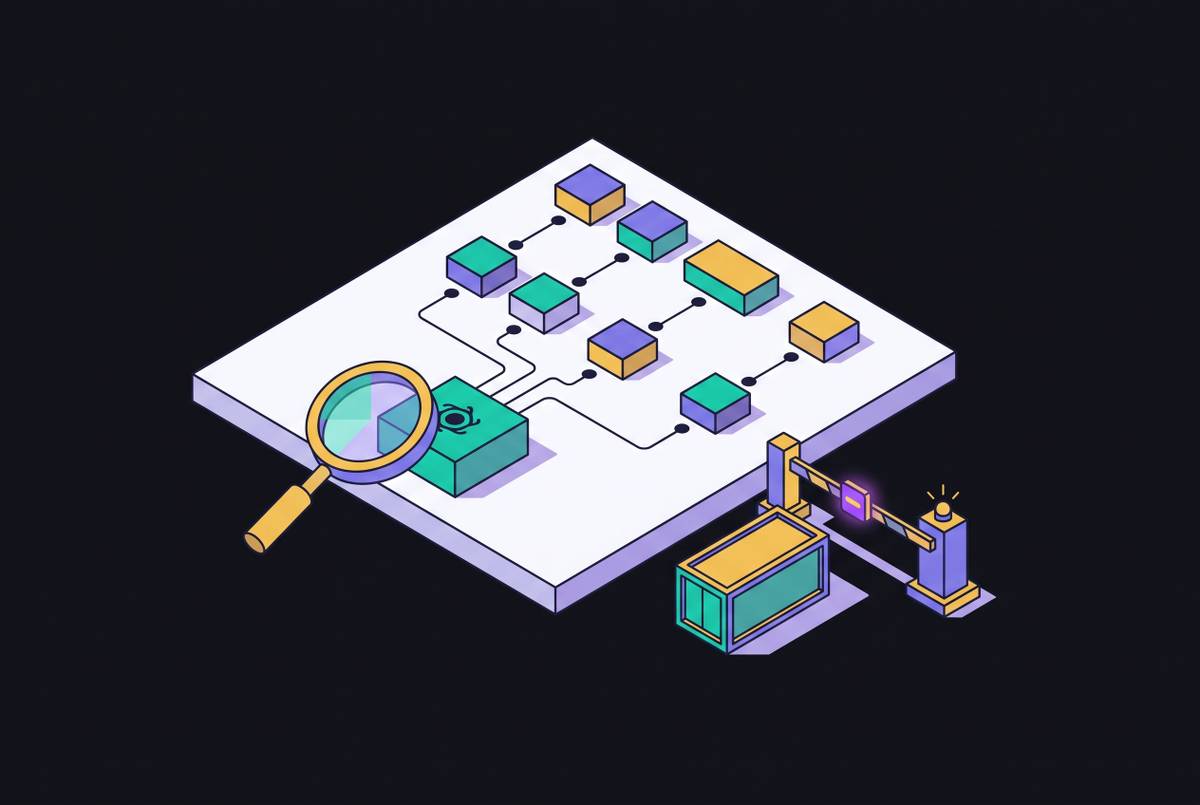
Shipping an improvement without replaying it against real historical traces is shipping blind. A curated test set covers what the team anticipated. The production trace corpus covers what actually happened, and those two lists are never quite the same.
A regression suite should be a living document that keeps growing, expanding past a fixed artifact written once and left alone. Every production failure that gets diagnosed and fixed adds a new case to the suite, so over time it reflects the real distribution of edge cases the agent runs into, rather than the distribution someone imagined the first time they wrote the tests.
Doing this properly takes more than storing input/output pairs. Replay needs a snapshot of the exact context each historical run saw, including the model version at the time, the tools available, the data state, and the runtime policies in force. It needs the ability to rerun the changed prompt against that frozen context and compare the new output directly against the one that originally passed. And it needs a diff view a human can actually look at and reason about, a reviewable change a person weighs in on, not a black box that auto-accepts or auto-rejects on its own judgment.
Structured replay against historical traces is the mechanism that produces all of this: run the proposed change against a historical trace and check whether the behavior that used to pass still passes, or whether the behavior that used to fail still fails the same way. This kind of replay has to cover the full trajectory of a run, not just the final answer, because a root cause buried at an early step can stay invisible until many steps later. Checking only the final output would miss it.
The rule that enforces all this is simple to state, even if it's not always simple to live with: if a changed prompt causes any previously-passing trace to fail, the change does not ship. Either the team fixes the regression, or someone consciously accepts it and writes down why. No silent degradation, ever, no matter how minor it looks in isolation. And even after a change clears the offline gate, it's worth routing a slice of real traffic through human review for the first stretch after deploy. The gate reduces risk before shipping. Human eyes catch whatever drift is visible after.
Operationalizing the gate: where this lives in the engineering workflow
Offline evaluation sets the baseline before deployment. Online evaluation checks whether that baseline actually holds once real traffic hits it. Skip the offline half and go straight to production monitoring, and there's no baseline to measure drift against, which makes "regression" an argument instead of a fact anyone can point to.
The eval loop should run in the same shape before and after launch, same dimensions, same weights, so a result from last month and a result from this morning are actually comparable. That consistency is what turns a regression from a vague feeling into something provable. Practically, this belongs in the pull-request pipeline: the eval suite runs on every prompt change as part of CI/CD, automatically, and blocks a merge if the thresholds aren't cleared. Not a manual QA step someone remembers to run before a release. A gate that runs whether anyone remembers or not, which is the only kind worth having.
The loop closes through observability. Production dashboards flag failures against the same dimensions the offline suite already scores, QA reviews the flagged evidence, and if it's a real regression, the failing trace gets added straight into the regression suite for next time. That's the mechanism keeping the suite honest and growing instead of static and stale.
A handful of tools have emerged to cover pieces of this workflow: platforms that support evaluation tracking and lifecycle management across a GenAI project, tools oriented toward tracing and debugging agent interactions, monitoring oriented toward multi-step agent behavior. Whatever gets chosen, the requirements don't change: full-session trace capture instead of per-request metrics, context snapshotting instead of bare input/output logging, the ability to replay against historical traces, diff-viewable comparisons a human can actually read, and a real integration point into the CI gate itself.
Automated attribution, the tool telling an engineer "this is where it broke and why," can be wrong. The gate has to present its confidence and its evidence alongside any diagnosis, treating an automated guess as exactly that rather than settled fact. The point of all this machinery is keeping a person who understands the stakes in the loop.
What a complete evidence record looks like for a prompt change
Put the pieces together and a shippable prompt change comes with a paper trail behind it, grounded in evidence instead of a vibe. Coverage spanning the happy path, the edge cases pulled from real traffic, the known failure modes already fixed once before, and the adversarial cases nobody wants to think about until they occur in production. Scores against defined dimensions, with a documented minimum floor per dimension, a documented weighted total measured against baseline, and zero tolerance recorded for any deterministic rule violation. A replay run against the full historical trace corpus, showing every previously-passing case still passes, or a written justification for the specific case that didn't.
What the record does not show matters just as much: no demo that went well, no manual test someone ran once, no promise to keep an eye on the dashboard. A prompt is code, and it deserves the same evidence code gets before anyone lets it anywhere near production.
Sources
- Production-Ready LLM Agents: A Comprehensive Framework for Offline Evaluation | Towards Data Science
- augmentcode.com
- How To Solve LLM Production Challenges & How Prompt Updates Drive Most Incidents | Deepchecks
- How to Version & Rollback LLM Agent Prompts
- futureagi.com
- confident-ai.com
- confident-ai.com
- medium.com