Memory Configuration Changes and Agent Behavior Regression
Subtle memory changes compound silently across sessions, evading standard tests.

Memory configuration changes, a new embedding model, a different retrieval threshold, a revised consolidation rule, behave nothing like the prompt tweaks and tool patches engineers already know how to test. Their failures build up over many sessions, cross session boundaries, and leave no error message behind. That combination puts memory in a category of its own, and treating it like any other harness variable is how regressions slip into production undetected for weeks.
Memory configuration as its own regression risk category
A bad prompt edit causes visible failures within the same run. The model says something off, a tool call fails, someone notices within the same run. Memory doesn't work that way. A change to how records get written, aged, or surfaced doesn't announce itself; it just quietly shifts what the agent has access to the next time it needs to recall something, and the next, and the next after that.
The memory layer is really three interfaces stitched together: what gets written in (ingestion), how what's written gets organized and aged (consolidation), and what gets pulled back out at query time (retrieval), and a change at any one of these three points propagates into the others without raising a flag. That interdependency is structural, which is part of why isolated testing of any single interface gives a false sense of safety.
There's also a specific reason memory failures don't look like noise. That means a corrupted or misaligned memory record doesn't generate scattered, random mistakes, it generates the same wrong answer, reliably, every time a similar query comes in. Consistency is usually a sign of a healthy system. Here, it's the mechanism by which a single bad record turns into a pattern of bad behavior.
Compounding is the word that matters most. Every session an agent runs adds new evidence to memory, and some of that evidence is built on answers that were already wrong, so the memory bank doesn't fail all at once, it degrades a little at a time, in a direction nobody chose. The MemoryArena benchmark from 2026 puts a number on what's at stake: swapping an active memory agent for a long-context-only baseline cut task completion by close to half on tasks that depended on information from earlier sessions. That gap appears only when tasks span sessions; a single-session eval would never catch it, which is exactly the blind spot the rest of this piece works through.
The three interfaces where memory configuration changes cause behavioral drift
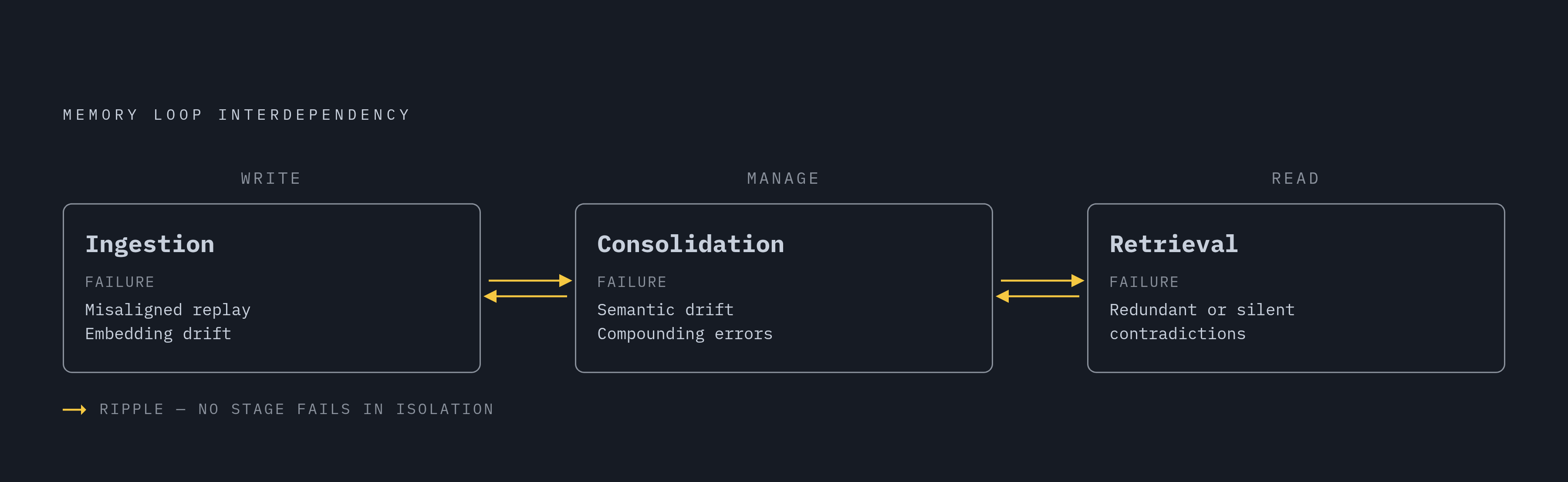
Write, manage, read. That's the loop, and each stage breaks in its own particular way when someone changes a configuration setting, and the breaks don't stay contained to the stage where they started.
Start with ingestion, the write path. Swapping the embedding model, adjusting a chunking rule, or tightening a filtering threshold shifts the set of things that become memories, not instantly across the whole store, but gradually, as each new session writes fresh records under the new rules. Research on the experience-following property shows that the quality of what gets stored determines future behavior, so a lower-quality record propagates errors into everything that gets retrieved against it later. One especially sneaky version of this is what researchers call misaligned experience replay, where a past execution looks correct on its face but actually gives the agent misleading guidance going forward, and there's no way to catch it without directly checking whether what gets retrieved correlates with the right downstream outcome.
Consolidation sits in the middle, and it's arguably the most concentrated point of risk. This is where records get merged, summarized, aged out, or promoted into what the agent treats as settled knowledge rather than recent, provisional observation. The taxonomy behind arXiv:2603.11768 names semantic drift during consolidation as one of the core failure points in the memory lifecycle, sitting right between write and read, capable of corrupting both directions at once. And because inaccuracies from past experience compound rather than cancel out, consolidation is where that compounding tends to concentrate hardest.
Retrieval is the interface engineers watch most closely, and it's also the one where failure is most invisible. A new embedding model reshapes the similarity space the retrieval step operates in, so records that used to surface reliably might now fall below the cutoff, while records that shouldn't matter start showing up instead. The MemChain paper describes a downstream consequence of this directly: retrieved candidates can be redundant, contradictory, or only loosely relevant, and if they get handed straight to the answer model, that model ends up resolving the mess on its own, silently, with no trace of what it decided or why. A tool schema mismatch throws an exception. A retrieval regression just produces an answer that sounds fine.
None of these interfaces fail alone. A looser write filter means more noise for retrieval to sift through. An aggressive consolidation rule can quietly discard exactly the record retrieval would have needed. Each change ripples sideways before anyone notices.
Why standard testing practices miss memory-layer regressions
Unit tests catch broken functions. Type checkers catch mismatched arguments. Single-session evals catch bad responses given whatever context happened to be available at the time. None of these tools were built to catch a regression that only becomes visible three sessions later, at a retrieval boundary nobody's watching.
The research literature already has a clean analogy for this from the tool-calling world: a schema mismatch throws a runtime error that a test suite will catch without effort, but a description mismatch, where the tool still runs fine but the model misunderstands what it's for, produces behavioral drift that no type checker will ever flag. Memory has the exact same split.
Single-session evals compound the problem because they measure the wrong thing. They check whether the response was good given the context retrieved, not whether the right context got retrieved in the first place, and not whether last week's embedding model swap already reshuffled the retrieval ranking underneath everyone's feet. Building a real regression suite for memory means having ground-truth annotations of which memories should surface for which queries, and the 2026 survey on agent memory is blunt about the fact that most teams simply don't maintain this data, which makes memory regression effectively untestable with the tooling most teams already have.
Timing makes attribution worse. A configuration change made this week might not produce an observable failure for several sessions, by which point nobody's first instinct is to go back and check what got deployed days earlier. Even the benchmark landscape reflects how hard this problem is: LoCoMo, LongMemEval, and BEAM, the standard multi-session memory benchmarks as of late 2026, exist specifically because cross-session behavior needed its own dedicated test category, and the hardest open problems they surface, cross-session identity, temporal abstraction at scale, memory staleness, are precisely the failure modes a single-session test has no way to reach.
Someone will point to production monitoring and say task success rate already catches this. It doesn't, not specifically. Task success rate is a lagging, aggregated number; it folds every possible failure cause into one line on a dashboard, and a gradual memory-driven decline buried inside overall traffic doesn't distinguish itself from any other cause of the same slow slide.
Mapping of the failure taxonomy onto specific configuration changes engineers make
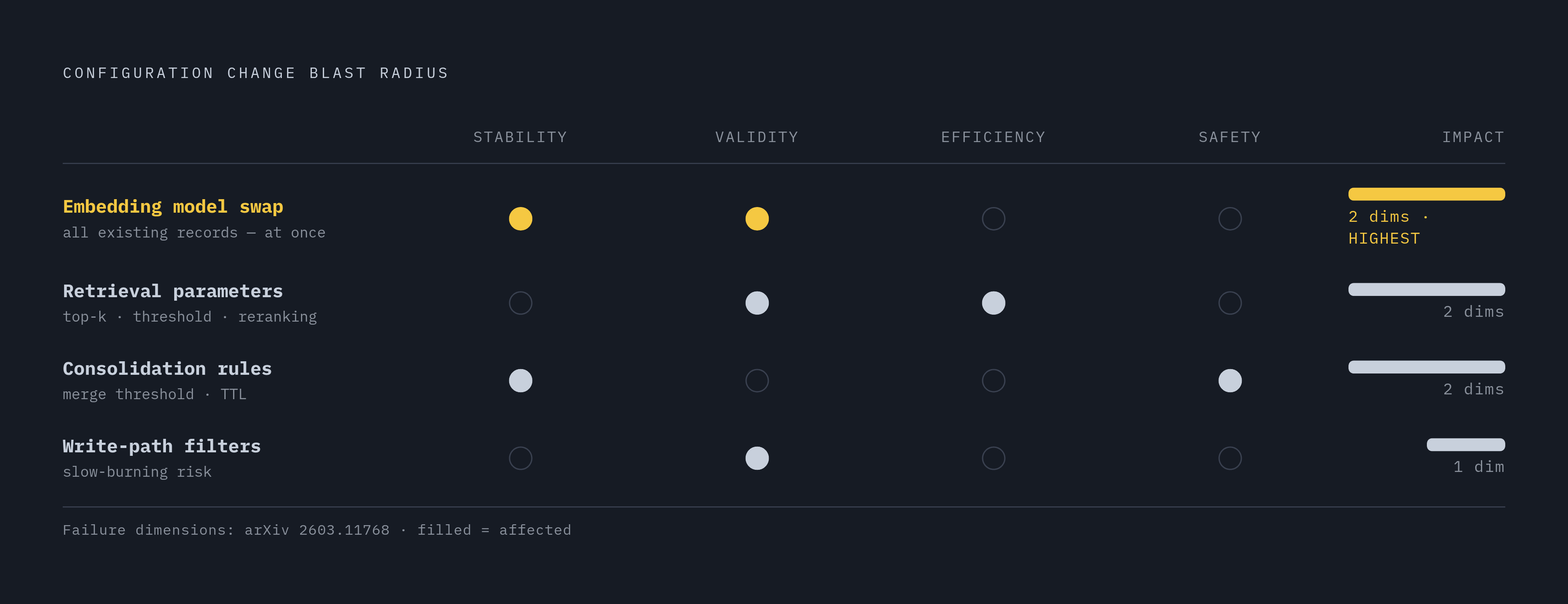
The four-dimension taxonomy from arXiv:2603.11768, Stability, Validity, Efficiency, and Safety, isn't just an academic classification exercise. It maps cleanly onto the actual configuration changes engineers make on a regular basis. The risk of a given change can be reasoned about before it ships, not just diagnosed after.
Embedding model swaps carry the highest blast radius of any single change, and they hit both Stability and Validity at once. Stability breaks immediately: the ranking of every existing record shifts the moment the new model deploys, before a single new session has even run, and records that used to surface reliably may simply stop appearing again even though nothing about their content changed. Validity breaks alongside it, because the semantic space itself has moved; records that used to sit apart from each other might now cluster as duplicates, or the reverse, records that were duplicates might now read as distinct. This is the one change that touches everything already in the store, all at once, so it deserves the most caution.
Retrieval parameter changes, top-k, similarity thresholds, reranking logic, map to Efficiency and Validity. Raising the similarity threshold can cause relevant records to quietly drop out of the results with no error to flag it. Lowering top-k cuts off the long-tail edge cases first, the ones the agent most needs for the unusual query. And this isn't a clean slate to begin with: MemChain's finding that retrieved candidates are already prone to redundancy, staleness, or conflict means tightening retrieval parameters without replay testing doesn't fix that problem, it sharpens it.
Regulating the quality of what's in the memory bank is important for long-term agent performance, and a consolidation rule that aggressively merges or prunes records can remove the quality signal the agent relies on. Forgetting rules deserve particular scrutiny here: if a rule deletes a record that encoded a past failure, the agent doesn't just lose information, it loses the guardrail that kept it from making that same mistake again.
Write-path filter changes carry a slower-burning Validity risk. Tighten the filters and write volume drops, but so does the supply of edge-case records that give the agent robustness, and that loss stays invisible right up until one of those edge cases reappears in production and the agent has nothing to draw on. Loosen the filters instead and retrieval noise climbs, worsening the same redundancy and conflict problem MemChain already flags as a baseline issue. Consolidation rule changes (merge thresholds, summarization triggers, TTL/forgetting rules) map onto Stability and Safety failures.
Attributing a behavioral regression to the memory layer specifically
Knowing that a regression happened is the easy part. Knowing it came from memory, and not from the prompt, the model, or a tool call gone sideways, is what lets the fix land anywhere near the real problem.
Agent failures live inside long, language-dense execution trajectories, and that density is precisely what buries root causes and makes repair harder than it should be. Memory failures are especially good at hiding in there, because the diagnostic question isn't "what did the agent say," it's "what did the agent see." The retrieval span in the trace is the actual dividing line. If what got retrieved was wrong or missing, that's a memory failure; if what got retrieved was right and the output was still wrong, the problem lives somewhere else.
A handful of concrete signals in a trace point specifically at memory. An agent contradicting a fact its memory bank should already contain points to a retrieval failure or consolidation drift. An agent repeating a mistake it had already corrected once before is the error propagation pattern directly, inaccuracies compounding forward through the experience-following mechanism. Task completion sliding specifically on multi-session or interdependent tasks while single-session tasks hold steady points at a cross-session retrieval problem, not a general model issue.
One-shot LLM judgment on a trace is a common way teams try to speed up this kind of diagnosis, but a September 2026 paper (arXiv:2609.13463) on the subject makes a sharp point about it: this approach tends to settle on a plausible diagnosis early and leaves critical evidence in longer traces unexamined, with memory failures particularly vulnerable since the causal evidence may appear much earlier in the trajectory than the observable failure. Memory failures are especially exposed to this weakness, because the actual cause, the bad retrieval, often occurs much earlier in the trajectory than the moment the failure becomes visible to anyone watching.
Observability platforms have mostly solved capturing agent run data. Tools built for tracing agent runs can show retrieval spans in detail, inputs, outputs, scores attached, but capturing the span isn't the same as knowing it was the culprit. Attribution requires comparing what got retrieved against what should have been retrieved, and that comparison needs a ground-truth expectation to check against, something most teams haven't built. This is also why memory earns its place as a distinct layer in agent harness design, alongside skills and protocols: pinning a failure to "memory, specifically" rather than "something in the agent went wrong" is what actually makes a fix possible. When retrieval latency or token cost per query shifts after a configuration change without a corresponding accuracy gain, this constitutes an Efficiency dimension failure, per arXiv:2603.11768.
Replay-based validation as the required check before shipping memory configuration changes
None of this adds up to a testing recommendation so much as a hard requirement: a memory configuration change should not ship without being replayed against real production traces first. No offline dataset built in advance can reproduce the cross-session dynamics that show whether a change is actually safe, because those dynamics only exist once real sessions have accumulated real history.
The general replay principle isn't unique to memory. Evaluations can run against production traces as well as curated development sets, and the loop looks the same regardless of what layer is being tested: a failure shows up in production, representative traces get turned into test cases, an evaluator gets built or tuned against them, the test runs offline before anything ships, and the evaluator then goes back into production monitoring to catch the next one. What memory adds is specificity about where in that loop the comparison needs to happen.
A framework called Chronicle formalizes something called cut-point replay: the full agent execution gets recorded, and engineers can replay from any point mid-trajectory to isolate exactly which change caused a regression. For a memory configuration change, the cut point that matters is the retrieval step itself: given the same query and the same state of the memory store, engineers can ask what the new embedding model or the new retrieval parameters would have actually returned. That's a testable, falsifiable question.
Replay for memory changes has to clear a few specific bars that generic replay doesn't. It needs multi-session traces, not single turns, because the regression signal for memory only exists in sessions that depend on what happened in earlier ones. It needs traces covering both the failure the change is meant to fix and the adjacent scenarios the change might accidentally break. And it needs a direct comparison of what records were returned before vs. after the configuration change for the same query state, which is the exact ground-truth retrieval comparison that arXiv:2603.07670v1 identifies as the missing ingredient in most teams' test suites.
The feedback loop this points toward already has a name in production systems elsewhere: production failures get converted into evaluation datasets, which then feed pre-deployment simulation before the next change goes out. Applied to memory, that means the traces of real memory-dependent tasks, the ones that actually broke, become the corpus every future configuration change gets replayed against before it ever reaches production again.
Sources
- Memory for Autonomous LLM Agents:Mechanisms, Evaluation, and Emerging Frontiers
- State of AI Agent Memory 2026: Benchmarks & Trends
- MemChain: Learning Interpretable Memory Traces for Memory-Augmented LLM Agents
- How Memory Management Impacts LLM Agents: An Empirical Study of Experience-Following Behavior - ACL Anthology
- Governing Evolving Memory in LLM Agents: Risks, Mechanisms, and the Stability and Safety Governed Memory (SSGM) Framework
- Root-Cause Attribution Is a Search Problem: Continual Search for Long-Horizon Agent Failures