Detecting Workflow Loop Regressions in Agentic Pipelines
Standard monitoring misses agentic loops because they return 200 while spinning endlessly.
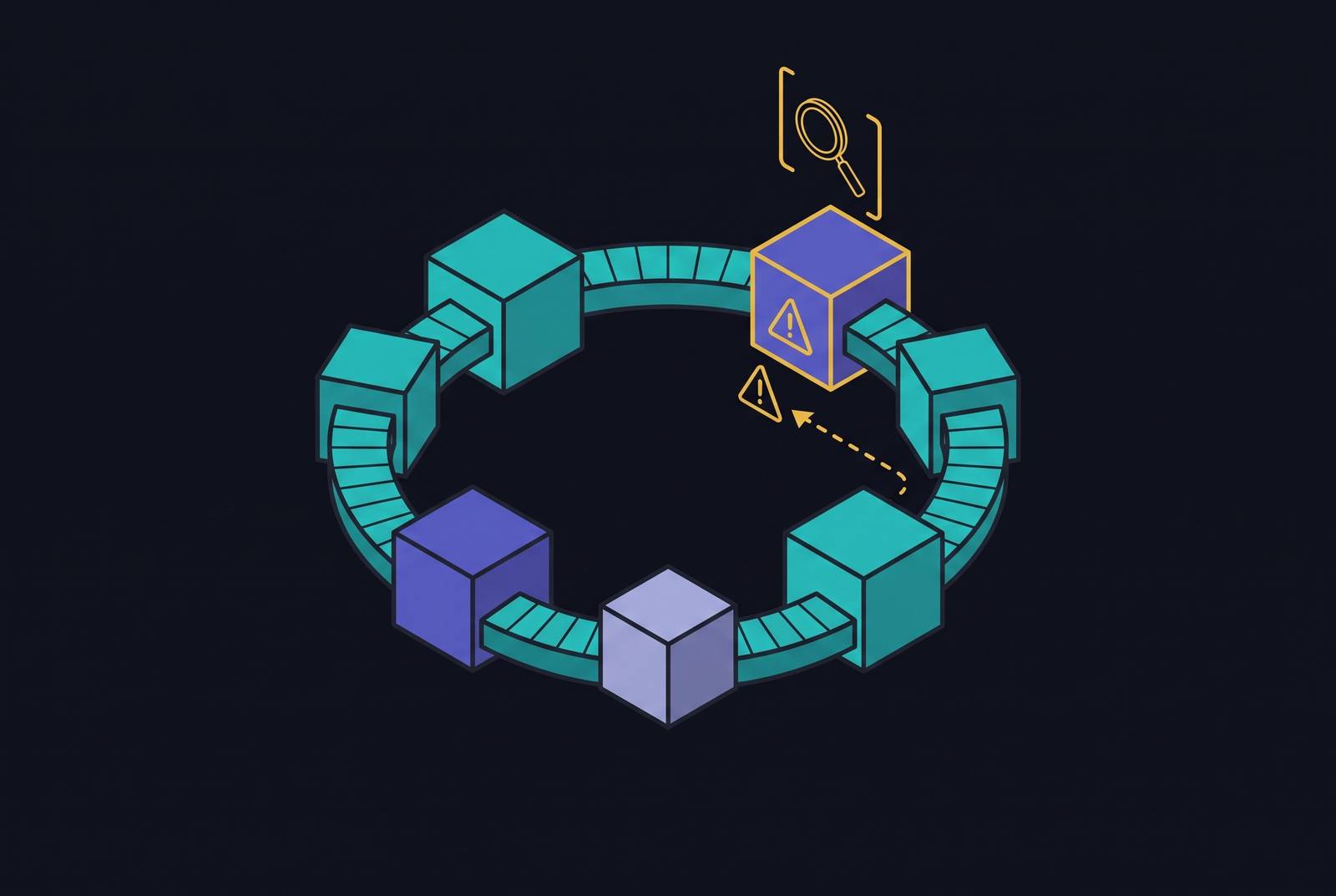
Workflow loop regressions are what happen when an agentic pipeline that once terminated correctly stops doing so, and the failure hides inside metrics that look completely healthy. That distinction matters because an agentic pipeline is self-referential by design: the model plans its own next step, executes it, and then judges whether the result counts as done. Feedback paths built that way are a structural feature of the architecture, not an edge case waiting to be hardened later. They're a structural feature of the architecture, and if they aren't bounded, the same mechanism that lets an agent adapt mid-task is the mechanism that lets it spin forever. Detecting Workflow Loop Regressions in Agentic Pipelines
The agent fails quietly, one indistinguishable step at a time. It's failing quietly, one indistinguishable step at a time.
A loop regression is a specific, narrower claim than "this pipeline has a loop bug somewhere." It means the pipeline used to terminate correctly on this task class, and something changed, a prompt edit, a tool response format, a model update at the provider, and a path that used to be bounded stopped being bounded. That's a regression, not a discovery, and the distinction matters for where you go looking for the fix.
Standard monitoring misses this almost by construction. An agent stuck in a loop still returns HTTP 200. It still consumes tokens the way a working agent consumes tokens. Cost dashboards see a run that's a little expensive. Latency alerts see a run that's a little slow. Neither one sees a run that is repeating the same tool call with the same arguments for the ninth time in a row, because neither one was built to look for repetition, only for failure codes and thresholds.
This isn't a theoretical worry. IAL-Scan, a static analysis tool evaluated against 6,549 LLM agent repositories, confirmed 68 IAL failures across 47 projects at 91.9% precision When Agents Do Not Stop: Uncovering Infinite Agentic Loops in LLM Agents. The failures are widespread across production codebases and detectable once someone builds the tooling to look for the right signal instead of the familiar one When Agents Do Not Stop: Uncovering Infinite Agentic Loops in LLM Agents. A single looping request can exhaust a cost budget, effectively deny service to other requests competing for the same model capacity, grow a context window without bound, and repeat external side effects, an email sent twice, an order placed twice, a database write repeated on a loop. None of that is a latency footnote. It's an operational incident wearing the disguise of a slow, successful run.
The four causal paths by which loop regressions enter a pipeline
Loop regressions don't have one cause. They arrive through at least four distinct mechanisms at the harness level, and which one applies determines exactly where in the trace to start looking.
The first path runs through prompt ambiguity. Stopping conditions, re-plan triggers, and termination criteria for an agent usually live entirely in the prompt text, not in any code path that enforces them mechanically. An edit made purely to tighten tone or shorten a system prompt can quietly delete the exact phrase the agent had been using to recognize that a task was finished. Nobody touched the model. Nobody touched the tools. The agent just lost the sentence that told it when to stop.
The second path is tool schema drift. When a tool's output format changes, a different field name, a restructured error code, a shape the parser wasn't built to expect, the agent can fail to recognize that the task completed and re-invoke the tool again. This has happened at scale before: the OpenAI functions-to-tools migration in November 2023 is a documented case where a schema change broke downstream parsers that depended on the old shape. Research published on SSRN in August 2026 makes explicit that the root cause sits in one layer of the system while the observable failure appears in a completely different layer. That gap is why teams misdiagnose these incidents.
The third path is a model update at the provider. Providers ship updates to hosted models more frequently than most teams ship internal releases, and those updates can shift behavior without any announcement that would prompt a team to go looking for it. A model that reliably respected a step budget or recognized a termination cue last month may simply stop doing either after a silent point update on the provider's side.
The fourth path is multi-agent handoff. Research cited in the paper "Agents of Chaos" documents circular exchanges and token-consuming spirals across seven different multi-agent frameworks, and separate research found that prompt injection can induce infinite action loops with over 80% success. In that fourth case, the loop isn't a bug the system stumbled into on its own. It's induced from outside, deliberately or not, by another agent's output feeding back into the system as a trigger.
A real-world instance of the fourth path, or arguably a fifth flavor of configuration failure adjacent to it, occurred in CrewAI: setting allow_delegation=True led to an infinite loop, documented in a GitHub issue as early as 2024. A configuration flag in the harness causes the failure.
Across all four paths, one thread holds: the regression is always attributable to a specific harness layer. Calling the incident a "timeout" in a postmortem loses that attribution permanently, because nobody goes back and re-derives which layer actually broke once the label sticks.
Production traces of a loop regression
A useful trace schema maps one span type to one failure surface: model invocation spans, tool call spans, memory read and write spans, and workflow transition spans. Each one tells you something different, and none of them alone tells you the whole story.
The loop signal lives in the combination of signals read together. Repeated span signatures, the same tool name paired with identical or near-identical arguments across successive spans, with no state change in between, are the clearest tell. Token count climbing across iterations without a corresponding drop in remaining task scope is another. Step count exceeding the normal distribution for that task class matters too, though it requires a historical baseline to mean anything at all; a raw step count without context is just a number. Memory read and write spans showing the same context going in and coming out across several iterations in a row point to an agent that believes it's making progress while actually standing still.
Retry count deserves its own field on every tool call span. Silent retry loops blend into ordinary traffic completely if that field doesn't exist to flag them.
The deeper problem is that agents return 200 OK even while they're looping, and traditional application monitoring was never built with non-deterministic, tool-calling systems in mind. That monitoring assumes a request either succeeds or fails cleanly. An agentic loop does neither: it succeeds repeatedly, at each individual step, on its way to accomplishing nothing.
Manual log review will not scale to catch this. The Who&When benchmark found that even state-of-the-art models achieve only 14.2% step-level accuracy in pinpointing the specific failure step in an agent trajectory CausalFlow: Causal Attribution and Counterfactual Repair for LLM Agen…. If the models built to read these traces struggle that badly, expecting an engineer to eyeball a log and spot the loop is not a strategy, it's a hope. Loop regression detection requires structured, span-level traces with explicit fields for retry count, argument hashes, and memory state, not aggregate latency numbers averaged over a fleet of requests.
Attributing a loop to the correct harness layer as the non-negotiable step
The gap between where a loop shows up and where it originates is the central difficulty here. Loop regressions arrive through at least four distinct harness-layer mechanisms, and knowing which one applies determines where to look in the trace.
Misattribution isn't a harmless delay. Fixing the wrong layer leaves the actual regression sitting in the pipeline untouched, and it adds new surface area on top of it. Patching a prompt when the real cause is a tool schema change doesn't just fail to fix anything, it changes agent behavior on every other run that touches that prompt, whether or not those runs were ever broken.
Research backs up how hard this localization problem actually is. Strong models struggle with root-cause localization on agent trajectories, and most existing approaches present themselves as taxonomies, benchmarks, or attribution methods, useful for understanding the problem in the abstract, but not built as deployable infrastructure a team can point at a live incident.
Some attribution logic can still guide the search by layer. If the repeated spans show identical tool arguments, check the tool schema first, since an output contract change is the leading suspect. If the loop started right after a prompt version changed, diff that prompt specifically for termination conditions, step budgets, and re-plan triggers, since those are the phrases most likely to have been edited out by accident. If the loop appeared with no internal change at all, on either the prompt or the tool side, suspect a provider model update on the relevant endpoint; the Groq and CrewAI incident from January 2025 showed a provider deprecation cascading through every agent sharing that endpoint at once. And if the loop involves a handoff between agents, look at the delegation configuration itself as well as each individual agent's prompt.
A cluster of research tools has emerged specifically to do this kind of layer-level attribution. AgentTrace builds causal graphs for root cause analysis in deployed multi-agent systems. The paper "From Flat Logs to Causal Graphs" (Wang et al., 2026) proposes hierarchical failure attribution for LLM-based multi-agent systems. CausalFlow performs causal attribution paired with counterfactual repair for agent failures. AgentDebugX shows that existing observability platforms capture and replay detailed agent traces well, but they leave the actual diagnostic work, which step was responsible, why, and how to repair it, entirely to the developer staring at the replay. The diagnostic workflow that all of this research converges on runs in a fixed order: capture the trace, isolate the span-level signal, attribute it to a layer, then propose a fix. Skip the attribution step and the fix becomes a guess dressed up as an engineering decision.
Harness-level fixes that close loop regressions once the layer is identified
Most loop regressions don't need model retraining to fix, because the structure that determines whether an agent terminates lives in the harness, outside the model's parameters entirely. That's good news operationally: the fix is usually a configuration change, not a research project.
At the prompt layer, an explicit step budget, a hard numeric ceiling on how many iterations the agent may take before it has to escalate or stop, closes off the most common failure mode directly. Instructing the agent explicitly to treat repeated, near-identical tool outputs as a termination signal gives it language to recognize its own loop, rather than relying on the agent to infer that lesson on its own. A hygiene practice makes any of this diagnosable later: treat every prompt template as a versioned artifact, checked into the same repository as the model code around it. If two prompt versions can't be diffed against each other, there's no way to explain after the fact why a loop appeared right after a prompt change went out.
At the tool layer, pinning the schema version an agent was validated against, and requiring a corresponding harness update and re-validation any time that schema migrates, closes the second causal path directly. An argument deduplication guard, middleware that notices a tool being called with the exact same arguments as the previous call and returns a synthetic "already attempted" response instead of re-executing, stops the loop mechanically rather than relying on the agent to notice it's repeating itself. Exposing retry count with exponential backoff directly in the span, rather than burying it in application logs, makes retry behavior something a dashboard can actually flag.
At the workflow and delegation layer, bounding delegation with an explicit depth limit closes the exact failure the CrewAI issue exposed, where an unconfigured allow_delegation flag was a loop waiting for the right conditions to trigger it. Separating infrastructure concerns from reasoning concerns helps here too: a workflow durability layer like Temporal handles retries, state persistence, and failure recovery at the infrastructure layer, while a framework like LangGraph handles prompt management and tool calling, and separating these concerns prevents an LLM-layer loop from bypassing workflow-level termination controls.
IAL-Scan's static analysis approach adds a pre-deployment check to all of this. It builds what its authors call an Agentic Loop Dependence Graph, recovering both explicit and framework-induced feedback paths, then checks whether any of those paths can repeatedly reach costly or state-growing operations without an effective bound, before the code ever reaches production. That's a genuine complement to trace monitoring, not a replacement for it, since trace monitoring catches what static analysis can't see coming. Separately, the paper "HarnessX: A Composable, Adaptive, and Evolvable Agent Harness Foundry" addresses composable harness design for agents that live a long time across many update cycles, which matters directly for keeping loop bounds intact as a harness evolves and produces a stable-looking product surface.
Validating the fix before shipping it, why replay against historical traces is the minimum bar
A fix that looks correct in isolation can still be wrong in a way that is visible only on adjacent traffic. It's entirely possible to close the loop on the exact trace that surfaced the incident while introducing a brand-new termination failure on a neighboring task class, and without replay testing, that failure stays invisible until it reaches production again under a different name.
Validating a loop fix properly requires a baseline trace set that includes the looping runs themselves alongside a sample of runs from the same task class that were already passing before the fix went in. The candidate fix then gets replayed against that entire set, including runs beyond the trace that failed. The step count distribution, token consumption per run, invocation frequency for whichever tool was implicated, and the final state of the run, terminated cleanly or still looping, should be tracked on each replay.
Gold set discipline applies directly here. Evaluation gold sets need adversarial edge cases and genuinely ambiguous inputs mixed in, and for loop regression validation specifically, that means including prompts already known to have triggered the loop alongside prompts that are structurally similar but should never loop. The two categories together tell you whether the fix actually understood the problem or just memorized the one failing case.
The underlying regression testing principle is straightforward to state and easy to skip under deadline pressure: same rows, same evaluators, same thresholds, new candidate system. A candidate that passes on the original failing trace but degrades on the adjacent traces has not fixed the regression. It has relocated it. Prompt versioning closes the loop on the audit trail, too: if a prompt diff introduced the loop in the first place, the fix is also a prompt diff, and keeping both changes traceable in the same versioning system means the regression can be reproduced on demand and the fix confirmed independently of whoever wrote it. The full workflow runs in sequence: broken trace, layer attribution, harness fix, replay validation against historical traces, then ship. Each stage depends on the one before it, and none of them is optional if the goal is an actual fix rather than a plausible-looking one.
Building detection into the pipeline so loop regressions surface before they compound
A loop regression that runs undetected for hours generates repeated external side effects the whole time, drains cost budgets steadily, and grows its context window with every additional turn. Catching it earlier isn't just about faster recovery. It directly limits how much damage the incident does before anyone notices it.
Continuous detection in production needs a handful of specific instruments working together. Step count alerting should use a per-task-class baseline, with the alert threshold set as a multiple of that class's own p95, rather than a single global limit that ignores how much task variance actually exists across a fleet of different workflows. Span signature hashing, combining tool name and argument payload into a single hash per span, turns a monotonically increasing count of identical hashes within one run into a direct loop signal rather than something that reads as ordinary latency. A rising token-per-step ratio without a matching increase in task complexity is a leading indicator of loop onset, often visible before the run has technically gone on long enough to trip any timeout. And if memory read and write spans show identical context across several consecutive iterations, that run deserves a flag regardless of whether it has technically timed out yet.
Provider update surveillance deserves a place in this stack as a trigger, not an afterthought. Because provider model updates ship more frequently than most teams' internal release cycles, a notification of a provider-side update should automatically schedule a replay of the loop-regression gold set, rather than waiting for a production symptom to force the question.
The ICML 2025 Spotlight benchmark from ag2ai frames the ambition worth aiming at here directly: given a failed task, automatically identify the agent and the step responsible for it. The benchmark treats that as a problem to evaluate rigorously, and it's solved enough to measure. Production teams should treat the same capability as something to actually deploy, not as a research aspiration to admire from a distance. Loop regression detection, attribution, fix, and validation form a repeatable workflow, and it deserves the same rigor teams already apply to code review and testing, with the production trace treated as the primary evidence and replay validation treated as the gate no harness change skips.