Historical Trace Validation Before Shipping Agent Fixes
Replay production traces against agent fixes to confirm they actually solve the problem.

Historical Trace Validation Before Shipping Agent Fixes.
Why agent fixes fail silently without replay validation
Validating an agent fix against historical production traces is the only reliable way to know whether a change actually resolves the failure pattern that caused it, without quietly breaking behavior that used to work. That is the whole argument of this piece, and everything below is in service of proving it.
An agent can look industrious and still be wrong. It reasons through a problem, picks tools that sound right for the job, produces an answer that reads as confident, and fails anyway. Per Confident AI's 2026 guide on agent evaluation, a single misunderstanding, one bad tool call, or one broken assumption early in a session can compound across hundreds of reasoning loops before anyone notices. The failure doesn't announce itself. It just accumulates.
This isn't a hypothetical concern for a handful of research labs. LangChain's 2026 State of AI Agents report found that 57% of organizations already run agents in production, and roughly a third of respondents named quality as the top barrier standing between pilot and scale LangChain 2026 State of AI Agents report.
Here is the trap most teams fall into. An engineer identifies a bug, writes a prompt change or adjusts a tool schema, runs it against a local test suite, watches it pass, and ships it. Two days later, the exact failure pattern resurfaces in production. The fix passed every test it was given, but the test never reconstructed the actual condition that caused the failure in the first place, so a fix that satisfies a synthetic scenario can be irrelevant to the real one. The real failure condition lived in a specific, messy combination of user input, tool state, and prior context that a hand-written test case is unlikely to recreate by guesswork. So the natural question becomes operational: how do you know a fix actually resolves the pattern that caused the failure, without introducing new problems in behavior that was already fine?
What a production trace records and why it is the right evidence base
Agent observability, done properly, captures every step an agent takes: which tool it picked, what arguments it passed, what the model returned, what it read from and wrote to memory, how its internal state changed, and which branch it took at each decision point. Per Braintrust's 2026 guide on agent observability, the result is a structured trace that lets an engineer reconstruct exactly what the agent did, in what order, with what inputs and outputs at each individual step. Without that reconstruction, you're debugging from a final answer backward, guessing at a process you never actually saw.
A trace worth using for validation needs to record four distinct kinds of spans. Tool-call spans capture the tool name, the arguments passed, the raw output, how long the call took, whether it retried, and whether it errored. Reasoning spans capture the plan the agent formed, the action it chose, the observation it made from that action, and the decision that followed. State transition spans capture the agent's working memory before and after each step, along with any handoff payload passed between components. Memory operation spans capture reads and writes against long-term storage: the query issued, the entries returned, their relevance scores, and how fresh that information was at the time.
Traditional infrastructure monitoring simply doesn't see any of this. A response can come back with a clean 200 status while wrapping a confidently wrong answer inside it. An agent stuck in an unproductive loop looks perfectly healthy on a standard monitoring dashboard, because nothing errored and latency looks normal. Agent observability closes this gap by treating every step of execution as a typed, inspectable unit rather than a black box that only reports success or failure at the end.
What a trace gives you that a synthetic test cannot fabricate is the actual state of the world at the moment things went wrong: the real context window, the real memory contents, the real argument the agent passed to a tool at that instant, not a reconstructed approximation built after the fact. LLM-agent provenance requires additional semantic relations beyond what OpenTelemetry and OpenLineage provide, such as generated claims, evidence support, contradiction, memory invalidation, tool-argument influence, and inter-agent responsibility. An agent's trace has to preserve semantic relationships too: which claims the agent generated, what evidence supported them, where contradictions appeared, when memory got invalidated, how a tool argument influenced a downstream decision, which agent in a multi-agent system was responsible for what. A trace, on its own, only tells you what happened, not whether it was correct. That judgment is evaluation's job, and a trace is simply the raw material evaluation needs to do it.
How agent failures are attributed to the layer that caused them
Not every failure has the same shape, and the shape matters for how you go looking for it. Failures that originate at the platform level tend to terminate execution outright: something crashes, something times out. Failures that originate at the agent's own reasoning or harness level tend to produce something subtler, a task that technically completes but does so badly. Mitigation has to be aimed at whichever layer actually caused the problem, because a fix built for the wrong layer changes nothing.
The MAST taxonomy, built from analysis of a large corpus of annotated agent traces, found that specification issues account for roughly 44% of system design failures. Step repetition was the single largest subcategory at 15.7%, and failure to recognize a termination condition came in at 12.4%. Most of what breaks agents in production is the harness around it, the scaffolding of prompts, loop conditions, and control logic that tells the model when to stop, what to do next, and how to interpret its own progress.
Attribution is genuinely difficult work. A two-year postmortem study conducted at a major retailer found a persistent attribution error rate of roughly 10%, where the model blamed a technology simply because it happened to be mentioned somewhere in the incident thread, whether or not it had anything to do with the actual cause. Any automated attribution tool has to be built with that failure mode in mind, or it will confidently point at the wrong component. The TRAIL benchmark makes the scale of the difficulty even clearer: even strong long-context models, given full trajectory traces to review, achieve only around 11% accuracy at diagnosing which step in the trace actually caused the failure. Attribution is a hard problem in its own right, separate from the fix itself.
This matters enormously for what comes next, because if you don't know whether a failure started in the prompt, the tool schema, a loop in the workflow, or a stale memory retrieval, you have no basis for knowing which fix to test. Replaying the wrong fix against the right traces proves nothing at all. It just produces a result that looks like validation without being validation.
What replay validation does and what it tests that synthetic evaluation cannot
Replay validation, mechanically, is straightforward. You take a production trace that captured a real failure, apply the candidate fix to the agent, and re-run it through the exact same inputs, tool responses, and context state that were recorded when the original failure happened. Then you check whether the failure pattern is actually gone.
A synthetic test can't catch what this catches. It catches the exact combination of context, memory contents, and tool return values that existed at the moment of failure. It catches multi-step compounding, the case where a fix that resolves the problem at step 3 quietly introduces a new one at step 7 under the same execution conditions. It catches tool argument edge cases that appear only under genuine usage patterns rather than the inputs an engineer imagined while writing a test. And it catches regression on traces that were already succeeding, a separate concern addressed in more depth below.
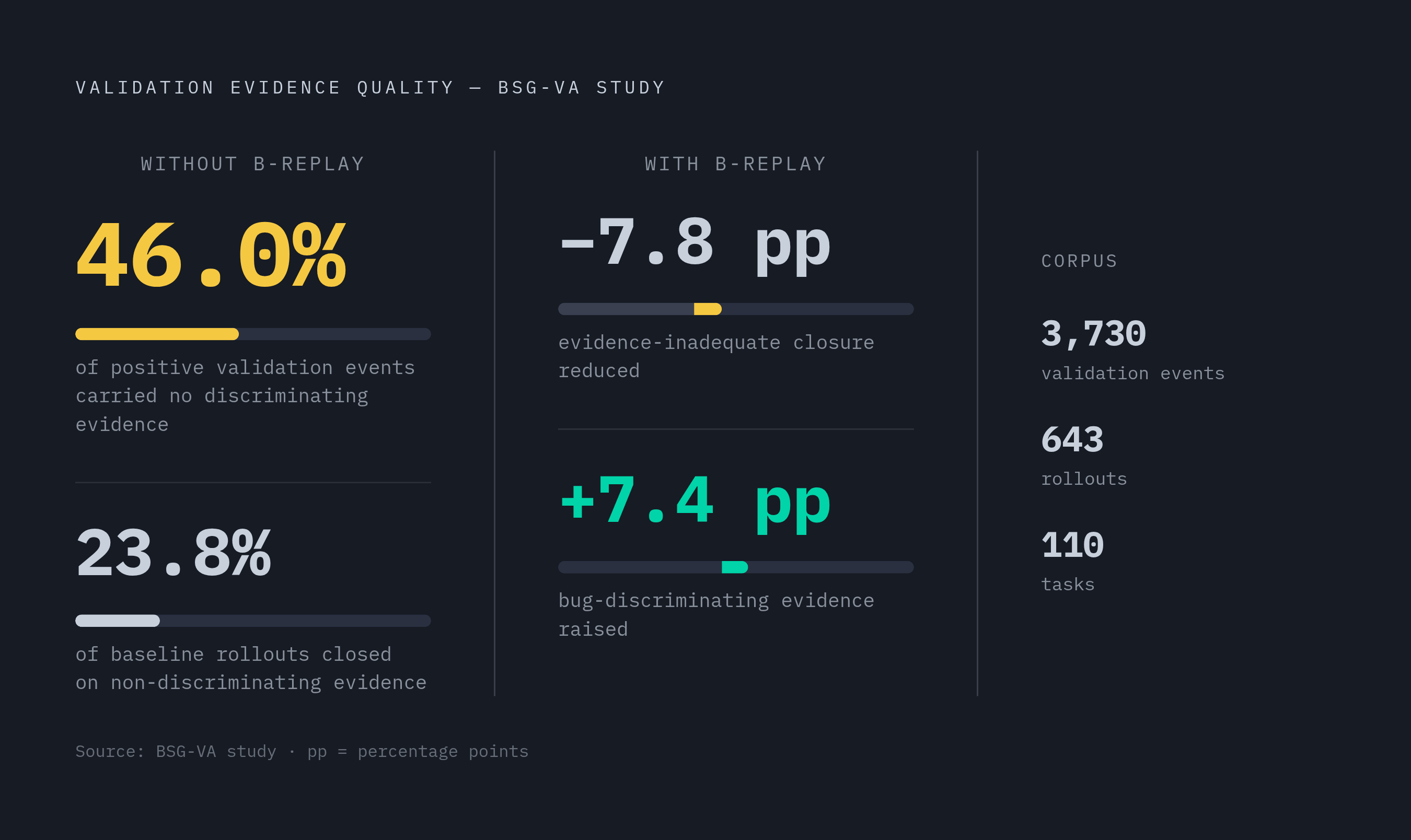
There's hard data behind why this distinction is not academic. Across 3,730 validation events in 643 rollouts on 110 tasks, 46.0% of positive comparable validation events carried no information that actually discriminated whether the underlying bug was fixed. Nearly half of the evidence that repair agents treated as confirmation told them nothing real about the defect. The downstream consequence was worse still: 23.8% of the baseline rollouts closed with a patch whose entire positive evidence base was of this non-discriminating kind Validation Evidence in LLM Repair Agents (BSG-VA).
Introducing bug-contrast feedback, replaying the candidate fix against the original buggy state (B-replay), the closest analogue to trace replay against historical production data, reduced evidence-inadequate closure by 7.8 percentage points and raised bug-discriminating evidence by 7.4 points, with no detectable cost to repair success Validation Evidence in LLM Repair Agents (BSG-VA). This mechanism is structural: it is produced by the way the system is built. A test that passes identically on both the buggy version and the fixed version of a system is regression-only by construction: it confirms nothing broke, but says nothing about whether the target failure got resolved. A production trace solves this automatically, because it hands you the buggy state as it actually occurred, without requiring an engineer to reconstruct it from scratch.
Regression protection: validating the fix without breaking what was working
Regression checking is a genuinely different exercise from fix validation, and treating them as the same step is a common mistake. Fix validation replays the failure trace to confirm the problem is gone. Regression checking replays a sample of traces that were already succeeding, to confirm the fix hasn't quietly broken any of them.
Agent regressions rarely look like the regressions engineers are used to hunting for in ordinary software. A prompt rewrite that clears up ambiguity for one tool call can introduce new ambiguity for a different tool that happened to share the same prompt segment. A tool schema tightened to block a malformed argument can also block a legitimate edge-case call that depended on the looser version of that schema. A workflow change that eliminates a step-repetition loop can accidentally skip a step that some downstream tool was quietly relying on. None of these appear in a simple pass or fail on the final output; they appear several steps removed from where the change was made.
The Self-Harness framework treats this as a mandatory gate rather than optional due diligence: every harness change proposal has to pass strict regression testing against the updated harness before it's accepted at all. That means regression testing is something a team must run, not something it runs when it has time.
Building a corpus for this kind of testing means pulling a representative slice of real production traffic, success cases, near-misses, and unusual tool invocations included, rather than hand-curating a small golden set that only covers the cases someone thought to write down. Evaluation itself has to run at three separate levels to catch what regression checking is actually looking for: whether the task completed end to end, whether the path the agent took to get there was efficient, and whether each individual tool call and reasoning step was correct on its own terms. Comparing final outputs alone will miss a regression buried in an earlier step, since a fix that resolves step 3 may break step 7 under the same execution conditions. And because agent behavior changes when prompts change, tool APIs evolve, or model versions update, catching regressions requires running this validation in the deployment pipeline.
Building the trace corpus that makes replay validation reliable
Replay validation is only as good as the corpus of traces backing it, and building that corpus is itself an ongoing discipline, not a one-time export. A session that fails in production becomes a regression case, and production failures stop being isolated incidents and start populating the evaluation suite directly.
A mature corpus needs a few specific properties. It needs failure traces labeled at the level of the specific span where the failure was attributed. It needs versioning: which prompt version, which tool schema, which model was live when the trace was captured, so a fix replay runs against the correct baseline rather than a mismatched one. It needs coverage across failure categories, tool selection errors, argument mistakes, step repetition, lost context, planning drift, because a corpus dominated by one category will only validate fixes for that category and leave the rest untested. And it needs enough volume of success traces sitting alongside the failures to make regression testing meaningful rather than anecdotal.
Braintrust's 2026 maturity roadmap describes this as a progression rather than a single milestone: trace capture comes first, then online scoring against a sample of live traffic, then feeding production failures directly into datasets, then running those same scorers inside CI and gating pull requests on quality thresholds. That arc, moved through in order, is what turns replay from something a team does occasionally into something a team can rely on every release.
The TRAIL benchmark's finding about weak attribution accuracy carries a direct implication here too. Even a corpus of labeled trajectory traces, complete with reasoning, planning, execution, and tool-use errors marked out, still produces poor attribution results from automated judges if the surrounding context isn't preserved alongside it. A corpus is only useful for replay if it keeps the tool arguments, the memory state, and the prior steps intact. On the tooling side, platforms like Arize Phoenix support replaying individual spans, meaning single LLM calls, to inspect a failure directly and include evaluation templates to score the result, while Braintrust offers an evaluation layer that scores production traces and routes failures back into the eval suite. The capability that actually matters across either approach is the feedback loop itself.
Where replay validation fits in the agent change workflow
Put together, the full loop runs in a specific order and skipping a step breaks the chain. A production trace captures a failure. The root cause gets attributed to a specific layer of the harness. A fix gets proposed, scoped narrowly to that layer. The candidate fix gets replayed against the failure traces to check whether it actually resolves the problem. The same candidate fix gets replayed against a sample of success traces to check whether it regresses anything. Only then does it ship.
Engineers short-circuit this loop in a handful of predictable places. Some propose a fix before attribution is specific enough, and end up fixing a layer the failure didn't originate in. Some validate only against synthetic inputs, which produces passing tests that never actually discriminate the real defect. Some skip regression replay entirely and find out about the regression only after deployment, from a user. And some treat a single passing run as sufficient proof, rather than replay across the fuller corpus of traces that captured the failure pattern in different forms.
There's a concrete case worth pointing to. IBM's AgentFixer work, presented at the AGENT 2026 workshop co-located with ICSE 2026, analyzed task templates run against IBM's CUGA enterprise multi-agent system and identified systemic weaknesses in controller indexing errors, planner misalignments, and schema non-compliance. Refining the harness based on that analysis preserved CUGA's first-place ranking on WebArena, which is the loop working at genuine production scale, not a lab demonstration. A validation gate built this way is a reviewable artifact in its own right: engineers can see exactly which traces a candidate fix passed, which it failed, and what the regression surface actually looked like, rather than trusting a single opaque score.
Microsoft's Azure SRE Agent offers a second data point at a different kind of scale Azure SRE Agent (Microsoft). It handles over 35,000 production incidents autonomously, and a harness improvement (exposing more context to the agent as files, which raised its "Intent Met" rate from 45% to 75%) cut time-to-mitigation from 40.5 hours down to roughly 3 minutes Azure SRE Agent (Microsoft). That's a harness change validated against real incident traces at genuine operational stakes. This is exactly why evaluating at the level of individual spans, tool calls, reasoning steps, retrieval calls, planning decisions, each scored on its own, matters so much: it gives replay validation the resolution to confirm a fix actually resolved the specific span that was failing, rather than merely noting that the final answer happened to change.
What teams get wrong when they treat trace replay as optional
The most common failure mode is quiet by nature. A prompt change ships, the original failure it targeted disappears, and everyone moves on. Weeks later a tool call that used to be perfectly reliable starts receiving ambiguous instructions from the very same prompt segment that got rewritten. No test caught it at the time, because no test replayed the case that would have revealed it. It appears in production as an entirely new class of failure, disconnected in everyone's mind from the change that actually caused it.
The evidence-adequacy problem documented in the BSG-VA study reflects something structural at scale. Its finding that 23.8% of baseline rollouts closed on entirely non-discriminating evidence reflects something structural about how agents validate their own repairs when there's no ground-truth replay forcing the comparison Validation Evidence in LLM Repair Agents (BSG-VA). That number doesn't shrink just because a team is smaller or its release cadence is slower. Replay is what forces a specific pass or fail outcome against the real buggy state. Without it, attribution can close confidently on the wrong cause and nobody notices until the same failure returns.
Without replay, "passing" means something narrow: the import didn't break, the output type still matches expectations, the tool got called at all. None of that confirms the actual target failure got resolved. And the risk compounds with execution length. Agents running long horizons make this worse, because an undetected regression in step 3 behavior may only manifest as a final-output failure on runs that reach step 20, making the causal link invisible without trace-level replay.
Every other discipline in software engineering already treats this kind of gate as non-negotiable. Code review gates on tests passing. Infrastructure changes gate on rollout validation before they reach every user. Shipping an agent harness change without trace replay is operating below the standard every other class of production change is already held to. Harness engineering is first-class engineering work, and the fixes that move through it deserve the same rigor as anything else that touches production behavior. LLMs reviewing execution logs tend to settle on a plausible-looking failure before fully exploring the evidence space; without replay forcing a specific pass/fail outcome against the actual buggy state, attribution can close on the wrong cause.
Sources
- LLM Agent Evaluation Metrics in 2026: Tool Calling, Task Completion, Reasoning, and Trace-Based Evals - Confident AI
- Validation Evidence in LLM Repair Agents: How Much of What Passes Actually Tests the Bug?
- Chapter 8: Agent Evaluation for LLMs: How to Test Tools, Trajectories, and LLM-as-Judge | by Vinod Rane | Medium
- From Agent Traces to Trust: Evidence Tracing and Execution Provenance in LLM Agents
- When Errors Become Narratives: A Longitudinal Taxonomy of Silent Failures in a Production LLM Agent Runtime
- Chronicle: Cut-Point Replay for Regression Testing of LLM Agents
- portal.fis.tum.de