Narrowing a Production Agent Outage to One Harness Layer Before the Postmortem Starts
Pinpoint which harness layer broke your agent before the postmortem meeting starts.
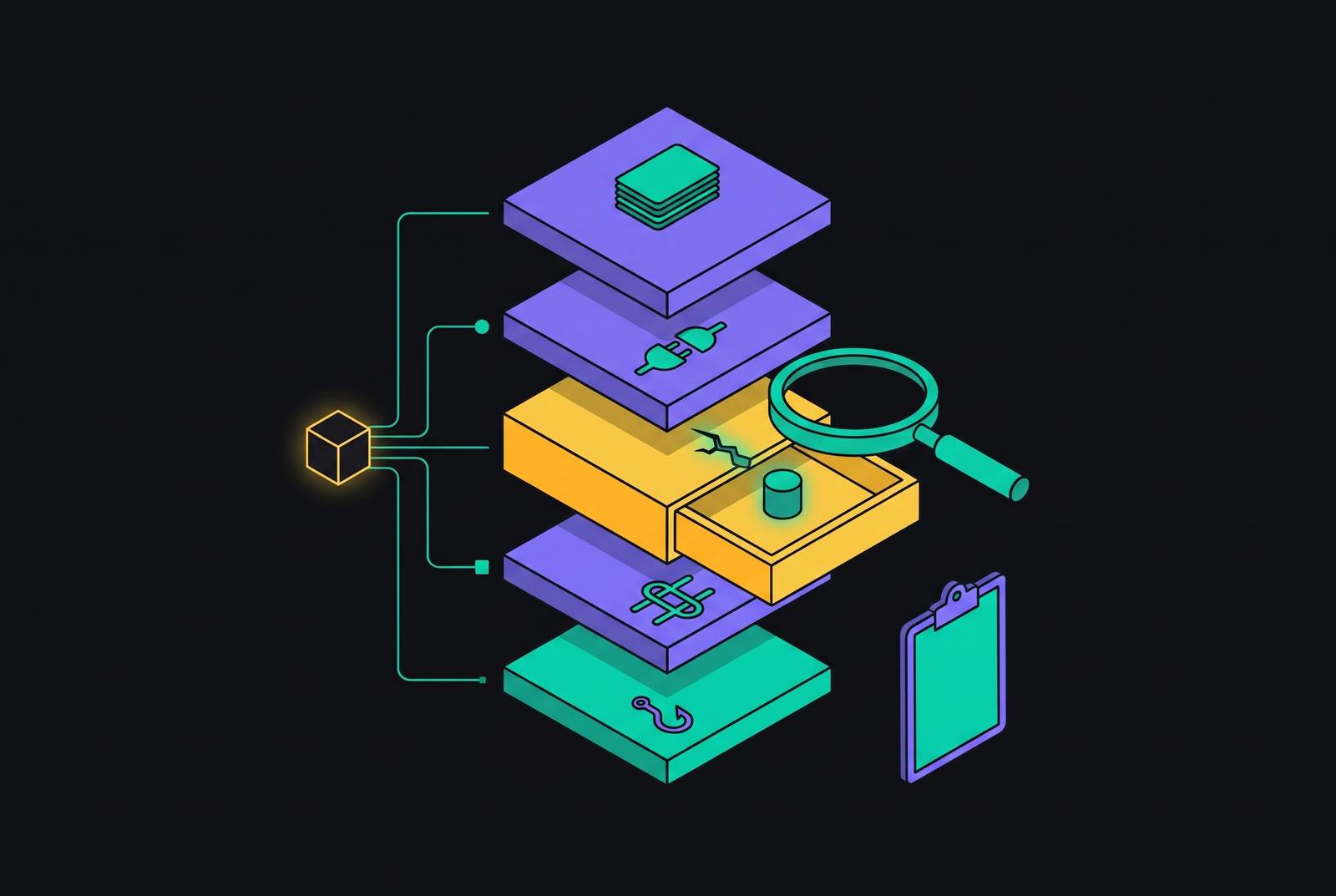
AI agent failure attribution by harness layer starts with span-level traces. Engineers can narrow a production failure by checking Tool Interface, Lifecycle and Orchestration, then Context and Memory before attributing it to the model. This sequence turns pre-postmortem triage into an evidence-led search, while replay tests connect the diagnosis to a validated repair.
Why production agent failures resist the instinct to blame the model
Blaming the model first sends an investigation toward reasoning quality before establishing what the model saw or what its tools did. The harness controls those conditions through prompt templates, tool interfaces, context construction, orchestration, memory, and retry policy. A capable model can therefore fail systematically. When production logging compresses a run into one response, the team loses the intermediate evidence needed to distinguish a reasoning error from a broken operating environment.
OpsHarness research from CUHK and ByteDance identifies this distinction in root cause analysis. Its 2026 results show a 63.4% accuracy improvement over a bare general agent, addressing a gap attributed to missing diagnostic expertise and unfamiliarity with the target system, both harness responsibilities. The practical implication is to inspect the conditions around the model before changing the model itself.
The ETCLOVG taxonomy as a triage map, not just a vocabulary
HarnessFix defines seven layers, namely Execution, Tooling, Context, Lifecycle, Observability, Verification, and Governance. Execution Environment and Sandbox provides safe, isolated environments that can be reproduced and where actions run with bounded autonomy. Tool Interface governs how agents discover, describe, select, and invoke tools, including schemas, documentation, and error feedback. Context and Memory determines what the model sees through its context window, session state, summaries, retrieved evidence, and persistent memory. These boundaries make a vague failure report searchable.
Lifecycle and Orchestration governs think-act-observe loops, retries, task-state management, multi-agent coordination, and termination. Observability records traces, logs, tool calls, errors, and cost information well enough to support diagnosis and monitoring. Verification is the part of the framework responsible for checking. Governance and Security constrains agent authority through permissions, identities, policies, approvals, and audit trails. Together, the layers separate responsibilities that a final response conceals.
Their diagnostic value lies in their different signatures. Tool Interface flaws include ambiguous schemas, poorly ranked tool candidates, weak parameter validation, and unactionable errors. With Context and Memory failures, a call can succeed but still lead to incorrect attribution. The taxonomy therefore guides where to look first. When a schema is rejected, the tool contract needs to be checked before considering whether retrieved evidence confused the model.
How do span-level traces pinpoint which agent layer failed?
A span-level trace exposes each step’s inputs, outputs, tool calls, and control flow. A flat log leaves those relationships hidden. The trace shows which step produced a wrong intermediate result, which call returned an error, and where orchestration branched. That visibility is the prerequisite for elimination, because a layer cannot be cleared merely because the final response contains no obvious sign of its failure.
HarnessFix formalizes this evidence through the Harness-aware Trace Intermediate Representation, or HTIR. It compiles raw execution traces and harness code into a normalized form that captures step-level provenance and control-flow relations. It also aligns runtime steps with the harness artifacts that shape their behavior. This connects symptoms to the code surrounding the model. It gives an investigator a basis for distinguishing a broken invocation from the instructions or context that preceded it.
Multi-agent runs make this distinction especially important. A supervisor can incorporate a subtly wrong subagent result without question, so its final response absorbs blame for an upstream error. Hierarchical spans preserve the node boundaries needed to find that origin. To keep diagnostic evidence available, the recommended retention policy is to retain all error traces and all traces above a cost threshold, then sample the remainder.
Starting the elimination sequence at the Tool Interface layer
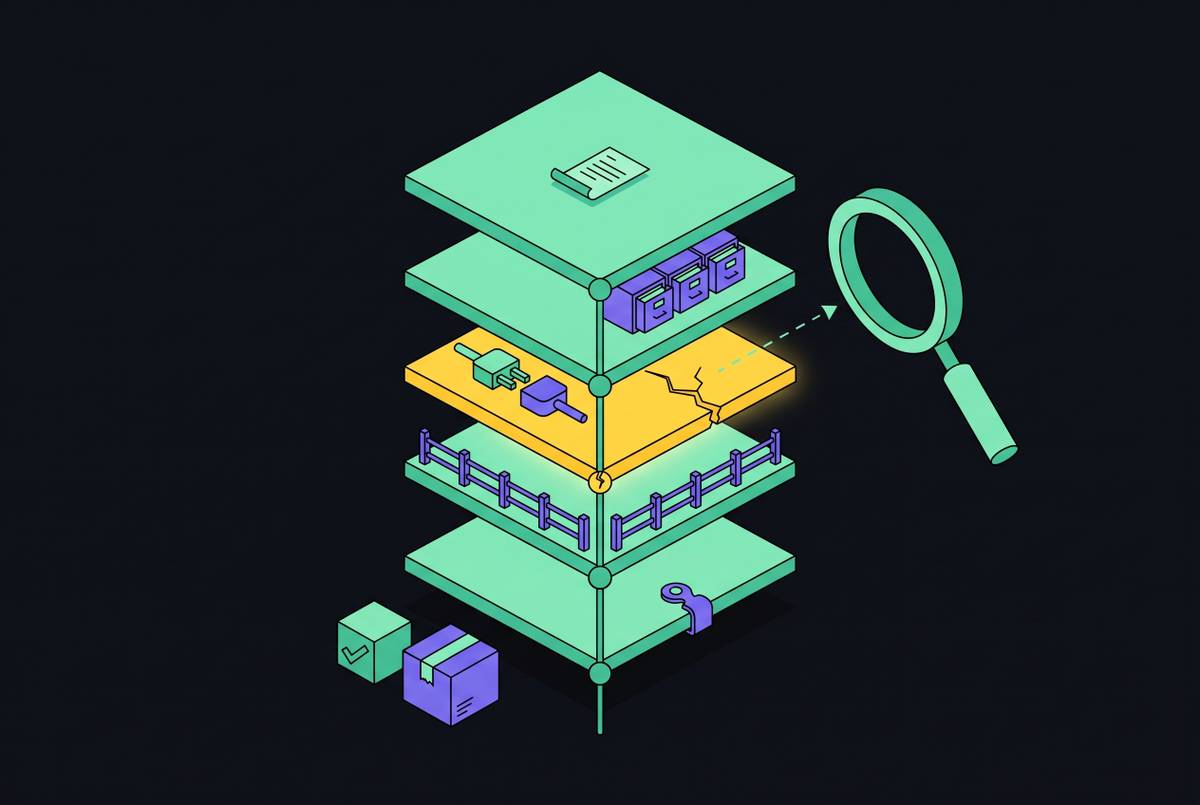
Tool Interface is the first check because broken calls leave explicit evidence, including wrong arguments, rejected schemas, and missing fields. These signals require no judgment about reasoning quality. Schema drift is the clearest example, with a renamed field, new required property, nested object replacing a flat key, changed enum, or stricter validator breaking an otherwise healthy agent. Happy-path evaluations can pass before the changed contract goes into production. An external API change can also occur on the vendor’s side without an alert to the team.
The resulting trace can contain a retry cascade. A retry layer treats schema rejection as temporary and resubmits, while a fallback handler switches tools and adds latency and noise. The visible failure then extends beyond the original call. Attribution must separate the rejected contract from the mechanisms that amplify it, rather than treating every failed downstream span as an independent cause.
The elimination check begins with argument payloads compared against the current schema snapshot. It then checks whether documented error codes point to validation failures or transient errors, and whether retry counts are above the P99 baseline. A matching rejection localizes the contract failure. Elevated retries help expose the cascade, but their cause still needs to be read from the call evidence. CI-side schema snapshot testing, with schemas recorded, diffed on each run, and breaking changes rejected, provides warning before production notices.
Checking the Lifecycle and Orchestration layer for loops and routing failures
If tool calls match their contracts, the next check concerns control flow. Lifecycle failures include infinite replanning, mis-routed steps, and retries that amplify errors. An agent may repeatedly replan the same step without progressing. A step count above the max-steps guardrail or a tool-call count above P99 exposes that stalled trajectory, even when individual calls remain valid.
ReAct-style agents provide a more specific signature. The agent reasons “I should search the documentation” but then calls search_web. The trace makes the mismatch directly visible. Comparing the stated action with the invoked tool identifies a routing problem without first judging the prompt or the retrieved context.
Retry behavior also belongs in this inspection, but its origin must remain distinct. Resubmitting every non-success code can turn a Tool Interface failure into a Lifecycle failure, which explains the order of inspection. The recommended checks are step counts above the established P99, repeated identical calls within a run, and reasoning that names one action while invoking another. If these signatures are absent, the investigation advances to Context and Memory.
Reading the Context and Memory layer for attribution errors and retrieval failures
Context and Memory failures are harder to eliminate because the run can complete successfully and still reach the wrong conclusion. The output may look entirely plausible. A rejected schema leaves a structural error in the trace, but missing evidence can leave no such sign. The model can reason consistently from the information it received while that information represents the wrong slice of the system.
The decisive comparison is between the context visible at the relevant reasoning step and the context that should have been present. That requires examining retrieved evidence, summaries, session state, and conversation history as inputs, rather than treating the final answer as a direct test of model ability. When evidence is missing, the investigation stays in Context and Memory. So does a misleading signal that dominates the context and steers attribution away from the relevant evidence.
Stale session state creates a related risk. Information from a previous run can corrupt the current run’s reasoning without leaving an obvious error signal. The comparison must therefore check whether the evidence belongs to the current task, even if the material in the context looks as though it fits. If the right evidence was present and the reasoning was still incorrect, attribution moves toward the model. That is a narrower conclusion than blaming the model because the answer was wrong.
Applying the protocol to multi-agent workflows where failures propagate across nodes
In a multi-agent workflow, node attribution precedes layer attribution. A root cause in one subagent can propagate through several downstream steps before appearing in the final response. The supervisor is not automatically the responsible node. Hierarchical traces let the investigator compare intermediate outputs with a correct trace and identify the first divergence, narrowing the search before examining the failing node’s tool, lifecycle, and context spans.
Replay provides a direct isolation test. Replacing one subagent’s output with a known-good gold output and checking whether the final outcome improves tests that node’s contribution to the failure. Once the node is isolated, the same elimination sequence applies to its trace. This keeps every downstream agent that used the bad result from sharing the blame. It also keeps the repair focused on the originating behavior that produced the final symptom.
LATS-RCA illustrates useful attribution boundaries through separate log and metrics agents coordinated by a supervisor. Each subagent has isolated context and narrowly scoped tool calls. Those boundaries make it easier to tell which subagent the evidence comes from. They do not remove the need for replay, because a plausible intermediate result can still pass through the supervisor without challenge.
What the triage sequence reveals that standard postmortem methods miss
A speculation-first postmortem starts with the final output and competing explanations. Trace-led elimination starts with evidence from the steps along the way and tests which part caused the failure. The distinction changes both the diagnosis and the speed at which it is reached. It separates the originating defect, such as a schema mismatch, from an amplifier, such as indiscriminate retries, so that a repair can address the broken contract without overlooking the control-flow weakness.
RCAtlas benchmark research shows why evidence-led investigation must not become a rigid script. Hand-crafted RCA agents that prescribe which evidence to read and when can skip decisive clues, including a log line or a service that stops receiving calls. Harnesses that let the model follow the evidence do much better on the same cases. Order is useful, but predetermined conclusions are not. Tool Interface, Lifecycle, Context, then model gives the search an order that can change to fit the trace.
HarnessFix finds that outcome-driven optimization without trace-grounded diagnosis can produce broad, indirect, or poorly scoped changes because it does not establish which harness layer caused the unreliable behavior. The finding must link the failed step to the harness artifact that caused it and show why the proposed change fixes the way it failed.
Validated repair before the postmortem ends: closing the loop from attribution to fix
A replay trace has the user input and system prompt, the tool calls and arguments, and the tool responses or snapshots. Scoring then checks whether the repaired harness produces correct tool selection, arguments, and sequencing on the traces where the original failed. The repair is tested against the actual failure conditions. That connection keeps diagnosis and evaluation tied to the same evidence.
The golden trace set serves as both the regression baseline and the replay surface for the fix. A repair must not degrade that baseline. Scheduled replay against the current production harness also gives early warning of silent drift before the next incident. This extends the value of incident traces beyond the immediate outage, turning the evidence used for attribution into a recurring test of harness behavior.
The baseline itself needs scrutiny, however. Tool-API drift can change schemas, error codes, or rate limits, while prompt drift can leave a rubric tied to an older prompt version. A stale golden set weakens the validation. The triage protocol should therefore include a check that the set reflects the current harness state rather than treating its previous usefulness as permanent.
Harness repairs do not require a weight update, so evaluation and release can proceed on a shorter cycle than a model revision. That makes a validated fix within the postmortem window a practical objective. The engineering discipline is to treat trace inspection, layer attribution, and replay validation as one incident-response workflow. Its endpoint is not a document naming the likely cause, but a scoped repair tested against the failure that exposed it.
Sources
- Free to Look, Free to Reason: Simple LLM Harnesses Outdiagnose Hand-Crafted Root Cause Analysis Agents
- From General Agents to RCA Experts: A Self-Evolving Harness for Root Cause Analysis
- From Failed Trajectories to Reliable LLM Agents:
- From Failed Trajectories to Reliable LLM Agents: Diagnosing and Repairing Harness Flaws
- Stalled, Biased, and Confused: Uncovering Reasoning Failures in LLMs for Cloud-Based Root Cause Analysis