Prompt vs Tool vs Workflow Failures in LLM Agents
Diagnose agent failures by identifying whether the defect lies in prompt, tool, or workflow.
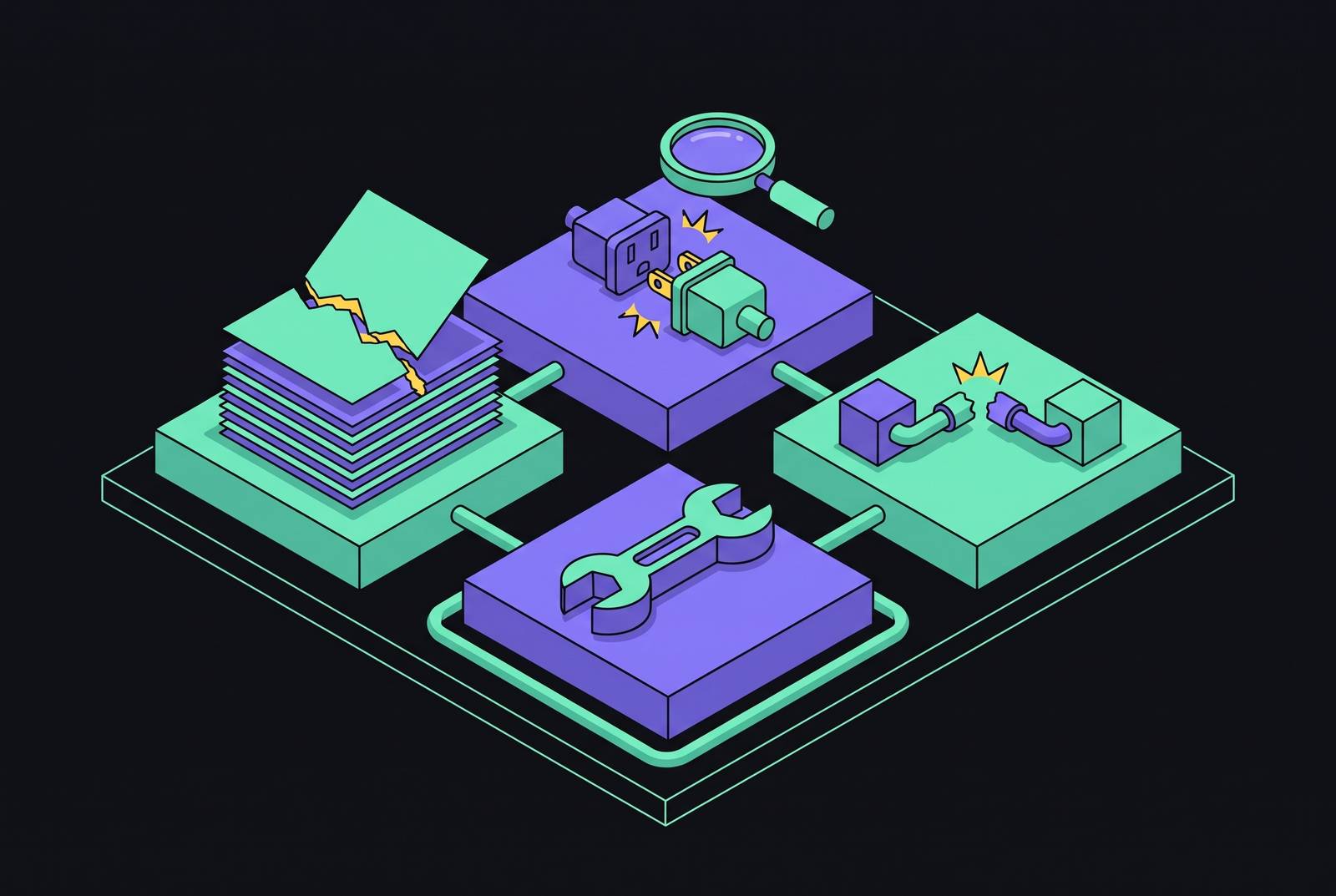
AI agent failure attribution by harness layer means separating errors in task interpretation, tool interfaces, and orchestration before choosing a fix. Prompt failures lead to valid actions aimed at the wrong goal, tool failures provide data that is wrong or made up, and workflow failures lead to a sequence that is invalid or non-converging. The responsible layer is the one whose correction would most likely have prevented the failure.
Why the layer that breaks and the layer that shows symptoms are rarely the same
An agent returns a structurally valid but semantically wrong result. The engineer inspects the last LLM call and finds nothing obviously broken. Its response follows from the information it received. The defect may instead be a planning constraint omitted earlier, a stale memory retrieval, an invalid intermediate assumption, or an incorrect handoff between agents.
AgentDebugX (2026) identifies this separation as a central problem in debugging agents. Long-horizon loops pass the output of each step into later steps, allowing an early mistake to propagate through apparently reasonable actions. TRAJDEBUG (2026) further distinguishes local errors that are repaired, remain harmless, or contribute to the final failure. Chronology alone therefore cannot establish responsibility for the outcome. Diagnosis requires tracing backward from the symptom to the decision whose correction would most likely have prevented it.
How standard observability tools miss the failures that matter most in agentic systems
General-purpose observability platforms expose execution traces but largely leave attribution and repair to the developer. Standard application performance monitoring is built around structured metrics, distributed traces, and dependency graphs derived from topology. Agent interactions also contain natural-language decisions and handoffs whose meaning is not captured by a static call graph. A request that succeeds can still move a failed task forward. An HTTP 200 response, for example, does not reveal that the tool returned the wrong data.
That gap becomes more consequential across repeated calls and subagent boundaries. An agent may drift off task or repeat the same call while infrastructure telemetry still shows that the calls succeeded. Tracing only the top-level orchestrator also leaves subagent activity outside the diagnostic view. The missing evidence sits inside those executions. A trace of the parent operation cannot explain a decision that its instrumentation never recorded.
The instrumentation therefore needs to be agent-aware as well as request-aware. Root spans, agent spans, LLM spans, tool spans, and retriever spans must be distinct, attributable units. AgentDebugX identifies the further gap between replaying execution and locating a cause that can be translated into recovery. More trace detail alone does not close that gap. Before better tooling can help, engineers need a working model of which harness layer the evidence implicates.
A working taxonomy of failure layers — prompt, tool, and workflow as distinct origins
Prompt failures begin when instructions are ambiguous, underspecified, or fail to separate instructions from data. The model performs the right kind of action in pursuit of the wrong intent. The format and tool use may still be fully valid. The mistaken interpretation then becomes a premise for later steps, which can remain internally coherent while moving further from the task. The fix changes the instructions or makes them clearer before the agent acts.
Tool failures begin at the interface between the agent’s understanding of a tool and the tool’s actual behavior. A registered description may retain an old parameter name, omit a new required argument, or reference a deprecated field. Tool-related failures also include invented outputs and misunderstood capabilities. The response may look right even when it is wrong. Downstream steps treat that data as authoritative, so the intervention belongs in the tool description, schema, or call-boundary validation.
Workflow failures begin in orchestration, including loops, termination conditions, handoffs, and state passing. Individual steps can be correct while their sequence violates a constraint or never converges. Repeated, unchanged retries are a characteristic example. So is a constraint that appears in the prompt but has no enforcement mechanism in the control flow. The intervention changes the sequence or adds a gate.
These categories form a practical model. Real failures can cross more than one layer. TRAJDEBUG’s case study describes a plan that violates a reservation-level uniform-cabin policy stated in the system prompt. That violation alone does not establish a workflow origin, because diagnosis must distinguish a mistaken interpretation from a missing enforcement mechanism. The location of the defect defines the useful boundary.
How do you pinpoint prompt ambiguity versus tool schema drift in a production trace?
Prompt diagnosis starts by comparing the earliest recorded planning or intent-setting spans with the task specification. A stated goal that excludes a required constraint or collapses distinct objectives points toward a prompt-layer defect. Later consistency strengthens that interpretation. Each subsequent action may follow sensibly from the wrong initial goal. The relevant evidence is the mismatch between the requested task, the instructions supplied, and the goal expressed in the trace.
The prompt itself then helps explain that mismatch. Instructions that can be read in more than one way, or that fail to separate user data from commands, are evidence of ambiguity. By contrast, an incorrect final response alone does not locate the origin. The fix should follow the evidence at that step. Explicit constraints, a clearer separation of instructions and data, or a goal-restatement step address interpretation before the mistaken premise propagates.
Tool diagnosis instead compares call arguments with the tool’s actual current schema and its registered description in the harness. A tool span may show a field name that is out of date, a required parameter that is missing, or a deprecated value. The call can still complete without a hard error. Its response may contain wrong data or a silent default that conflicts with expected behavior. Updating the registry, validating arguments at the call boundary, or adding a schema-version check addresses this interface mismatch.
The decisive contrast is between wrong intent and wrong data. In a prompt failure, the step structurally succeeds but expresses the wrong interpretation. In a tool failure, the call returns or appears to supply information that downstream steps should not trust. Both can leave a trace full of successful responses. AgentDebugX uses global trajectory context to trace from the visible failure to the responsible event, rather than assigning responsibility from an isolated span’s status.
How to identify workflow failures, which look like everything else until the trace is read as a sequence
Workflow diagnosis requires a different unit of inspection. A single span may show the right tool, valid arguments, and a response that makes sense, with no sign of a defect. The cause may be something absent from the sequence, such as a termination condition, constraint check, or required state transfer. There may be no wrong value to isolate. Workflow diagnosis examines whether the transitions between otherwise valid steps permit the task to succeed.
Repeated states and unchanged tool calls are strong clues to the cause. They indicate that activity is continuing without progress toward a valid exit. Another signal is a task constraint that never appears as an enforceable control-flow condition. Unlike an omitted instruction, that constraint may already be explicit in the prompt. Attribution depends on establishing whether the agent misunderstood it or the workflow lacked a mechanism to prevent the prohibited action.
Reading the trajectory therefore means following changes in direction and their effects on later steps. TRAJDEBUG distinguishes errors that contribute to failure from errors that are repaired or remain harmless. A useful diagnosis follows that causal distinction. In multi-agent execution, a receiving agent may correctly follow a message that already violates the task, so investigation must reach back to the sending agent’s decision. When the defect lies in orchestration, the repair is an explicit exit condition, a handoff check, or a hard gate that enforces the constraint.
Why misidentifying the responsible layer produces fixes that make things worse
Consider a tool whose schema has drifted while its registered description remains stale. The agent receives plausible but incorrect data, and the final answer fails. If the engineer responds by making the prompt more explicit, the agent approaches the same broken interface with clearer intent. The rewrite leaves the agent receiving plausible but incorrect data. Greater confidence in the result can let the error propagate further before it becomes visible.
The reverse mistake leaves the agent using a cleaner interface to pursue the wrong goal. Fixing either layer still leaves a workflow stuck if its loop has no valid exit. More accurate steps still produce no completed result. Worse, harness components interact, so a tightened schema may conflict with a prompt assumption, while a new termination condition may cut off a valid retry path. A local improvement is not evidence of a system improvement.
Correct attribution narrows the change to the mechanism implicated by the trace. It does not establish that the repair is safe. AgentDebugX converts diagnosis into a rerunnable correction while retaining original and repaired branches for comparison. That comparison is necessary because the consequences of a harness change cannot be assumed from its intent.
Validating a layer-specific fix against production traces before shipping it
A layer-specific fix is still unproven until replay tests it against the runs where the failure happened. Validation compares milestone and utility outcomes while examining whether the attributed defect was actually resolved. A prompt correction should produce the intended intermediate interpretation, an interface correction should resolve the argument or response mismatch, and an orchestration correction should repair the failing transition. Adjacent traces must also retain their performance.
AgentDebugX implements this comparison through its Rerun stage. An approved correction is applied from an appropriate checkpoint, with the original and repaired trajectory branches retained for inspection. If the rerun fails, the new failure enters the next attribution cycle. Recorded tool outputs and sandboxed side effects support deterministic, inexpensive reruns that isolate a harness change from environmental variation.
Unit evals test one step at a time, including whether a prompt change leads to the right intermediate output. Regression suites judge subjective output quality across the broader set of traces, while ongoing sampling of production traces catches drift that appears at scale. A successful unit result cannot substitute for evidence that the surrounding workflow still behaves correctly.
This standard requires engineers to inspect what changed and compare the resulting trajectories before accepting a repair. An unauditable auto-fix introduces another possible source of harness drift. Validation must therefore leave both the correction and its effects available for review.
Treating layer attribution as a repeatable engineering discipline, not a one-time debug session
Production agents change even after a particular defect is repaired. Prompts, tool schemas, MCP servers, context policies, orchestration loops, and governance rules all create new opportunities for layer-specific failures as they evolve. Repeated attribution builds a collection of diagnosed failures that gives later investigations more to work from. Recurrence across different runs is especially useful because it exposes structural weaknesses that an isolated patch may leave intact.
Failure-log reviews identify recurring patterns, harness updates target the attributed layer, and regression validation precedes deployment. Changes to prompts, tool schemas, workflow control flow, and memory receive the same rigor as code review and testing. Each decision has evidence that others can inspect. When this practice is working, reliability work is scheduled, layer-specific, traceable, and validated before shipping, rather than driven by guesses about the last visible failure.
Sources
- AgentDebugX: An Open-Source Toolkit for Failure Observability, Attribution, and Recovery in LLM Agents
- TRAJDEBUG: Tracing Error Lifecycle to Identify Critical Failures in Long-Horizon Agent Trajectories
- [2607.18754v1] AgentDebugX: An Open-Source Toolkit for Failure Observability, Attribution, and Recovery in LLM Agents