Regression Assertions on Tool Return Payloads That Catch Silent Failures Before Output Corruption
Catch silent tool failures before they corrupt agent pipelines.

Silent tool failure detection in production multi-agent pipelines requires assertions against tool return payloads. A tool can return HTTP 200 with a parsable body that violates the task’s expected outcome. Regression assertions check those expectations before the payload becomes model context, making otherwise silent violations visible and turning recorded failures into repeatable CI tests.
Why tool return payloads are a blind spot that infrastructure monitoring cannot cover
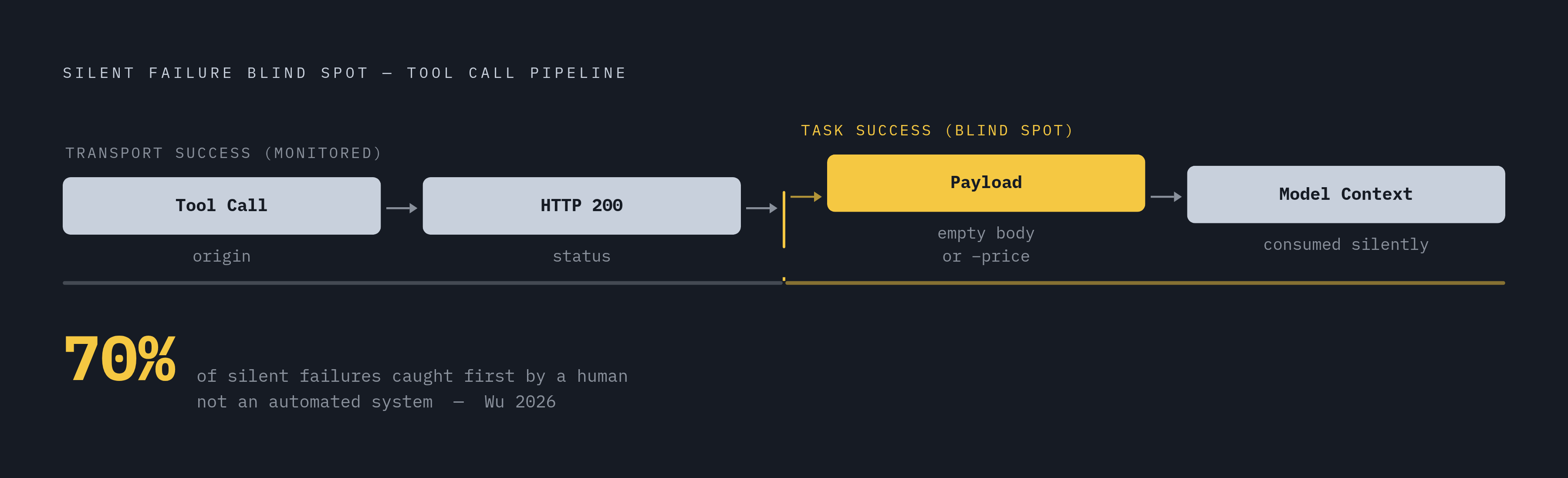
Panthi & Abdelfattah (2026) document a cached HTTP error page that an agent consumed as content and turned into a confident fabricated analysis. The response reached the model with no clear signal that it had failed. Monitoring focused on uptime, latency, error rates, and status codes cannot distinguish that outcome from a successful retrieval because those measurements describe delivery.
The blind spot is a mismatch between transport success and task success. An HTTP 200 with an empty payload can leave no exception to catch, while a negative price can arrive in the expected format. Both require a check on the returned content. Wu’s 2026 study of agent runtime silent failures found that a human reading output was the first to catch roughly 70% of them, before an automated system did. The missing signal belongs at the payload boundary, before a reader has to discover the defect in the final answer.
How a structurally valid but semantically wrong payload corrupts everything downstream
A wrong payload does not remain local because each step in an agent pipeline supplies context for the next. If an early retrieval supplies bad context, a later step can produce a wrong result that another agent then treats as established fact. The workflow continues with an appearance of normal operation. By the final response, the original defect may be several layers removed from the text it corrupted, so inspecting only that response does not reveal where the chain first went wrong.
A tool description mismatch can cause the model to call a tool in situations where it should not, or omit it when it should, without producing an error signal. A schema mismatch, by contrast, can raise a runtime error. In the semantic case, the agent has to reason through two separate problems: how to spot an inconsistent observation and which recovery action to take. Neither follows automatically from a successful tool invocation.
Panthi & Abdelfattah’s ToolMaze evaluation shows that agents struggle with these implicit failures when detection, localization, and recovery are left to the language model. Their Outcome Monitors raised completion to 28.1% across four models in two provider families by supplying the missing contract layer, demonstrating a recovery benefit. It makes the distinction important because a monitor that identifies a bad observation has solved only the first of the agent’s two problems.
What production APIs actually declare about their own return contracts
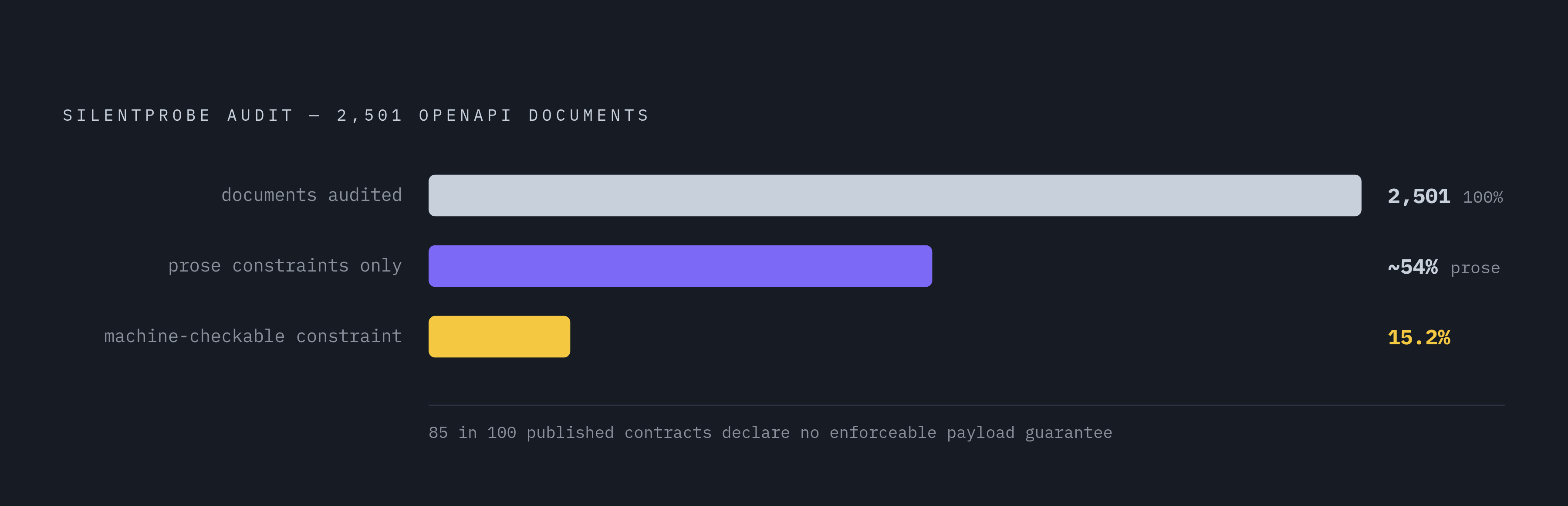
SilentProbe (Li et al., 2026) audited 2,501 independently published OpenAPI documents and found that only 15.2% declared any machine-checkable constraint at all. Only a small minority declared an enumeration, while a substantial portion stated at least one constraint in prose that the schema did not enforce. A field may be described as non-negative or non-empty while its schema still accepts values that violate that description.
The same study identifies a particularly difficult ambiguity for an agent consuming API results. A query that matched nothing and a query the server did not understand can both return HTTP 200 with a parsable body. There is no exception or distinguishing field to branch on. An empty result alone consequently cannot establish which event occurred, and a schema that accepts emptiness does not resolve the uncertainty. Detection needs an expectation tied to the request, such as whether the query is known to match records.
For teams operating these tools, boundary assertions often require writing constraints beyond those available in schemas. Waiting for upstream API authors to supply complete constraints leaves the current workflow exposed. The engineering task is to combine what an API explicitly promises with what known-good execution establishes, without confusing an absent constraint with permission to trust every returned value.
What outcome contracts are and where to mine them when schemas don't provide them
Panthi & Abdelfattah define outcome contracts as invariants specifying expected relationships between tool calls and their results. A deterministic monitor evaluates the returned result against those relationships. The request is part of the contract. For example, non-emptiness makes sense for a query known to match records, but using it for every query would treat a genuine lack of matches as a failure. This makes an outcome contract more precise than a general instruction to check whether a response looks reasonable.
Known-good execution traces provide one source of these invariants. The recommended approach is task-disjoint cross-fitting, which mines nominal executions without deriving and assessing contracts on the same specific tasks. Candidate properties include non-negative quantities, expected field presence, and non-empty arrays where matches are known to exist. Task separation limits overfitting to the examples used for mining. It also keeps the intended object of the contract clear, which is a relationship that should hold beyond one recorded answer.
Public schemas provide the complementary source through required fields, enumerations, and type constraints. These declarations can become assertions directly, without trace mining. Their strength is explicit structural coverage. Trace-mined contracts extend that coverage to semantic properties a schema permits but nominal behavior does not exhibit, such as a technically nullable field that is never null in the relevant executions. Neither source supplies a universal specification, so each assertion needs a defined context in which its expectation holds.
Designing assertions that intercept silent failures at the payload boundary
Effective assertions check deterministic outcome properties before a returned result enters model context. Structural presence checks cover missing required fields and null values where nullability would propagate incorrectly downstream. Categorical checks reject values outside a declared enumeration or expected set. Range and conservation checks catch quantities that are negative, counts that are zero for queries known to match, and totals that do not add up across line items. Referential checks compare returned identifiers with the identifiers supplied in the request.
Chronicle’s 2026 benchmark provides concrete incidents against which these distinctions become useful. The refund-sized-to-order-identifier case requires checking the relationship between the refund and the original order, rather than accepting a numeric value because its type is valid. To catch a currency mismatch, a check must compare the returned currency with the expected one. The notional-versus-quantity trade error requires preserving the intended meaning of the amount. An over-broad permission grant requires checking the scope of the result against the requested scope.
A returned value can violate an outcome contract, while an unsafe action may instead require an assertion about the tool selected, its arguments, or whether a guarded action was refused. The evidence determines the assertion’s proper target. Checking only the response-shape in every incident would leave semantic relationships and unsafe actions untested.
The Outcome Monitors interface separates detection from recovery through an advisory receipt. On a violation, the monitor preserves the raw result and issues a nonbinding receipt naming the violated property and available recovery tools. The agent chooses what to do next. The study’s controls found that removing the recovery-tool list left completion at the 10.9% baseline, while restoring it recovered the effect. Diagnostic detail and timing alone made no detectable difference, so the recovery affordances were the part of the receipt that made a difference in those controls.
Where to place assertions in the pipeline and what they must not do
Non-enforcement keeps what the monitor does separate from the agent’s choice of how to recover. A runtime guard that blocks actions or selects repairs makes it difficult to distinguish improved reasoning from the guard’s intervention. Silent correction creates a related audit problem. If an assertion replaces or discards a bad result, the subsequent workflow no longer exposes the observation the agent would otherwise have received. The advisory design instead preserves that observation and gives the agent information with which to choose a recovery.
This constraint distinguishes a post-return outcome monitor from a pre-execution gate. The former checks what a tool returned without restricting an action, executing a repair, or selecting a response. The latter intervenes before execution and enforces a decision. They serve different architectural purposes, and results from an advisory monitor should not be interpreted as evidence about an enforcing guard. The measured recovery gains concern agents that retained responsibility for their next step.
Placement follows from that separation of responsibilities. The assertion runs after the tool call completes and the HTTP response arrives, but before the response is appended to conversation history or used to construct the next prompt. That is the interception window for the observation. To preserve the decision trace, the record must include which tools were called, their parameters, their returns, and how those returns shaped the next step. A monitor that silently edits the evidence undermines the reconstruction needed when a workflow goes wrong.
How to turn these assertions into regression tests that run in CI
A production assertion detects a violation in one run. Encoding that assertion against the triggering trace turns the incident into a regression scenario with an explicit expectation. The trace becomes the test fixture. A failing or suspicious production run, retained with its intermediate tool calls, model decisions, and final output, provides the recommended starting point. Labeling that scenario with an expected output assertion lets the test set grow with actual failures after release.
Chronicle introduces cut-point replay to test changes against recorded incidents. Full replay is deterministic and requires no model calls, while cut-point replay serves selected boundaries from the record and executes the complementary subset live with new code. The same structural assertion evaluates the relevant behavior. This separates repeatable reproduction of the recorded incident from testing the changed portion of the system, so a recorded failure can remain useful as surrounding code evolves.
The benchmark has six recorded incidents, each with a small agent whose tool gives an unsafe result when unguarded and corrects it when guarded. Its refund, currency, trade, and permission cases give the assertion types described earlier specific failures to test for. These test expectations allow a CI test to check whether a guarded action was refused, while an advisory outcome monitor still leaves runtime recovery to the agent.
The recommended initial scope is limited to a minimal set of invariants that would have caught the last real failure. A single canary eval assertion per tool can catch schema drift in CI. Reliability still needs its own check. If the same candidate run swings substantially across repeated runs of a control slice, the gate is noisy and the assertion needs tightening before it can serve as a dependable CI signal. Passing that test establishes stability for the checked expectation.
The coverage boundary of payload assertions
Outcome contracts can detect only the failures that their vocabulary can describe. Panthi & Abdelfattah found that detection fell to 46% on cases outside the mined vocabulary, even though receipts were still delivered and task completion stayed the same. The limitation is in the contracts’ expressive coverage. New production incidents therefore need to extend that vocabulary, rather than merely accumulate as more examples evaluated by an unchanged set of assertions.
Payload assertions also do not establish trajectory correctness. An agent can choose the wrong tool, pass wrong arguments to the right tool, or put otherwise valid calls in the wrong order while getting an acceptable result from each call. Those failures need trajectory-level evaluation, and end-to-end evaluation checks the task outcome they lead to. A valid payload is not proof of a valid workflow.
A violated contract identifies a problem at the tool-result boundary, but it does not necessarily identify the upstream agent step that created the condition. AgentDebugX (2026) uses DeepDebug for that deeper investigation, carrying out multi-turn root-cause diagnosis with an understanding of the trajectory as a whole. Payload assertions provide a precise detection point for that investigation.