Scoring Platforms on Whether Their Agent Observability Feeds Forward Into the Next Release Cycle
Eight observability platforms ranked on whether production traces improve the next release.
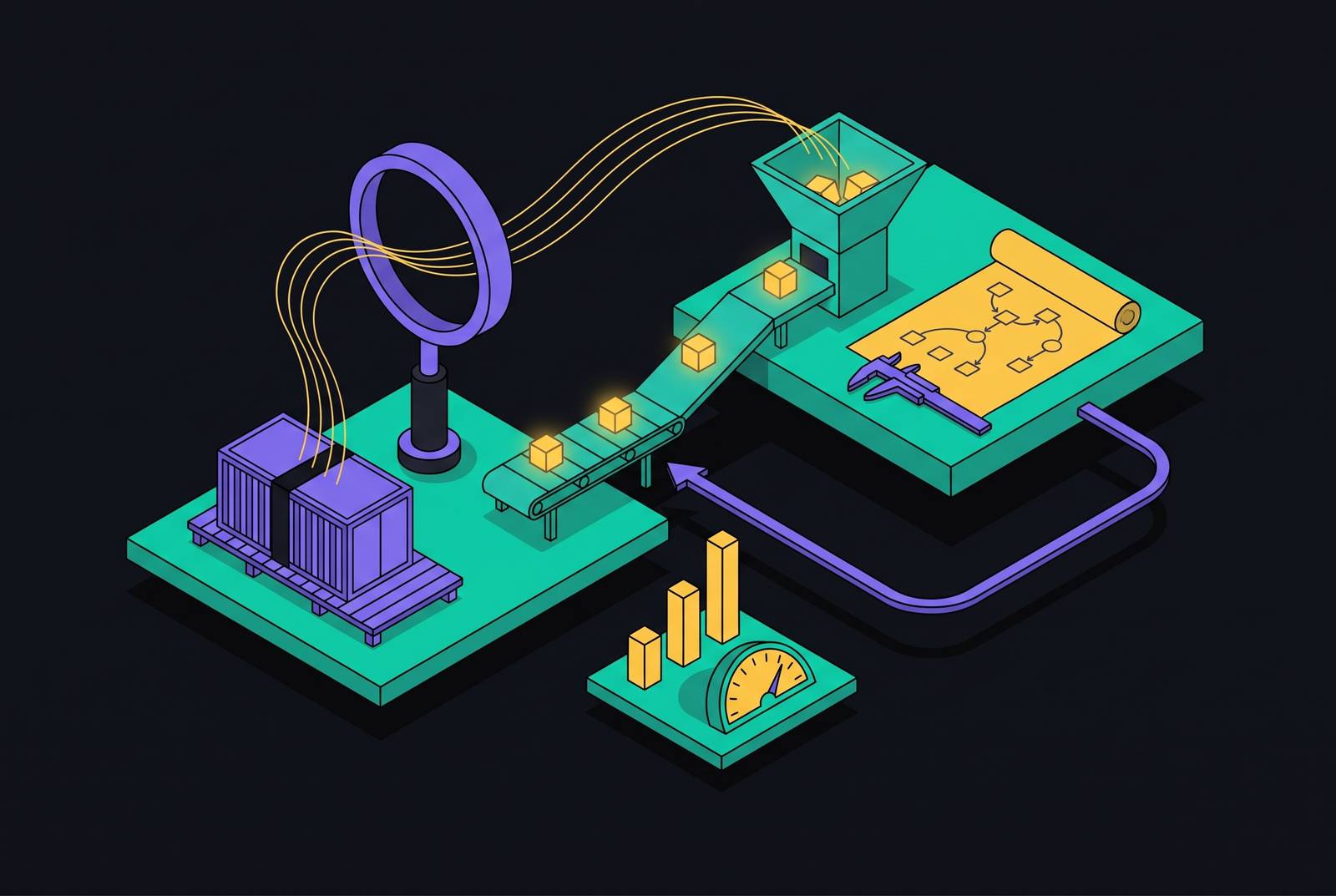
Production agent observability feeds forward when traces become regression cases, failures get layer-specific diagnoses, and proposed changes pass replay validation before they are deployed. The useful scoring criterion is therefore not trace capture but a compounding improvement loop from production observations to validated releases. This article compares eight platforms against that criterion, distinguishing documented capabilities from gaps that still need testing.
Why recording agent traces no longer counts as observability
Having traces is not the same as being able to act on them. Structured capture is now table stakes, while the gap between production monitoring and evaluation remains substantial. A majority of production teams have wired observability, but a significantly smaller share have wired evals. Recording execution does not, by itself, establish which change would improve it.
Wang et al.’s evidence-tracing survey explains that accuracy alone cannot establish how an answer was produced, which evidence supported its claims, or whether tool calls were justified. Sisodia’s multi-layer analysis finds a related problem in how model-level signals connect to infrastructure-level anomalies. Individual monitoring layers have matured, but connecting their signals into an operational explanation remains unresolved. Platform differentiation begins with that connection.
What a trace must actually capture before feed-forward is possible
A usable trace needs typed, parent-child-linked spans across reasoning, tool execution, state transitions, and memory operations. Reasoning spans record the plan, chosen action, observation, and next decision so that teams can see plan drift and wrong-branch selection. A single LLM span cannot show that sequence. Tool execution must expose the selected tool, its arguments, its result, and how that result affected the next decision. Otherwise, a successful response can conceal an unjustified call or an execution failure.
State-transition spans expose a different class of defects. Working memory before and after each step, context edits, and handoff payloads make context loss and summarization drift visible during longer runs. Memory-operation spans need the query, returned entries, relevance scores, and freshness to expose stale reads, wrong-entity retrieval, and leakage between users. These records supply the provenance that Wang et al. describe as necessary for localizing failures across evidence, actions, and intermediate reasoning.
Execution context also has to be identifiable. Prompt, model, and parameter tracking must connect a run to its prompt version, tool schema, retrieval index, and agent version, particularly when a small prompt change can disrupt a multi-agent flow. Fine-grained step metrics explain each decision, while trace-level metrics measure quality across runs in production. Without both, the platform remains stronger at inspecting one failure than assessing a release. Capture completeness is the prerequisite for everything downstream.
Why agent failures resist diagnosis without layer-specific attribution
The step that exposes an error is often not its origin. A wrong final answer may follow retrieval failure, tool misuse, stale memory, unsafe instructions, inter-agent miscommunication, or invalid intermediate reasoning. The output alone cannot distinguish these causes. MAST extends this structural problem to specification mismatches, miscoordination, weak verification, and cascading errors. Attribution has to work backward through dependencies to find the cause, beyond the last step that failed.
Those dependencies are too large to check easily by hand. MegaRCA-Mix, a 2026 benchmark cited in AgentRx, has failure trials in which the median execution-log size is 286K tokens. Who&When and AgentRx focus on localizing the critical failure step and assigning root-cause categories from trajectories. This is a more demanding task than replaying an execution. It requires identifying which upstream decision explains the observed failure.
AgentDebugX, introduced by Zhu et al. at EMNLP 2026, separates that work into Detect, Attribute, Recover, and Rerun. Detection identifies step-level errors, attribution locates causes, recovery proposes ranked fixes, and rerunning regenerates the trajectory around the failure point. Its DeepDebug diagnosis is read-only and never re-executes the run’s tools. That boundary lets teams audit the diagnosis while keeping it from changing the execution being checked.
The three failure categories that a feed-forward platform must distinguish
A behavioral regression occurs when a code, prompt, or model change alters agent behavior. The fixtures already in use can stay valid, but behavioral evaluations must run again. For example, a prompt change may keep the same success rate while adding to the work needed to finish. The regression affects the trajectory while the answer may remain unchanged.
A contract mismatch is a problem with the interface the agent uses. If a calendar tool renames attendee_emails to invitees, an eval pinned to a frozen schema snapshot can miss the incompatibility while production tool-call success declines. Affected fixtures should be rejected in preflight with a specific contract-mismatch signal. A coverage gap is different again. When an agent requests valid data outside fixture rules, the harness lacks coverage and should report that limitation explicitly and withhold a pass or fail judgment on the behavior.
These distinctions become especially important with multi-tool agents and standardized tool ecosystems, where reliability depends on sequences, side effects, and state. A three-layer evaluator combines deterministic checks for schemas, signatures, and latency with trajectory metrics and an LLM-as-judge qualitative gate. Trajectory metrics include path length, tool correctness, and loop detection. Step count deserves explicit attention. In the example where steps rise from six to nine, cost and latency increase roughly 50% even though success rate holds.
How eval-prod drift silently breaks the feed-forward loop before it starts
A prompt edited and deployed through a prompt-management UI can diverge from the main-branch prompt file used by the eval harness. Weeks later, engineers may look into an unrelated eval regression using a prompt that is not in production. Both systems can appear internally consistent.
Eval-prod drift is this slow, unattributed divergence between the configuration loaded by evaluation and the configuration assembled at request time. A pipeline connecting monitoring to testing cannot compensate for it. Prompt versioning and configuration tracking must therefore connect to the trace pipeline rather than remain in a separate UI without eval linkage. Otherwise, a passing score validates the wrong agent.
Deterministic replay provides a stricter correctness check than another probabilistic run. Tool calls can introduce hidden time, randomness, or version drift, while a ReplayToolClient makes those interactions deterministic. Under binary equivalence between record and replay, unchanged agent code should not diverge. A divergence then signals a correctness issue such as a control-flow fork, prompt drift, misaligned planning and execution logic, or an untraced dependency. This makes replay useful for testing configuration alignment as well as proposed improvements.
What genuine feed-forward looks like at the platform level
A genuine feed-forward workflow connects observation, diagnosis, evaluation, improvement, release gating, deployment, and feedback. Production traces enter the evaluation dataset, the dataset scores runs, and low-scoring traces are clustered for investigation. Root-cause attribution then informs proposed changes. Those changes go through historical-trace validation before they ship, and what happens next in production supplies the next evaluation cases. Each stage supplies evidence needed by the next.
Risky or low-scoring production traces become cases for future CI and regression testing, and the dataset refreshes on a defined cadence. Prior cases form the regression floor. New cases drive the current score so that evaluation keeps up with failures seen in production, instead of relying on a fixed set that grows less useful over time.
Harness hill-climbing runs a benchmark suite, changes one variable, re-scores, and retains the change if the score improves. Changing system-prompt wording and tool descriptions together conflates two signals. Even a better aggregate result would leave the cause uncertain. One-variable-at-a-time iteration preserves the attribution needed to make the next improvement deliberate.
Replay validation then serves as the release gate. Span-based replay reproduces call sequences and tool invocations so that proposed changes can be tested against historical traces before recommendation. Automatic clustering, rubric generation, and dataset versioning can reduce curation work, while the team still defines the policy. Automation does not remove the need for scrutiny. Engineers must be able to inspect what changed, why it was proposed, and which evidence supports shipping it.
Scoring eight observability platforms on their feed-forward capability
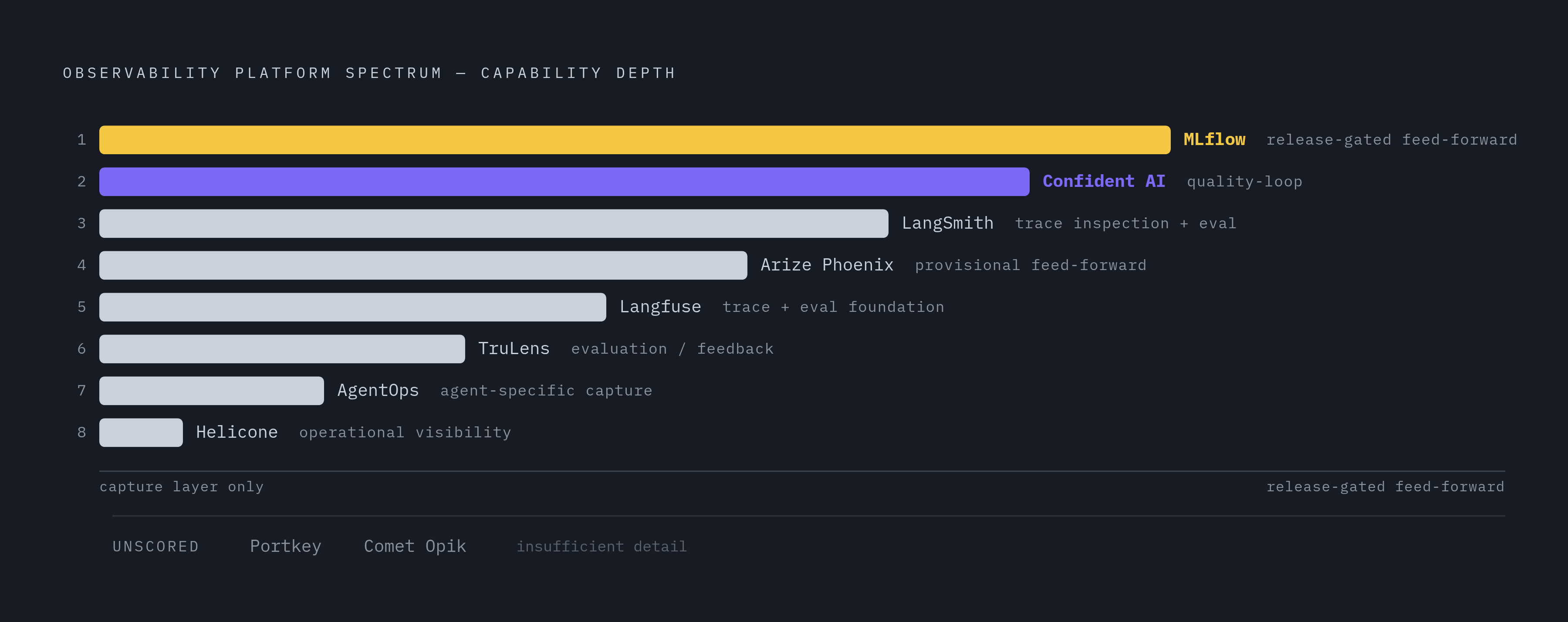
The available evidence supports a qualitative ranking. MLflow has the broadest documented release-validation coverage in this comparison, while Confident AI has explicit trace-to-dataset and quality-loop capabilities. LangSmith connects tracing and evaluation closely within its orchestration ecosystem. The other platforms have narrower documented strengths or insufficient detail to establish an end-to-end loop. A thin description leaves a capability’s presence uncertain.
MLflow sits closest to release-gated feed-forward on the documented capabilities. It combines prompt versioning and A/B testing under real traffic with evaluation by a language model, hallucination detection, groundedness scoring, and trace replay for failure reproduction. CI/CD integration can block prompt regressions before deployment. Compatibility spans LangChain, LlamaIndex, OpenAI, Anthropic, and Hugging Face, making it a broad-ecosystem candidate. Automatic low-score clustering and dataset-refresh cadence remain undocumented in the supplied material.
Confident AI is in the quality-loop category because it has explicit trace-to-dataset workflows, step-level and trace-level scoring, anomaly detection, and quality alerts. Its described visibility includes tool calls, sub-agent handoffs, retrievals, and retries. That mix fits teams that want to keep building a set of evaluation cases from production failures. The evidence requires qualification, however. These are self-authored claims with limited independent validation in the supplied material, which also does not establish the complete replay-gated improvement workflow.
LangSmith sits between trace inspection and feed-forward because its tracing and evaluation work closely together. Its strongest fit is a LangChain-native stack, where alignment with orchestration primitives reduces instrumentation friction. That ecosystem depth is also a constraint. Teams using other orchestrators face more friction, and the supplied evidence does not establish automatic improvement generation or the full historical-replay release gate.
Arize Phoenix is an open-source tool for tracing and evaluation. It is a candidate for teams seeking that foundation, but the available detail does not establish how production failures become validated release changes. Its feed-forward placement therefore remains provisional.
Langfuse also provides a tracing-and-evaluation foundation, with open-source and self-hostable deployment. That makes it relevant where hosting control is a selection criterion. The supplied material does not show whether it has attribution, improvement generation, or replay-based gating, so a higher feed-forward score would need more evidence.
Helicone sits toward operational visibility in this comparison. Its documentation focuses on showing cost and latency along with tracing, which fits teams looking into those areas. The evidence does not establish a coupled trace-to-dataset and release-validation loop. Seeing cost alone cannot show that a proposed change in behavior is safe.
AgentOps sits in the agent-specific tracing category. That specialization establishes relevance to agent execution, but the supplied description offers too little detail to score attribution, dataset refresh, or replay validation. Its placement remains a capture-layer assessment rather than a judgment about undocumented functionality.
TruLens sits toward evaluation through feedback functions. That orientation makes it relevant to quality assessment, but the available evidence does not connect those functions to a complete production-to-release workflow. Portkey and Comet Opik are not scored because the supplied material has too little detail on their feed-forward capabilities.
What the feed-forward criterion means for how teams should evaluate and adopt these platforms
For teams adopting this framework, evaluation begins with the agent’s call graph. Mapping it identifies the spans a platform must capture and exposes architectural gaps before a purchasing decision. A two-week pilot on a single workflow then tests documented capabilities against production behavior. The constrained scope is deliberate. It gives the team a concrete setting in which to assess attribution, dataset conversion, configuration alignment, and replay validation before organization-wide rollout.
The release process must also consume the evidence. Developers can overfocus on prompt changes when the required improvement concerns the harness, evaluator, or handoff design. Harness engineering should treat prompts, tools, skills, evals, and memory with the rigor applied to code review and testing. Changes need reviewable evidence and replay validation, one variable at a time. A platform can support that discipline but cannot substitute for it.
Deployment choices should reflect governance and operational capacity. Self-hosted tools offer data control and auditability of tracing logic, while SaaS platforms reduce operational overhead. Neither model connects model behavior to infrastructure signals in the way Sisodia identifies as unresolved. Teams should assess progress toward that integration as well as current features.
Score platforms on their ability to pinpoint a failure’s cause across layers, propose a fix, validate it against historical traces, and expose enough evidence for an engineer to decide whether to ship.
Sources
- From Agent Traces to Trust: Evidence Tracing and Execution Provenance in LLM Agents
- AI Observability for Large Language Model Systems: A Multi-Layer Analysis of Monitoring Approaches from Confidence Calibration to Infrastructure Tracing
- Top LLM Observability Tools in 2026: A Pro Guide
- What Is Agent Observability? A 2026 Developer Guide
- Externalization in LLM Agents: A Unified Review of Memory, Skills, Protocols and Harness Engineering
- AgentDebugX: An Open-Source Toolkit for Failure Observability, Attribution, and Recovery in LLM Agents - ACL Anthology
- TRAJDEBUG: Tracing Error Lifecycle to Identify Critical Failures in Long-Horizon Agent Trajectories