Tool Update Regression Testing in Multi-Tool Agent Workflows
Agent regressions hide in cascading tool calls, not in final outputs alone.
The n8n upgrade from v2.4.7 to v2.6.3 is the concrete production case: the Vector Store Question Answer Tool (toolVectorStore v1.1) began generating invalid tool schemas in its tool calls, and both OpenAI and Anthropic integrations were broken simultaneously, because the schema for tool arguments had changed between versions with no mechanism to surface that change to the harnesses consuming it. The failure did not stay confined to the Vector Store tool itself. Every downstream step that relied on a valid response from that call inherited the corruption, because each step in an agent workflow consumes the output of prior steps as reasoning context, not merely as raw data to pass along. A changed field name or a malformed response at step 3 injects a poisoned assumption into the planning and tool-selection logic running at steps 4 through 8. A 2026 agent evaluation comparison names this precisely: a model update that changes how the agent interprets tool responses at step 3 corrupts reasoning several steps later, and a team evaluating only step-level outputs will not see it happen. A guide to agent evaluation describes the same dynamic under the heading "Errors compound": a weak plan, a wrong tool choice, or a bad early assumption does not stay contained to the step where it occurred, and it cascades through every step that follows, so the visible failure appears far downstream of the actual mistake.
The three ways a tool update breaks a downstream step
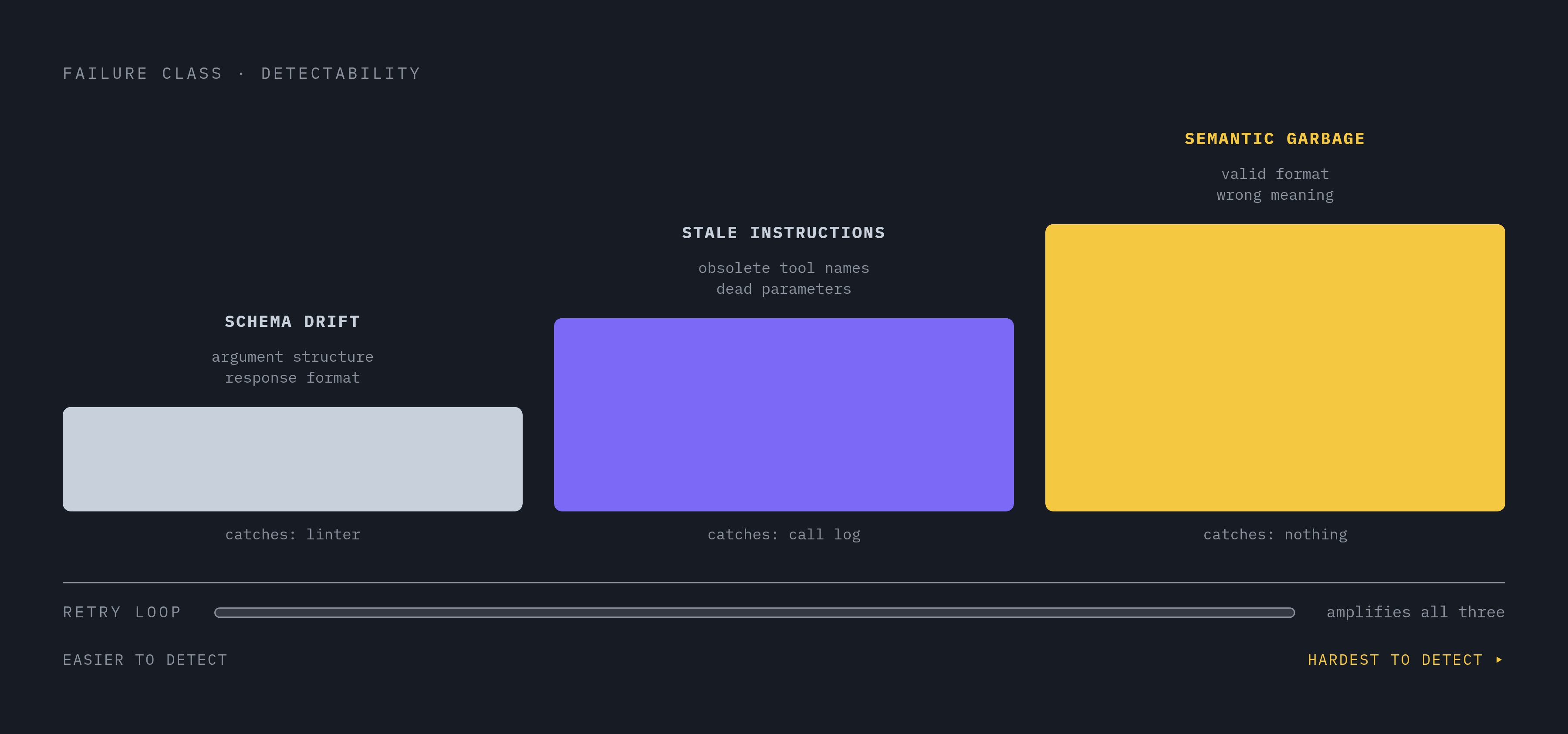
Tool updates produce three structurally different failure classes that require different detection strategies, and conflating them is why generic output checks miss most regressions.
- Schema drift happens when a tool's argument structure or response format changes shape, and the harness consuming it receives data that is malformed but still plausible enough to pass through unflagged. The n8n case is schema drift in its purest form. A related variant occurs at the tool-surface level rather than the single-call level: adding a large number of new tools at once can push existing tool definitions past the effective context window the model is working with, degrading selection accuracy across the entire tool surface, so that an MCP server refactor adding 50 new tools can regress tool calls that were never touched by the refactor. Schema drift often produces no error. It produces a response that looks fine and passes downstream until a human notices the output is wrong.
- Stale instructions occur when static system prompts and agent instructions still reference tool names or parameter structures that no longer match the updated tools. The agent, following instructions that were accurate before the update, attempts to call functions under names that no longer exist, or passes parameters shaped for an interface that has since changed.
- Semantic garbage is the hardest class to catch, because the tool returns data that is valid, well-formed, and complete, and the data is simply wrong in a way no schema validator can detect. An agent passes a customer name into a field that expected an ID, or a search API returns zero results because a filter value was semantically adjacent to the correct one without being syntactically correct. Nothing about the response trips a validation rule. The failure lives entirely in meaning, not structure.
A fourth pattern worsens all three once they occur. When a schema mismatch triggers a retry, identical arguments against a broken tool produce identical garbage on the second attempt and the third. The correct response to a broken tool is not to retry with the same arguments, because the tool itself is malfunctioning, and a retry loop amplifies the cascade rather than recovering from it.
Why attributing failure to the right step is hard
Knowing the three failure classes does not tell a team which step in a given trace actually caused a given downstream symptom, and that attribution problem is still largely unsolved at production scale. The step where a cascade failure becomes visible is almost never the step that caused it. Existing evaluations that reduce agent failures to a single system-level outcome, pass or fail, obscure where the fault actually originated, and the same visible failure might call for a prompt fix, a tool schema correction, a workflow restructuring, or a model adjustment depending entirely on where the problem began. Correlation-based attribution methods confuse symptoms with root causes and produce low accuracy as a result, and LLM-as-Judge methods remain inadequate because they cannot model the causal dependencies that connect an early decision to a late failure.
A 2026 research line takes this gap seriously enough to formalize it. The paper "From Flat Logs to Causal Graphs: Hierarchical Failure Attribution for LLM-based Multi-Agent Systems," posted to arXiv, argues for representing agent execution as a causal graph rather than a flat log, because a flat log cannot represent which earlier decision caused a later symptom. That move from flat logs to causal graphs is necessary precisely because the dominant format teams already use for debugging, the linear trace, structurally cannot answer the question that matters: which step broke things. Automated attribution is improving, but it remains far from reliable enough to serve as the primary defense against tool update regressions. That reality points in one direction. If attribution after a failure is still this hard to get right, the only realistic strategy is catching the regression before it ships, because reconstructing causality after the fact, manually, does not scale to production traffic and never will.
What standard output-level testing misses
Testing individual call outputs after a tool update checks the wrong unit of analysis for a multi-tool agent, because the regression caused by the update almost never appears at the call that changed. Research attributed to Wei et al (2023) found that agents evaluated only on final-output quality pass significantly more test cases than a full trajectory evaluation of the same runs reveals.
Agent regressions appear at the interaction level, not at the level of any individual call: a change at step 3 is invisible to a scorer that only sees step 3's output, and it only becomes visible to a scorer that can see what step 4 did with that output. Confident AI's evaluation guide frames the consequence sharply: evaluating only the final output of an agent resembles grading a math exam by checking the last answer. The reasoning errors, the wrong formulas, and the correct intermediate steps that nonetheless produced a wrong conclusion all go unseen.
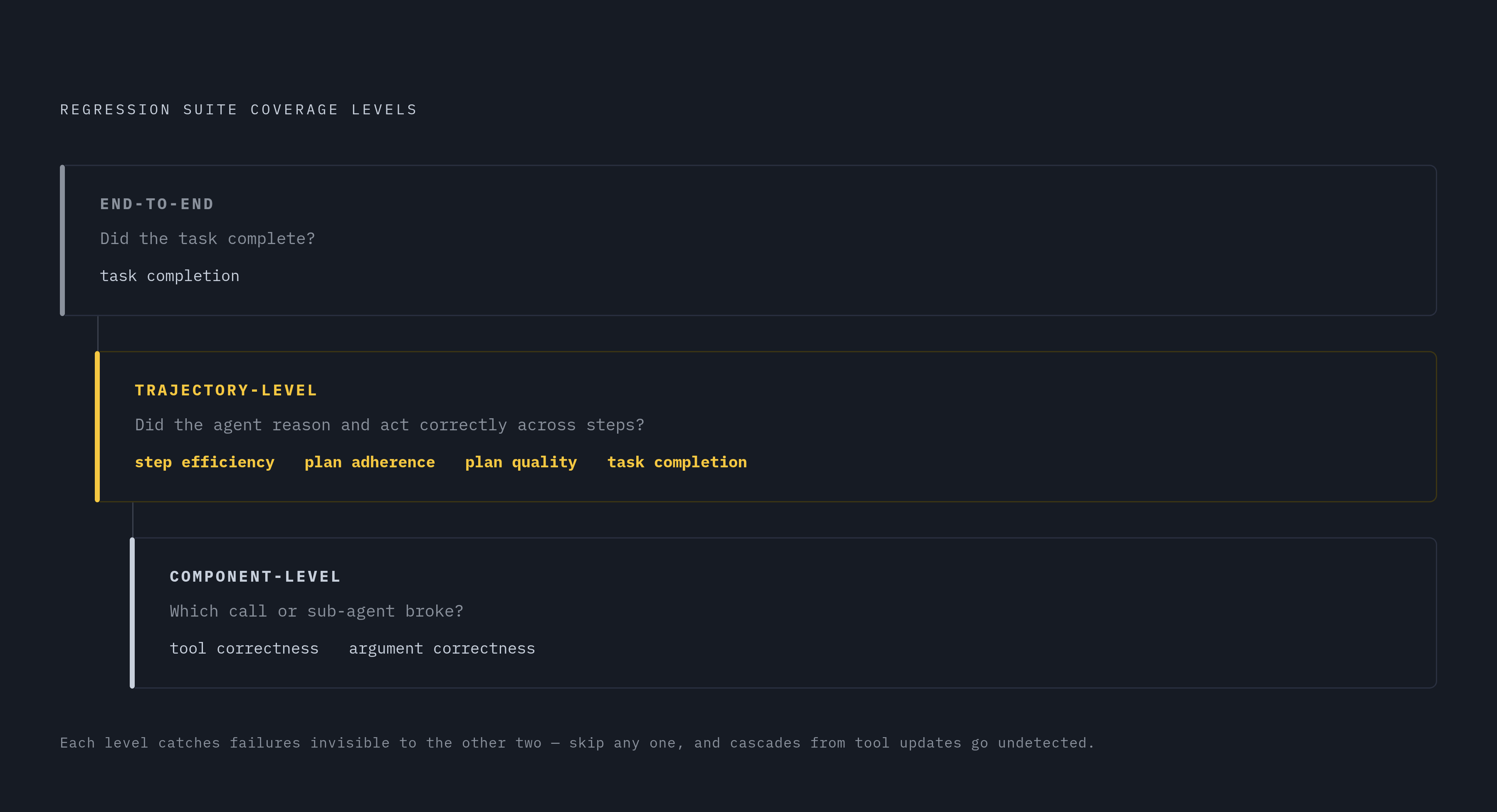
The correct unit of analysis is the interaction trajectory, the full sequence of tool calls, intermediate state mutations, argument values, and reasoning steps that produced the final output, because cascade regressions live in that sequence and nowhere else. Scoring a trajectory well requires covering several things together rather than any one in isolation: whether the right tool was selected, whether the right arguments were passed, whether reasoning stayed coherent across steps, whether the plan adjusted sensibly as new tool outputs arrived, and whether the task actually completed. Confident AI's guide groups these into four evaluation areas, tool calling, planning, task completion, and reasoning, and specifies that each must be evaluated at three distinct levels: end-to-end, trajectory-level, and component-level. A testing approach built around any single level misses what the other two would have caught.
Building a regression suite from production traces rather than synthetic cases
The highest-leverage source of regression tests for tool update failures is the set of production traces where an agent has already failed. Tool update regressions tend to be exactly the failure modes a team did not anticipate. Synthetic test suites, however carefully constructed, routinely miss them.
The practical workflow follows a simple loop: when a production session fails and a domain expert annotates it, that annotated session becomes a test case, and after the next tool update, the same suite runs against the updated tool to verify whether the update introduces a regression on a failure pattern the agent has actually exhibited before. A production-annotation eval system operationalizes exactly this loop: it auto-generates eval cases from production failures, turns an annotated failed session into a test case automatically, and reruns the same suite after a model or tool update to check for regressions against known failure patterns. A comparable tracing approach builds a loop around converting any production trace into a test case with a single click, so that failed traces become permanent regression tests, with a native integration posting eval results directly to pull requests and the full loop from production failure to permanent regression test taking minutes rather than days. These two implementations illustrate the same underlying practice rather than competing for the same slot: what matters is the method, not which platform runs it.
Production traces outperform synthetic cases on this specific problem because synthetic cases are written against the tool interface a team had in mind at the time of writing, while production traces capture the actual argument values, the actual response shapes, and the actual downstream reasoning an agent uses in live traffic, including edge cases nobody anticipated in advance. The schema drift failure class benefits especially from trace-based regression testing: a trace that recorded a working tool call under schema version A becomes a direct test of whether the updated schema at version B preserves the same argument interpretation and the same downstream reasoning that the original trace produced.
None of this works without the right data captured at the point of the call. A tool-level instrumentation layer needs to record the argument passed, the schema context in force at call time, and the response, in sequence, because without that record, distinguishing which of the three failure classes occurred requires a manual reconstruction effort that does not scale past a handful of incidents.
Instrumenting the harness before a tool update ships
A trace-based regression suite is only as useful as the data the harness captures at the moment each call happens. A team that logs only final outputs cannot reconstruct the trajectory that produced them, and without the trajectory, there is no way to replay the run, attribute the failure to a step, or write a regression test that means anything.
At each tool call boundary, the harness needs to record a specific set of facts:
- The exact argument values passed to the tool, together with whether the call actually fired.
- The schema version of the tool in force at call time, which is what lets a later regression test distinguish an agent that passed the right arguments for the old schema from one that correctly adapted to the new schema.
- The raw response returned by the tool, captured before any parsing or transformation touches it, because semantic garbage failures disappear from the record entirely if only the parsed output gets logged.
- The downstream step that consumed this output, along with what that step did with it.
The harness is a larger surface than the system prompt alone. Production harnesses need to wrap tools with schema validation, versioning, and scoped permissions, and the harness code itself spans system prompts, tool wrappers, planner-executor loops, retry policies, and context compaction logic, every one of which becomes a potential regression surface the moment a tool updates.
Distinguishing which layer actually produced a given failure matters for deciding what to fix. A repeated failure in tool-call formatting is a harness-layer signal, while a systematic hallucination pattern is a model-layer signal, and routing a given failure to the correct layer is a precondition for choosing the right repair. A 2026 continual learning framework lays out this routing directly: harness-layer learning means optimizing the agent's scaffolding code, to the point that a coding agent can suggest improvements to its own harness after evaluating results across a batch of tasks, while context-layer signals point toward knowledge gaps and model-layer signals point toward weight-level issues. The distinction carries a practical payoff. Harness changes do not require a weight update, so they can be evaluated and released on a shorter cycle than a base model revision, which makes harness instrumentation and harness repair the highest-leverage intervention available for tool update regressions specifically.
Designing regression tests that cover interaction trajectories, not call outputs
A trajectory-level regression test for a tool update has to assert something more demanding than "the updated tool returns a valid response." It has to assert that downstream reasoning and state stay correct once the updated tool's output flows through the full interaction sequence that depends on it.
Three evaluation levels need to be covered together, because each one catches something the other two cannot:
- End-to-end: did the task complete correctly? This is the traditional check most teams already run, and it remains necessary, but it is not sufficient on its own.
- Trajectory-level: was the path to the answer efficient and sound? This level covers tool selection order, intermediate state mutations, retry behavior, and plan adherence as new tool outputs arrived over the course of the run. Confident AI's evaluation guide specifies the trajectory-level metrics that matter here: step efficiency, plan adherence, plan quality, and task completion, evaluated against the complete ordered trace rather than collapsed into a single end-to-end score, with argument correctness and tool correctness classified separately as component-level metrics.
- Component-level: which specific tool call, retriever, or sub-agent actually broke? This level calls for deterministic checks on things like tool correctness, reserving LLM-as-judge scoring for decisions that genuinely depend on the agent's actual output context rather than on a fixed rule.
For schema drift specifically, the test needs a particular shape: replay the original production trace against the updated tool schema, and assert that argument interpretation at the changed step produces the same downstream state that the original trace produced, not merely that the call completes without throwing an error. A call that completes without error can still have silently changed what the agent believes to be true at every step that follows it. The regression test that matters is the one built to notice that difference before a production system does.