Continual Learning Cadences for Agent Harness Teams
Production traces reveal which harness layer caused failure and how to fix it.
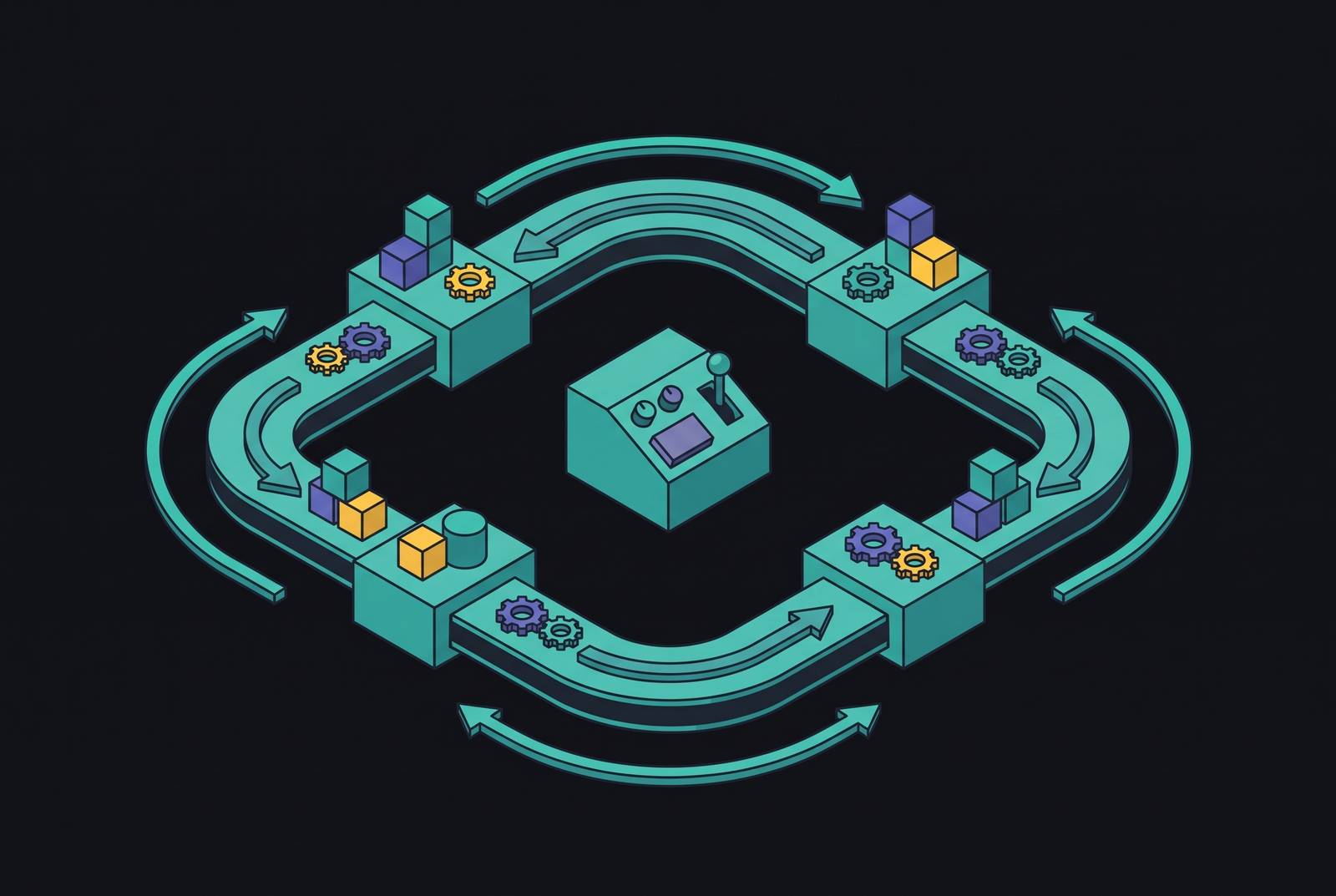
Continual learning for agent harness teams is a repeatable engineering cadence. Production traces become a compounding improvement loop when teams detect recurring failures, attribute them to specific harness layers, validate fixes before shipping, and re-evaluate at a defined rhythm. The accumulated record of what worked makes each cycle more informed than the last.
Why the harness — not the model — is where agent behavior actually lives
The model supplies capabilities, but the harness determines how those capabilities meet the environment. It controls what the model observes, which actions it can execute, and how execution recovers after deviations. Its scope includes system prompts, tools, orchestration logic, memory, verification rules, and failure-recovery procedures. A prompt template is therefore only one part of an executable runtime.
Different harnesses can make the same model weights behave in very different ways. Coding-agent harnesses combine shell access, persistent file-system memory, subagents, and background jobs, while research-agent harnesses organize hypothesis generation, experimentation, and evidence collection. Life-Harness (2026) reports an 88.5% average relative improvement across model-environment settings and shows that one evolved harness can work across domains and base models.
Harness-R1 (2026) distinguishes two complementary places to improve an agent, namely model parameters and the harness around a fixed model. For deployed teams, the latter offers a path that does not require retraining. Because this runtime is independently improvable, it needs its own systematic improvement process.
Why agent failures are hard to attribute and why attribution is the starting point for any cadence
The difficulty is that an agent’s visible failure rarely identifies the component that caused it. An error can cascade through planning, memory, tool use, and orchestration before appearing as a wrong answer or failed task. The final step exposes damage whose origin may lie earlier in execution. Outcome-level metrics therefore show that intervention is needed without showing where to intervene.
Root-cause attribution separates model failures from harness, environment, and grader failures. Those distinctions lead to different work, including post-training objectives, harness changes, and benchmark repair. Within the harness, engineers still need to distinguish a prompt problem from a tool schema, memory, or control-flow problem. Changing the component nearest the visible error can leave the initiating fault untouched.
Structured traces make this distinction possible by preserving the steps behind the outcome. Platforms designed for harness engineering, including Moda, use production traces to isolate the responsible layer. Hard cases require a multi-round diagnosis that produces an auditable root-cause report with evidence and a recommended fix. Attribution is thus the first diagnostic requirement of the cadence and requires structured traces.
What production traces must capture to make attribution possible
Traces need to record every model invocation, tool call, memory read and write, and decision branch. They link each action to its causal antecedents so that engineers can follow a failure backward through execution. Aggregate metrics then show patterns in step counts, token consumption, error rates, and latency distributions.
The trace also needs enough structure to separate changes in behavior from changes in operating conditions. The same prompt can produce different tool-call sequences because of temperature, retrieved context, or prior memory state. High-cardinality fields let teams filter by tool version, model version, or user segment to separate unlike runs. This structure must support detection of tool-API drift, prompt drift, and retrieval-corpus drift, including behavior changes after a re-index without a visible code change.
Tail-based sampling retains every failed, expensive, or anomalous trace in full while sampling the happy path aggressively. Span-based trace replay also requires more than traditional logs can provide for non-deterministic agent behavior. Systems that generate and validate improvements from historical runs, as Moda does, depend on preserving step-level detail and decision pathways. Trace design is therefore an engineering commitment made before the improvement cadence can run.
The specific harness failure categories that recur and should drive cadence priorities
Tool schema drift is visible in rising tool-call failures without a matching change to the prompt or model. A required field may have been added or an endpoint deprecated while the model continues using the old contract. The visible symptom can be intermittent failure rather than a dramatic crash, but the intervention belongs at the tool interface.
Prompt ambiguity has a different signature, namely high variance in quality or tool-call sequences for structurally similar inputs. Workflow loops are visible in calls that repeat with small changes and step-count distributions that shift upward. Activities that consistently consume most retries point toward work on the prompt, tool specification, or downstream API. These signals direct diagnosis without making the aggregate metric itself proof of a particular cause.
Context truncation appears when failure rates correlate with input length or memory state size because critical instructions disappear at the context boundary. Cost regressions also count as harness failures even when answers stay just as good. If average steps rise after a prompt change while success stays constant, cost and latency have regressed. The cadence must therefore make room to address failed execution and wasted execution as well as visibly wrong answers.
Why replay-based validation must gate every harness change before it ships
Identifying a failure category does not establish that a proposed fix will work across production inputs. A plausible prompt rewrite or workflow guard is still a hypothesis about behavior. Shipping it without trace-based validation is structurally equivalent to shipping code without tests. The validation gate must check how the edit works, beyond how good it looks.
The production-to-eval path begins by promoting a failed trace into a sanitized case with references and expected behavior. Task runs must remain joined to trace and span IDs so that the evaluation tests the failure that motivated the change. Unless model outputs, retrieval results, tool responses, environment state, and relevant external data are recorded or mocked, rerunning an agent produces a new trial.
Harness-R1 (2026) shows why this distinction between plausible editing and outcome validation matters. It reports unstable results from frontier harness editors, including reward reductions on at least one benchmark, while its outcome-validated approach improved task success by 9.3 percentage points. Its method validates patches through fresh same-batch reruns of the frozen target agent before updating the engineer’s policy. A cadence must likewise include a validation gate before shipment and a further check afterward, rather than treating a shipped patch as the end of learning.
How do teams turn production agent traces into a recurring improvement cadence?
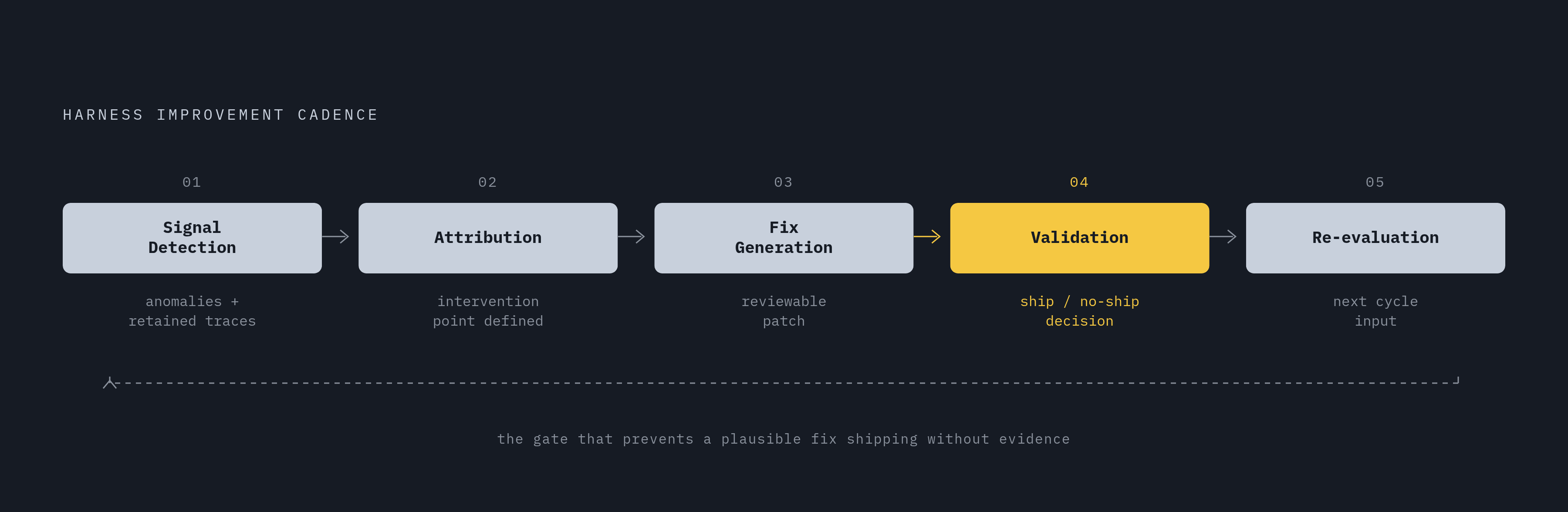
The workflow has five ordered steps, each with an owner, an input, and an output that gates the next. First, signal detection compares production behavior with its baseline, looking for failure-rate changes, step-count regressions, retry-budget shifts, and tool-call error spikes. The output is a set of anomalies backed by retained traces. Second, attribution assigns those failures to the responsible component and, where appropriate, the specific harness layer. That diagnosis gives the engineer responsible for the change a defined intervention point.
Third, fix generation produces concrete, reviewable changes to that layer. These can include prompt rewrites, tool schema corrections, workflow loop guards, or context management changes. The proposed change must be inspectable by the engineers who will ship it, rather than hidden behind an unauditable automatic fix. Harness-R1 (2026) supports failure-conditioned editing over fixed editing rules and reports task success reaching 53.6% with its outcome-optimized approach. Patches should be generated from diagnosed trajectories.
Fourth, validation tests the proposed fix against production cases that have been promoted with references and expected behavior. A fix that fails validation on the traces that motivated it does not ship. Fifth, re-evaluation checks the same metrics after deployment to see whether the gap closed and whether new regressions appeared. Step-count and retry-budget aggregates are early signals that behavior is degrading under production distribution shift.
The rhythm should follow the production system’s failure rate. Agents that generate hundreds of traces daily can support an attribution and fix cycle each week, while deployments with fewer traces may use a biweekly or monthly rhythm. The same cycle governs evaluation dataset refreshes, with current failure cases replacing or supplementing cases that no longer represent live behavior.
How memory and experience accumulation compound harness quality across cadence cycles
Each completed cycle can leave behind more than a patch. It can preserve the failure pattern, its attributed layer, the intervention, and the validation outcome. That record compounds reusable knowledge by letting subsequent diagnosis begin with evidence about what worked and what did not.
LLMA-Mem (2026) finds that compact procedural memories distilled from episodic experience improve long-horizon performance over baselines while reducing cost. It also finds that larger multi-agent teams do not always perform better over time, because better experience reuse can make smaller teams preferable. These findings apply directly to agent teams and only indirectly to engineering headcount. For harness teams, the narrower lesson is that structured reuse can help more than adding capacity.
Agent Workflow Memory (AWM) induces reusable workflow patterns from past trajectories to guide future decisions. The harness-team equivalent is a retrievable record of which prompt rewrites, tool schema fixes, and workflow guards resolved which categories of failure. As that record grows, it should be tagged by failure category, harness layer, and outcome. Harness-R1 (2026) describes co-evolution of engineer and agent, with gains that hold both before and after target fine-tuning. A mature cadence follows that pattern by improving the process of diagnosis as well as agent behavior, while reactive teams repeatedly handle failures without accumulating the same advantage.
What harness distillation reveals about the ceiling of harness-only improvement — and why it reinforces, not undermines, the cadence
Harness-only improvement has a real constraint because its gains remain tied to the runtime used at deployment. A specialized harness is not automatically the best harness across domains, instances, and models. Harness-Zero (2026) studies how to move harness-induced behavior into model weights so that the gains hold under a single fixed target harness. This improvement path complements runtime engineering.
Harness-Zero (2026) reports that average recovery was 82.3% across 28 behavioral patterns in three domains. With the specialized harness removed, it improves the base model’s macro-average task success, even exceeding the level reached with that harness attached. The result shows that harness-discovered behavior can become a training target. It does not establish that every useful harness change should be distilled.
For production teams, distillation is downstream of identifying a stable, high-value improvement. The cadence supplies evidence about which behaviors help, which interventions are reliable, and which gains should be internalized. Harness iteration discovers the candidate, while distillation changes where the behavior resides. The model and harness are complementary improvement locations, and the cadence helps establish when movement between them is justified.
How Moda fits into the cadence as the operational layer that closes the loop from trace to validated fix
Moda ingests production traces and attributes failures to the responsible layer, including prompt, tool, workflow, memory, model, or product logic. It generates concrete, reviewable improvements and validates them against historical traces before recommending what to ship. Teams can use this path without model retraining or manual log review. Engineers can inspect and audit the changes they keep, with no black-box fixes.
The operational value lies in connecting those steps. Teams still need a set schedule to review signals, refresh evaluation cases, and check behavior after deployment. Continual learning becomes an engineering discipline when that full loop repeats and its validated outcomes inform the next cycle.