Model Output Drift Detection in Production Agent Traces
Detecting silent AI agent failures layer by layer before they reach users.

Model output drift detection in production agent traces requires a compounding improvement loop from production agent observability. Score every trace, attribute regressions to the prompt, model, tool, or workflow layer, and replay candidate fixes against historical failures before shipping.
Why production agents drift silently while every infrastructure metric stays green
A support agent’s groundedness scores fall from 89% to 81% to 76% across a week. The endpoint still returns HTTP 200, latency stays flat, and no alert fires. A Slack thread eventually asks whether the model is broken. In this scenario, the cause is a silent provider weight update mid-week. The failure has already reached users before infrastructure monitoring gives anyone a reason to look into it.
Standard APM tracks latency, error rate, throughput, and saturation, but none measures whether an answer remains grounded in its supporting context. A response can thus read well and still be a semantic failure even when it passes every structural check. In an agent, that failure can compound through plan generation, retrieval queries, tool selection, and final answer grounding. By the time the output exposes the regression, its origin may sit several steps earlier. Rising token cost, longer trajectories, thumbs-down spikes, and compliance escalations are lagging indicators.
Why drift is not one phenomenon but at least four, each with a different origin layer
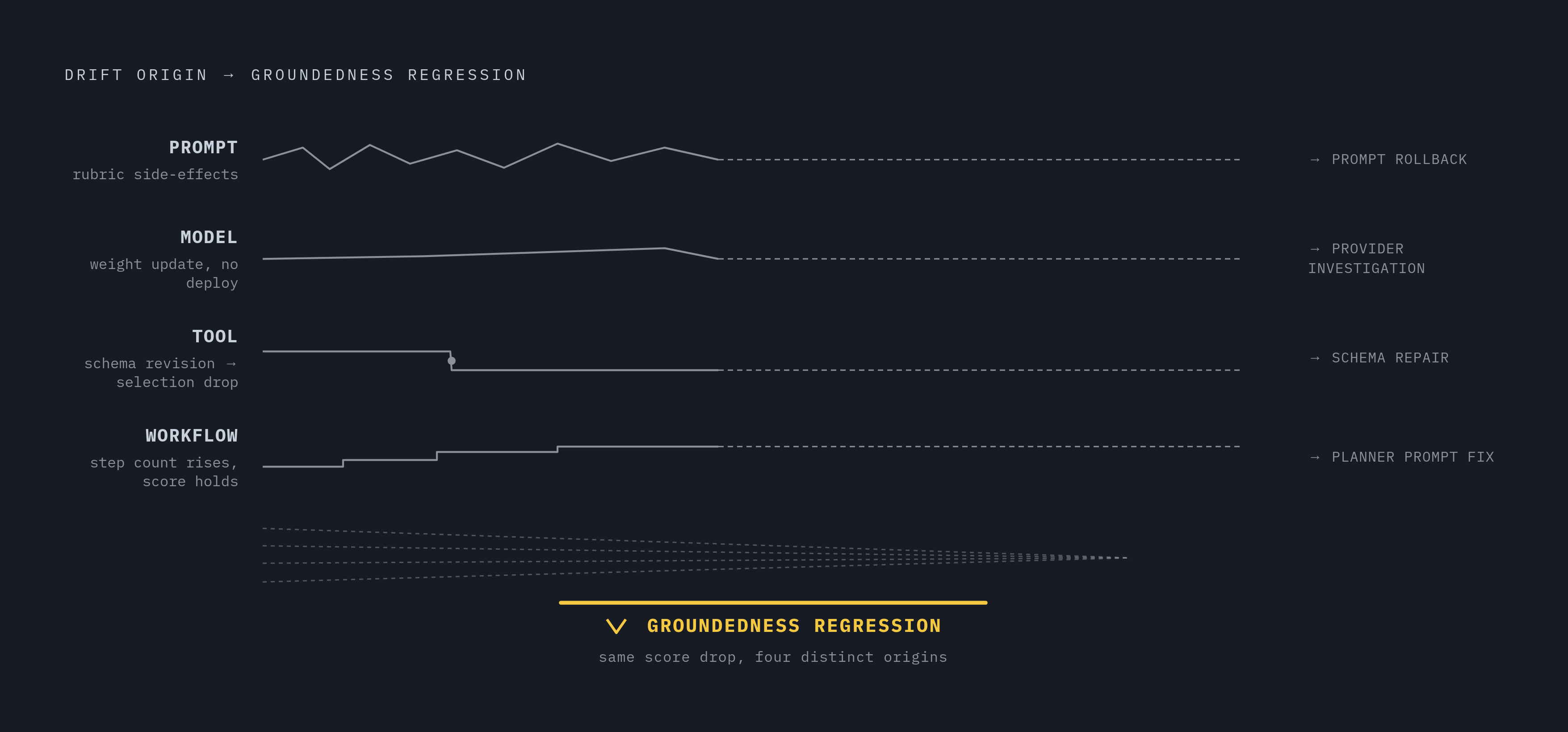
Diagnosis first distinguishes changes in an agent’s layers from movement in its scores. Prompt drift starts when instructions change, and those changes can affect rubrics the author did not mean to change. Model drift starts when the model’s behavior changes, even if the team running the agent has deployed nothing. Tool drift starts when tools or their supporting context change, while workflow drift shows up in how the agent plans and carries out its work. These origins require different interventions even when each produces the same drop in groundedness.
What stays constant helps distinguish them. A provider update can change how the model behaves under the same protocol, while a prompt edit can raise both groundedness and refusal rate. A change to a tool schema can change which tool the model picks because each tool’s name, description, and schema is part of the prompt on every request. With workflow drift, step counts can rise for the same task class even as final task success stays the same. With retrieval drift, too, the supporting documents change while the prompt stays the same.
Eval-score drift is therefore an observable result. A falling rolling mean says validated behavior is slipping, but it does not identify the repair surface. The MAST taxonomy distinguishes specification issues, inter-agent misalignment, and task verification failures, reinforcing the need for more than one failure category. Layer attribution supplies the missing distinction between a provider investigation, a prompt rollback, and a schema repair.
Why scoring every production trace — not sampling error rates — is the only reliable early signal
Detection must begin where semantic failures appear, which is in rubric scores attached to production spans. Groundedness, refusal calibration, tool-call accuracy, and safety verdicts turn behavior into a signal that can be compared over time. Attaching those verdicts to every trace also preserves the connection between a falling score and the execution that produced it. Error-rate monitoring cannot replace that link because a request that succeeds can still have a wrong answer. Waiting for errors or complaints means waiting for drift to cross a user-visible threshold.
OpenTelemetry provides the tracing substrate that ties scores to executions, token counts, and release comparisons. The AgentTelemetry project provides an OpenTelemetry-based observability layer specifically for AI agent systems. Above that substrate, rolling-mean comparisons offer a simple starting point, while CUSUM and Bayesian online change-point detection can expose abrupt shifts earlier. Embedding-based methods, including K Core-Distance, cosine centroid drift, and MMD, address semantic movement that PSI and KS tests can miss. The operational requirement is multiple window sizes and route-level comparisons.
Those comparisons must preserve the cohorts in which behavior changes. Scoring each cohort, prompt version, and model route on its own shows where a regression is local and where traffic is still stable. A system with many prompts, model ids, retrievers, and tools can otherwise hide a serious decline inside an acceptable overall mean. System-level aggregation does not merely make diagnosis harder. It averages the signal away.
How to detect prompt-layer drift before a bad change ships and after it lands in production
Teams control prompt changes, so pre-ship validation is the first line of defense. The fingerprint of an unintended side effect is an improvement in the target rubric paired with a regression elsewhere. Every prompt PR must therefore run the full rubric vector rather than only the metric the author hopes to improve. A groundedness gain does not justify an unnoticed refusal-calibration loss. Moda supports this pattern through reviewable, diffable prompt changes validated against historical traces before shipping.
Offline success is not sufficient, however, because the eval set may omit a production cohort. Rollout-cohort drift appears when a new prompt passes offline evaluation but loses rubric performance for that uncovered group. Post-rollout monitoring must compare per-rubric pass rates by prompt version and cohort. A rolling-mean decline confined to one prompt_version cohort points the investigation toward that prompt. Per-user A/B testing and rule-based rollback then provide a response tied to the rubric that moved.
Schema evolution has a different fingerprint. Adding a tool, inserting a policy line, or reformatting instructions can change how the model reads earlier instructions whose wording remains unchanged. Version-pinning prompts and comparing rubric vectors across versions makes that indirect effect visible. The relevant diff captures changes across the assembled instructions, including the sentence an engineer intended to edit. Together, these patterns connect the pre-ship gate to the production cohorts that test its coverage.
How to detect model-layer drift when the provider has changed something you didn't ask them to
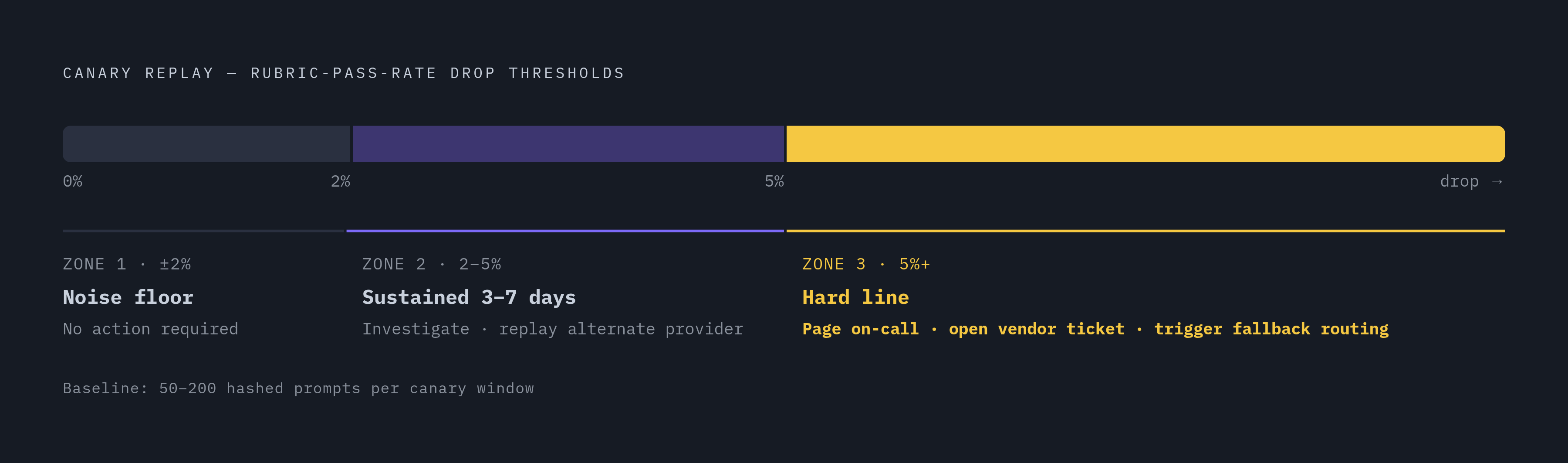
With provider-side drift, there is no release event to help teams track down the cause as they can with prompt regressions. The main way to detect it is to run a canary replay set each day against every model id in production. Maintain a versioned, hashed, dated set of 50–200 prompts with expected outputs and rubric scores recorded at the baseline date. Replay those prompts against the same model id and compare the fresh rubric vector with the day-one reference.
A change within the noise floor, roughly ±2% on rubric pass rate, requires no action. A 2–5% drop sustained over 3–7 days warrants investigation and replay against a different provider to test the provider-side explanation. A 5%+ drop warrants paging, a vendor ticket, and a fallback decision. The baseline must remain fixed during the investigation, because moving it erases the delta being examined.
When groundedness falls and hallucination rate rises on just one provider model route, model drift is a more likely cause than a prompt issue across the whole system. Canary movement combined with stable production rubrics for a different model id strengthens that attribution. After confirmation, response options include freezing the provider upgrade, rolling traffic back through model fallback routing, and mirroring the affected cohort. Failing rows also belong in the regression eval dataset so later tests check for the behavior just found.
How to detect tool and workflow drift when the harness itself is the origin of the failure
When the tool-selection accuracy score falls but the tool-call success rate stays normal, there is good reason to check tool schemas before blaming model quality. The calls can execute correctly even when the agent chooses the wrong tool or changes its selection pattern. Because the schema enters the prompt, its revision is also an implicit instruction change. Schema drift, stale tables, and uncertified sources belong in the investigation even when tool error logs remain quiet.
Workflow drift requires a trajectory view. A final-output check can miss wrong tool sequences, missing steps, and repeated steps, especially when the agent gets the task done in the end. A rise in agent.trajectory.step counts for the same task class shows this change more directly. A cycle detector in the eval harness can catch repetition before it exhausts context or budget. The repair surface is then the planner prompt and the plan-vs-execute eval.
DriftNet from Northern Arizona University illustrates the value of joint whole-trace and step-level labeling for compromised trajectories. Its dual-head trajectory Transformer classifies the full trajectory and assigns each step a label, namely benign, injection point, hijacked, or failed injection. That localization helps distinguish where a compromise entered from the downstream calls it contaminated. MAST classifies failures retrospectively from logs, while early drift detection requires step-level scoring as behavior changes.
Building a rolling eval dashboard that attributes a drift alert to the responsible layer
A useful dashboard combines rubric movement, execution metadata, and a routing rule for the investigation. Groundedness compares whether responses remain supported by context, while HallucinationScore tracks unsupported-claim risk. ToolSelectionAccuracy shows whether the agent’s tool choices have changed, and a context relevance measure checks whether the context it was given still fits the request. The agent.trajectory.step field shows how long the trajectory is, which helps catch planning regressions. Together, these measures describe more than whether the final answer passed.
The essential slicing dimensions are model route, prompt_version, tenant, retriever_index, tool_schema_version, and timestamp. Each lets the team check whether a regression is tied to one slice or runs through all production traffic. Groundedness falling and HallucinationScore rising on one provider route should trigger canary replay and provider investigation. ToolSelectionAccuracy falling with longer trajectories after a schema or prompt commit should trigger a diff of the tool description or planner prompt. A rubric regression confined to an uncovered production cohort should trigger prompt rollout-cohort investigation and A/B rollback.
Every alert should compare the current cohort with a fixed reference cohort that stays the same while the team looks into the change. Root-cause analysis then needs to find the first divergence from a correct execution and assign responsibility to the component involved. AgentDebugX frames this work as Detect, Attribute, Recover, Rerun, with hard cases escalated to a diagnosis agent that produces an auditable root-cause report. This architecture also appears in Moda, which ingests production traces, attributes failures to harness layers, and generates reviewable improvements validated against historical traces. The dashboard’s output is thus an investigation directed at a responsible layer.
How do teams close the loop between agent monitoring and shipping better agents through replay gates?
Knowing where drift originated does not establish that a proposed fix will hold. Diagnosis identifies the repair surface, but remediation changes behavior and can create a different regression. Replay validation closes that gap by testing the candidate against the production traces that exposed the failure. An evaluation harness makes this repeatable through golden tasks, deterministic tool-call replay, and rubric scoring. CI must block the change when those tests show a regression.
That gate must cover execution behavior as well as final success. If an agent averages 6 steps and moves to 9 after a prompt tweak, cost and latency rise even if success rate remains constant. The harness should fail the build on that signal rather than accept unchanged success as sufficient evidence. The gate itself also needs a health measure. If the replay suite flakes more than roughly 1%, it teaches engineers to ignore the very control intended to prevent drift.
MemoHarness (July 2026) describes self-improvement from live traffic through a dual-layer experience bank containing per-case diagnoses and distilled global patterns. Its mechanism connects failure evidence to changes in generation policy, orchestration, memory, and output handling, without establishing it as a production-ready commercial tool. For teams implementing the same discipline, Moda’s workflow connects broken traces, layer attribution, generated improvements, and replay validation before recommending a change. The compounding gain comes from making each discovered failure part of the evidence used to judge later releases. A fix that cannot be validated against the traces where drift occurred should not ship.
Sources
- DriftNet: A Dual-Head Trajectory Transformer for Detecting and Localizing Prompt Injection in LLM Agents
- Quantifying non deterministic drift in large language models
- Toward Measuring Structural Drift in LLM Communication Loops
- A Diagnostic Framework and Multi-Evaluator Audit of Evaluator-Driven Preference Dynamics in Self-Adapting LLM Agents
- TRAJDEBUG: Tracing Error Lifecycle to Identify Critical Failures in Long-Horizon Agent Trajectories
- Root-Cause Attribution Is a Search Problem: Continual Search for Long-Horizon Agent Failures