Prioritizing Agent Fix Backlog by Production Failure Evidence
Three production signals—recurrence, layer, blast radius—beat loudness and recency.

Production agent backlogs don't balloon because engineers are slow. They balloon because most failure signals arriving at an engineering team's queue are impossible to triage with the evidence available, so prioritization defaults to whatever is loudest or most recent. The defensible fix is a prioritization method grounded in three production signals: recurrence frequency, layer attribution, and downstream blast radius.
Why production backlogs grow faster than engineering capacity can clear them
The backlog problem is fundamentally an observability problem before it's a capacity problem. Traditional application monitoring measures CPU, memory, and HTTP error codes, none of which can reveal whether an agent made the wrong decision, called the wrong tool, or produced a semantically wrong output that looked syntactically correct. What these metrics miss is precisely what determines whether a fix is worth shipping.
Non-determinism compounds the difficulty. The same input can trigger different tool sequences across runs, and an output that looks correct can be wrong in ways that only become visible later in the trajectory. By the time the failure surfaces, the evidence connecting it to its origin has been buried under a growing pile of apparently reasonable intermediate steps.
The consequence is a stream of failure signals that cannot be quickly triaged, so fixes get ranked by recency or complaint volume. Those are the two inputs most likely to misrepresent actual production impact, and they're the default when nothing in the pipeline produces better evidence. Given this flood, the question becomes what defensible prioritization actually looks like.
Why treating the visible failure as the cause is the primary source of bad triage decisions
The step where a failure becomes visible is almost never the step that caused it. An agent may return an incorrect final answer because of a planning constraint omitted much earlier, a stale memory retrieval, an invalid intermediate assumption, or an incorrect handoff between agents. The symptom surfaces only after many apparently reasonable actions, as AgentDebugX from UIUC, Stanford, Google, and Toronto documents in its 2026 release.
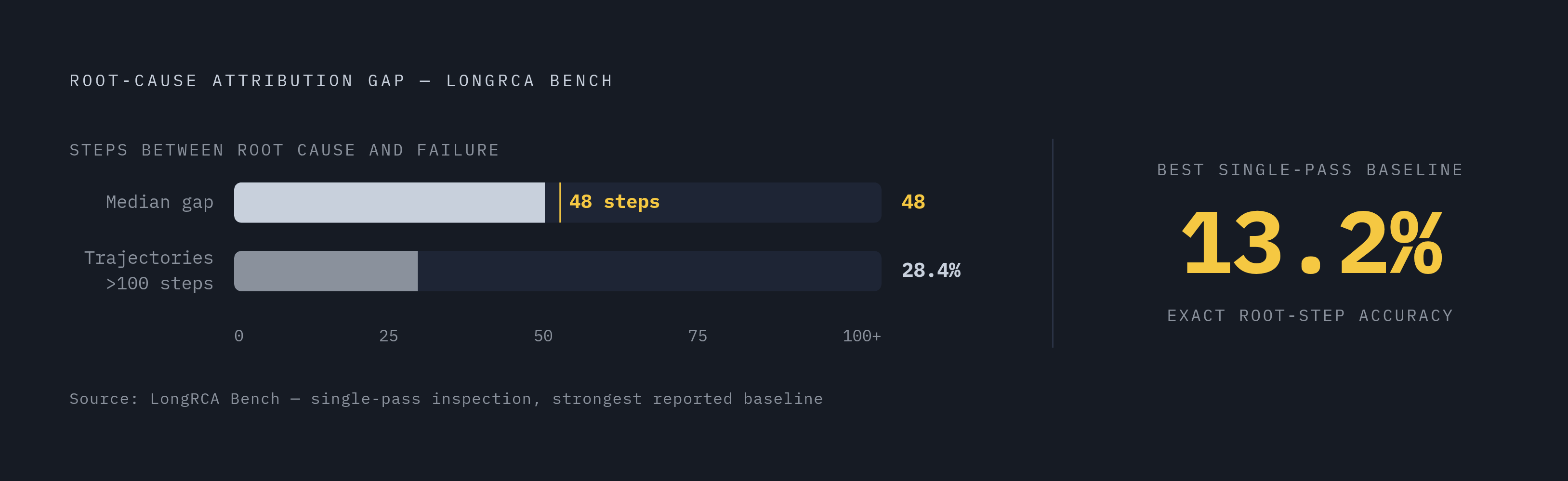
Intermediate states accumulate and condition every decision that follows them. The LongRCA Bench benchmark puts a number to this distance: reference root causes precede task completion by a median of 48 recorded steps. The decisive error occurs far earlier than where engineers typically look.
This attribution gap produces the practical result every backlog suffers from: teams open the wrong layer for repair, ship a fix that doesn't address the root, and watch the failure recur. It gets duplicated. The backlog grows not because new problems keep appearing, but because the same problems keep reappearing under different ticket numbers.
The strongest objection to this framing is that a team can simply replay the trace and see what went wrong. But replaying execution traces shows what happened. It doesn't tell you why. Replay is observation, not attribution, and observation without a theory of where to look is how an engineer ends up reading a million tokens and fixing the symptom at step 19.
The four harness layers where production agent failures actually originate
Almost all production agent failures originate in the harness, not the model, and the fix must be directed at the responsible layer or it won't hold. Model failures inform post-training objectives. Harness failures guide harness design. Getting this wrong means shipping a fix into a layer that wasn't responsible.
Tool schema drift and malformed arguments form the first harness failure category. The tool returns data, but it doesn't conform to the contract the agent was promised: wrong field types, missing required keys, invalid JSON. The agent faithfully executes against a contract that no longer matches reality, and the visible failure surfaces somewhere downstream of the mismatch.
Prompt ambiguity covers three structural gaps. There's no exit condition, so the agent loops or drifts without terminating. There's no fallback handling, so the agent halts on the first tool failure instead of recovering. There's no format specification, so the output is substantively correct but unparseable downstream. Each gap produces a different trace signature: the first shows repeated tool calls, the second shows an abrupt stop, the third shows a clean run followed by a parsing error in a different system.
Workflow loops are the third layer. This category covers infinite loops, state drift, hallucinated tool calls, tool-permission creep, and partial-completion ambiguity. The trace signature is repetition, and it's usually visible even in coarse telemetry, though identifying why the repetition started still requires digging. Memory and context failures form the fourth and most common category in aggregate: stale retrieval, missing business semantics, schema drift blindness. Moda, for instance, ingests production traces and pinpoints whether a failure originated in the prompt, tool, workflow, memory, model, or product logic, converting raw failure volume into triage-ready evidence that separates signal from recency bias.
Why one-shot trace inspection fails to attribute root cause reliably in long-horizon runs
A single pass over an execution trace settles on a plausible diagnosis early and leaves critical evidence in longer traces unexamined. This isn't a failure of effort or skill. It's a failure of method. Automated root-cause attribution that makes one pass is treating a search problem as a local inspection, and the cost of the resulting misattribution is higher than the cost of the original failure.
LongRCA Bench puts numbers to this limitation. The strongest evaluated single-pass baseline achieves only 13.2 percent exact root-step accuracy across the full benchmark, on trajectories where 28.4 percent contain more than 100 subsequent steps after the root cause. Detection sufficiency and localization sufficiency are different properties, and the metadata and trace-format views that preserve detection fidelity rarely preserve enough decision content to localize origin.
The corrective is to treat attribution as a search through an evidence space. On the Who&When benchmark, AgentDebugX achieves meaningfully better exact agent-and-step attribution accuracy than single-pass baselines, per its 2026 report. Tracing agent decisions back to their originating layer, rather than just logging execution order, is what closes the attribution gap and makes it possible to rank fixes by actual root cause instead of symptom visibility. That's the specific work tools like Moda are built to automate, so developers don't have to infer the responsible layer from a replayed execution order alone.
A three-signal scoring framework for ranking fixes by production failure evidence
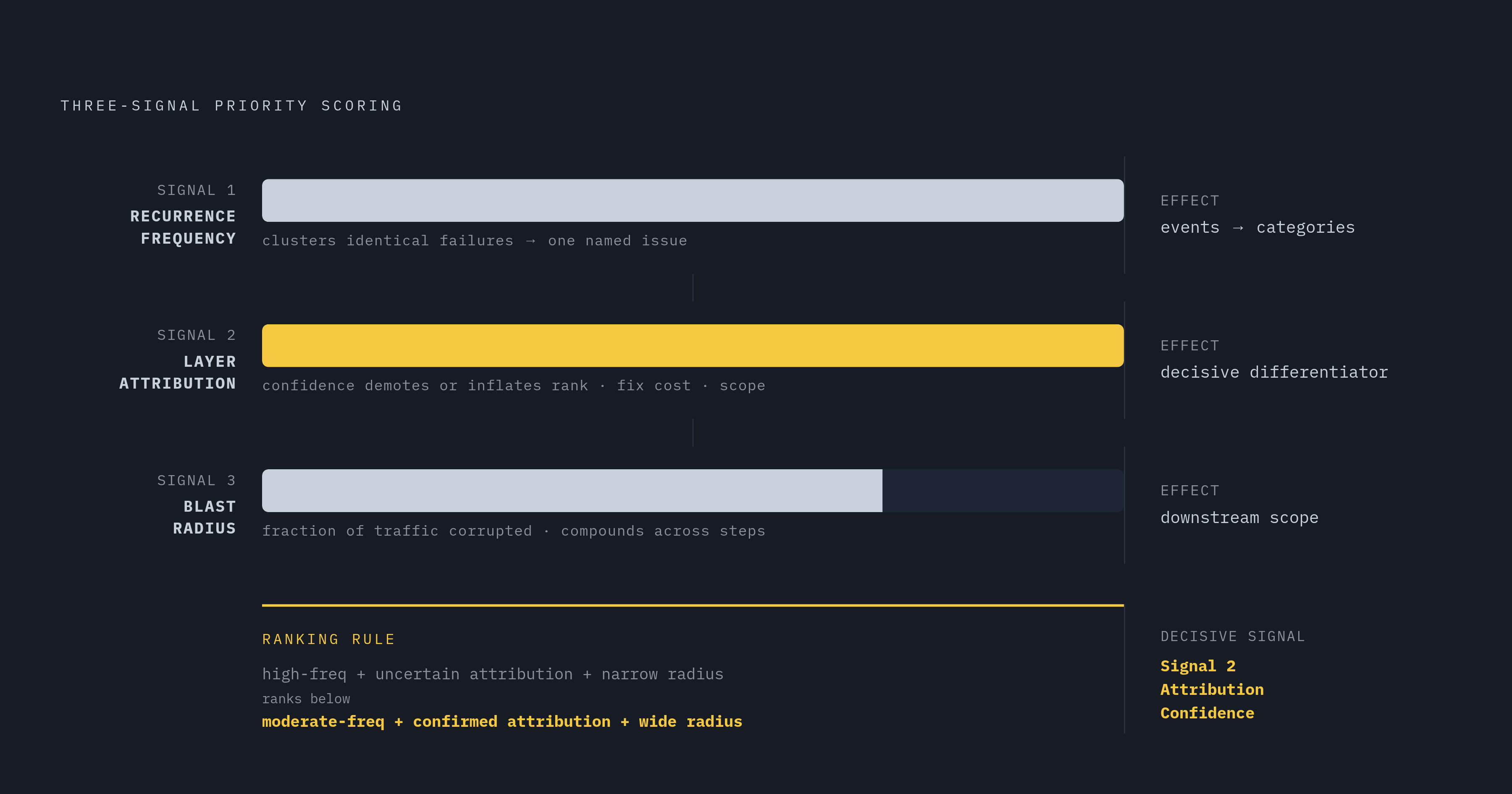
A defensible fix backlog ranking requires exactly three production signals per failure pattern: recurrence frequency across traces, layer attribution, which harness component owns the fault, and downstream blast radius, how much production traffic the failure corrupts. Each signal answers a different question, and all three are necessary before a fix can be ranked against competing fixes with any rigor. Recurrence frequency separates events from categories. A single failed trace is an event. The same failure pattern recurring across many traces is a category, and only categories belong in a prioritized backlog. Failure clustering is the prerequisite here: fifty broken calls with the same schema mismatch should appear as one named issue, not fifty separate items. Both show up as five failures a day, but one represents five percent of its path's traffic and the other represents half a percent.
Layer attribution determines fix cost, fix risk, and fix scope. A workflow restructure to eliminate a loop class is higher-risk and requires replay validation across more traces. The responsibility here is to treat attribution confidence as a scoring input, not an optional annotation.
Blast radius measures the fraction of production traffic a failure pattern touches, including downstream effects on multi-step trajectories. A failure that corrupts the first tool call in a 10-step agent has compounding effects across all subsequent steps. Its blast radius is larger than a terminal-step error of equal frequency. A high-frequency failure with uncertain layer attribution and narrow blast radius ranks below a moderate-frequency failure with confirmed attribution and wide blast radius, because uncertainty in attribution should reduce a fix's priority, not inflate it.
How to name and cluster failure patterns before scoring can begin
The scoring framework assumes named, discrete failure categories exist, and creating them is the step that determines whether the rest of the framework works. "It feels worse lately" cannot be scored. "Tool schema drift on the payments API, missing required field on 30 percent of calls" can be, because it names a layer, a failure mode, and a measurable frequency.
The practical method is straightforward enough to complete in a few hours with a batch of traces. Assign each group a name that encodes the layer and failure mode, not just a symptom description. The initial taxonomy effort is front-loaded and pays down as the category set stabilizes.
A named taxonomy converts monitoring, "we're seeing more failures," into a backlog of measurable, fixable problems. AgentDebugX's Error Hub operationalizes this at scale, providing an opt-in corpus of scrubbed failure-diagnosis-repair bundles that teams can share and reuse as debugging memory, per AgentDebugX's 2026 report. It's the institutional version of the naming step: a living taxonomy where every incident adds the offending input with the correct expected behavior, so the failure vocabulary grows as the system encounters new failure modes.
Why fixes must be validated against historical traces before they enter the backlog queue
Shipping a harness fix without replaying it against the traces that produced the failure pattern is shipping blind. The fix may address the attributed layer while introducing a regression in a neighboring pattern, and no amount of confidence in the attribution prevents that outcome. Replay testing is the gate between ranked fix and shipped fix, and skipping it breaks the evidence chain the framework is built on.
Replay testing re-runs an agent's evaluation using pre-recorded inputs and tool responses as deterministic fixtures, bypassing live APIs. It tests whether the proposed fix actually changes the outcome on the traces that defined the failure category. Regression coverage built from production failures catches tool-call sequencing breaks, latency regressions, and cascading multi-turn context drift that golden-answer suites miss, because it replays actual user journeys rather than curated hypotheticals.
A tiered eval structure makes replay tractable: smoke tests, core regression cases, and torture tests built from the hardest production failures. A fix only needs to pass the tier corresponding to its blast radius before it can be queued for shipping. AgentDebugX's Rerun step closes the loop by regenerating the trajectory around the failure point after a fix is proposed, testing whether the proposed recovery actually improves agent behavior before the fix moves forward.
How the scoring framework changes as live traffic surfaces new failure categories
A fix backlog ranked once against a static trace corpus goes stale as soon as production traffic shifts. The framework only holds its value if it runs continuously against live traffic and updates category frequency, layer attribution, and blast radius as new failures appear. Static golden datasets drift because examples were drawn from the original product spec. Real users ask different questions, and an agent can pass a high share of golden tests while failing substantially more real production requests.
The first weeks of real-user traffic after a release almost always surface failure categories that survived every pre-launch check, because they require real usage patterns to appear. Shadow evaluation against live traffic, running the scorer against production traces continuously rather than in periodic batches, is the mechanism that keeps the taxonomy current and the backlog rankings accurate. Scale AI's Continual Search was designed for exactly this scale problem: iteratively challenging a standing attribution diagnosis as new trace evidence accumulates, rather than committing to a one-shot reading.
The resulting flywheel compounds. Moda operationalizes this flywheel as a repeatable engineering workflow rather than a one-time audit: it ingests production traces, attributes failures to the specific responsible layer, generates reviewable improvements, and validates them against historical traces before recommending what to ship. The value is not the scoring math. It's the continuous loop the scoring math enables.
What defensible backlog prioritization looks like in practice
The output of this process is a table, not a ticket queue. Each row is a failure category, not an individual trace. Its rank is determined by the three-signal score, and no row advances to the fix queue without a confirmed layer attribution and a replay-validated fix candidate. A prioritized backlog that doesn't meet those conditions is a sorted list of failure counts with extra steps.
The practical test is a simple one. If the answer requires appeal to intuition, complaint volume, or recency, the ranking is not yet defensible. The framework prevents this by requiring attribution confidence as a scoring input, so the uncertainty is visible in the rank itself.
What the framework encodes is the same discipline as any other engineering quality process: evidence gates action, changes are reviewable, and improvements are measured against the same signal that identified the problem. It's a standard of evidence to hold the team to. That's the meaningful shift: the backlog stops being a list of things that broke recently and becomes a record of what production traffic actually demonstrates needs fixing.