Regression-Driven Observability Contracts for Tool Return Payloads in Multi-Agent Orchestrators
Checking tool outputs against trace-derived baselines catches silent drift.
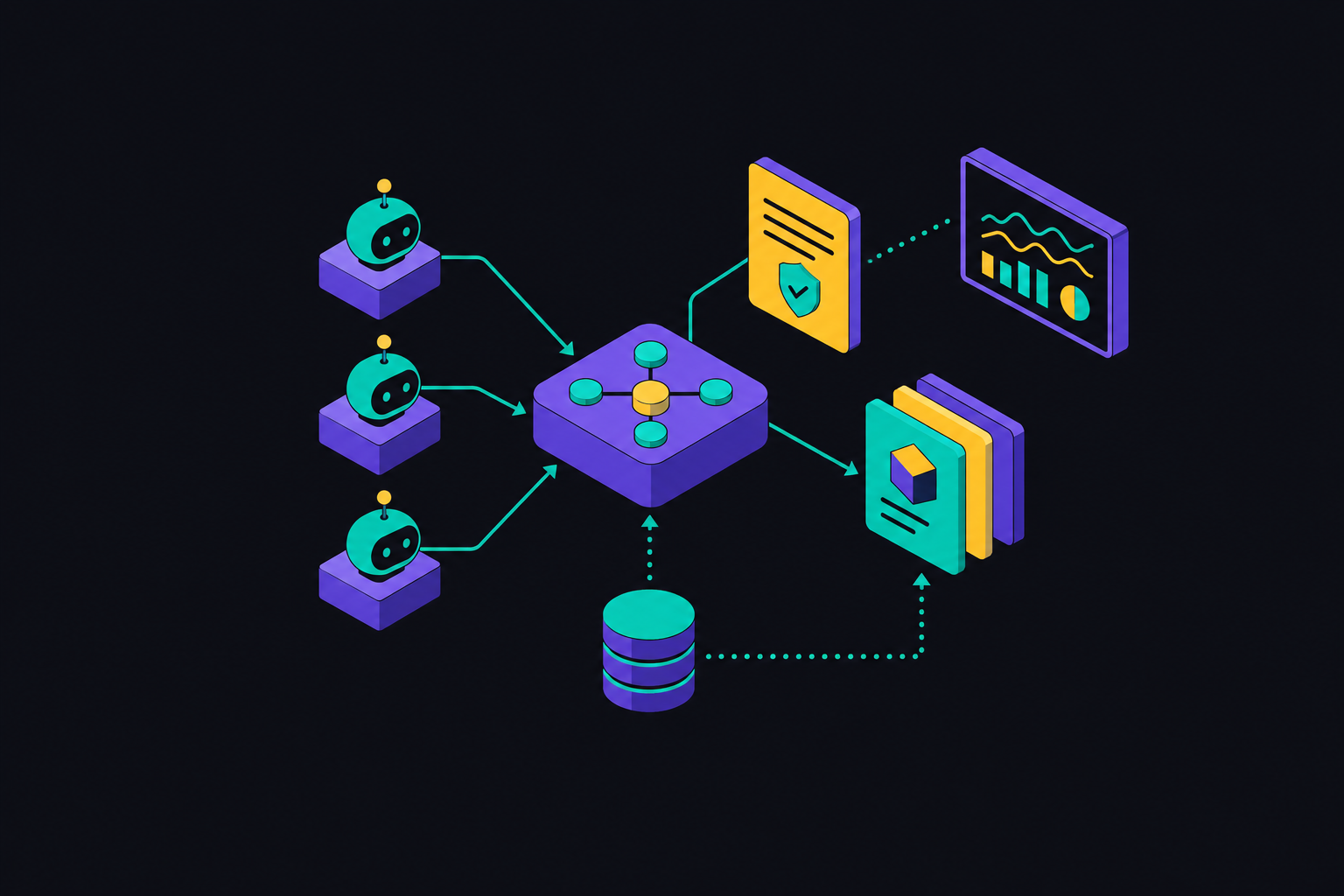
To detect silent tool failures in production multi-agent pipelines, outputs must be checked at the boundary between tool execution and agent reasoning. Regression-driven observability contracts derive expected payload shapes from known-good production traces, check each return against a versioned baseline, and emit typed violations through existing telemetry. This makes tool-layer drift detectable and attributable before downstream agents absorb it as reasoning input.
Why tool return payloads are inputs to probabilistic reasoning, not validated data
In a conventional typed service, a renamed field or changed enum can break a type check or trigger a deserialization error. In an agent harness without return validation, the same payload becomes text for the model to interpret. The model can continue without the expected field. Because the model can reason flexibly over text, it can take in a change that a strict client would reject without giving the runtime an explicit failure signal.
The distinction is between interpretation and enforcement. A model may give a plausible response to an unfamiliar payload, but that does not prove the tool met the interface the workflow depends on. The tool can complete successfully while returning something the agent was not expected to consume, even when the model functions correctly. The missing safeguard is an explicit contract between the tool and the harness that decides which outputs may enter the model’s reasoning context.
How schema drift becomes invisible in a multi-agent stack
A drifted payload does not remain within the agent that first reads it. The orchestrator can pass that agent’s interpretation downstream as a handoff payload, where another agent treats it as context for its own work. The error then propagates through the orchestration graph. Later agents may get the interpretation in place of the original tool output, making the failure visible further from the boundary where the payload changed.
Retry logic can conceal that boundary even when code raises an exception. In one failure path, a retry loop parsed a new payload for fourteen days, found the expected field missing, raised a KeyError, and counted it as a retryable failure. The exception existed, but its classification was wrong. Repetition did not restore compatibility because the missing field represented a contract break.
Format translation presents a related risk when a compatibility layer stands between a tool and its consumer. If translation lets the workflow go on without enforcing the expected return shape, getting through that layer does not prove the return will work for downstream reasoning. On either path, a drop in output quality can look like normal variation until failures build up enough for customers to see them and the cause must be traced across multiple agents.
Why existing test suites and observability stacks don't catch this category of failure
A test suite that uses a frozen schema snapshot cannot catch a change to a production tool if it never sees that change. A tool renames a parameter from attendee_emails to invitees, while the eval continues to use the old schema and passes. That example concerns arguments rather than return payloads, but it exposes the same separation between the tested interface and the serving interface. Eval-prod drift is not simply model regression.
Traditional APM answers a different set of questions. A dashboard can report a 200 response, normal latency, and a healthy error rate without establishing that the agent retrieved the right payload field or stayed on the original plan. A successful request is not a validated decision. When an agent absorbs drift, infrastructure metrics can remain healthy even while the workflow produces wrong answers or repeats unsuccessful work.
An edit to a tool-description can change its call share from before a deployment to after it without changing the schema or raising an exception. That requires behavioral observation. For return-payload drift, the missing layer is a per-request check that compares the production output with the payload the agent is expected to consume and emits a typed failure when they diverge.
What a regression-driven observability contract for a tool return payload is
A tool return payload contract is a formal, versioned declaration of the output a specific tool must produce. It covers field presence, field types, enum value sets, and structural shape, and it is evaluated between tool execution and agent reasoning. The boundary is essential to its function. A check made only after the final answer can catch a bad result, but it cannot stop the invalid payload from entering downstream reasoning.
“Regression-driven” identifies where the declaration comes from. The baseline is derived from known-good production traces and continuously checked against real returns, rather than authored solely from documentation or test fixtures. A documented schema states how the interface should work, while a trace-derived contract records the interface that worked correctly in the serving environment.
A complete contract combines a stored payload fingerprint, an explicit drift policy, and a versioning mechanism. The fingerprint records structural shape, field names, types, and enum values, while the policy specifies warning, blocking, or rerouting execution in response to a violation. Under a blocking policy, the deserializer rejects extra fields, unknown enum values, or missing required keys before reasoning proceeds. The violation becomes a typed tool event. Existing alerting can then respond to tool failures instead of waiting for an unexplained decline in answer quality.
How do contracts show whether a tool call failed silently?
Without a boundary check, the first sign of a malformed return may be a downstream quality regression or workflow loop. The tool execution itself looks healthy, so the search for the cause starts in the prompt, model, or workflow. The symptom points to the wrong layer. A tool-call failure can therefore be an entry point to debugging without being a diagnosis of where the failure began.
A contract violation supplies the missing evidence at the point of divergence. It names the tool, the violated field, the expected value set, and the actual value, connecting the failure to a specific interface expectation. For example, a violation on inventory_check that names an unexpected status value of available points an engineer to the inventory API’s changelog. It does not require an engineer to infer the tool change from a final answer. The contract establishes that the returned value departed from the accepted baseline before the model interpreted it.
That evidence also changes how downstream loops are investigated. Loop detection and delegation-failure instrumentation can flag when an agent’s call count exceeds a threshold within a run. With a shared trace, those events can be correlated with the earlier contract violation. Attribution becomes a bounded investigation into the tool interface. It provides a concrete upstream break against which those symptoms can be examined.
What the instrumentation looks like across a multi-agent trace
Contract enforcement sits above the tool-call spans already collected by an agent observability stack. Those spans record the tool name, arguments, raw output, duration, retry count, and error state. The evaluation attaches at that boundary and emits a typed violation when the return diverges from the recorded fingerprint. No separate monitoring system is required. Reasoning spans, state transition spans, and memory operation spans provide the surrounding context needed to follow the violation’s effects.
Parent-child span propagation connects that local event to the full orchestration graph. The handoff payload is recorded on the parent agent’s trace, and the receiving agent’s run is nested beneath that handoff span. Both retain the same trace ID. A violation inside a sub-agent is therefore visible within the orchestrator’s trace rather than buried in a separate session, making the relationship between tool output, handoff, and downstream behavior inspectable.
OpenTelemetry’s gen_ai.* semantic conventions provide a vendor-neutral instrumentation path, although they are in Development status. A backend compatible with the telemetry protocol can receive contract violation events through the existing telemetry pipeline without a proprietary SDK. The engineering work is the assembly of validation and trace context. The span taxonomy gives the records, while the contract sets the rule for what to accept and the event that marks when that rule is broken.
A sufficiently complete trace also supports replay. Recorded prompts, tool outputs, and retrieval payloads allow an engineer to reconstruct the inputs the agent saw and rerun the case in a sandbox. The corrected tool schema can then be tested against the failure before release. Where binary equivalence is the replay criterion, unchanged agent code provides the basis for examining divergence such as a control-flow fork, prompt drift, or a mismatch between planning and execution.
Deriving contracts from production traces rather than writing them from spec
Trace-derived contracts need not become a separate exercise in documenting every possible return. Their starting point is the tool-call data already collected during normal operation. The important choice is the sampling window. A baseline from a known-good period, such as pre-incident traces or traces that passed downstream quality evals, records behavior that led to correct outcomes instead of accepting whatever production returns most often.
The derivation process begins by extracting field names, types, observed enum values, and structural depth from those spans. Together, these form the payload fingerprint against which later returns are compared. A deviation is a candidate violation.
Versioning separates intentional interface changes from unannounced drift. A planned change with a version bump and contract update goes through the revision workflow, while a departure with no matching deployment event is investigated as an incident. This preserves the distinction between evolution and breakage. Production traces expose undocumented behavior and environment-specific quirks, but those observations enter the accepted interface only through the revision process.
Retries provide additional evidence for that process. Recording whether a retry followed a schema mismatch, missing field, or unexpected enum turns each retry into a bug report. The failure can then inform the fingerprint and its policy. This means using the failure to refine what the contract must detect and validating any revision against known-good traces.
Connecting contract enforcement to the broader harness engineering discipline
Tool contracts belong within the complete harness that wraps the LLM, including prompts, tools, workflow logic, memory, and evals. Reliability depends on how those layers interact. Each layer needs an inspectable boundary. At the tool boundary, return contracts set which payloads to accept, while workflow loop detection and circuit-breaker logic link repeated execution to the violation that may have caused it.
The same evidence strengthens evals and state inspection. Golden tasks built from production failure modes, with replay using recorded tool outputs, cover failures that frozen schema fixtures can miss. State transition spans record handoff payloads before and after each step so that context loss becomes visible where it occurs. Prompt structure has an analogous role. The P2 prompt pattern formalizes the orchestrator-subagent agreement through an objective, output format, tool guidance, and task boundaries.
These controls address how the agent represented in a repository differs from the agent assembled by the serving stack. An eval pinned to a prompt file and frozen schema measures the former, while production traces expose the inputs and interfaces used at request time. Contract violations make that difference actionable. Production reliability comes from that evidence-backed engineering process.