Why Synthetic Evals Fail to Catch the Agent Regressions That Production Traces Surface Immediately
Replaying real production traces catches agent regressions that invented test cases never imagine.
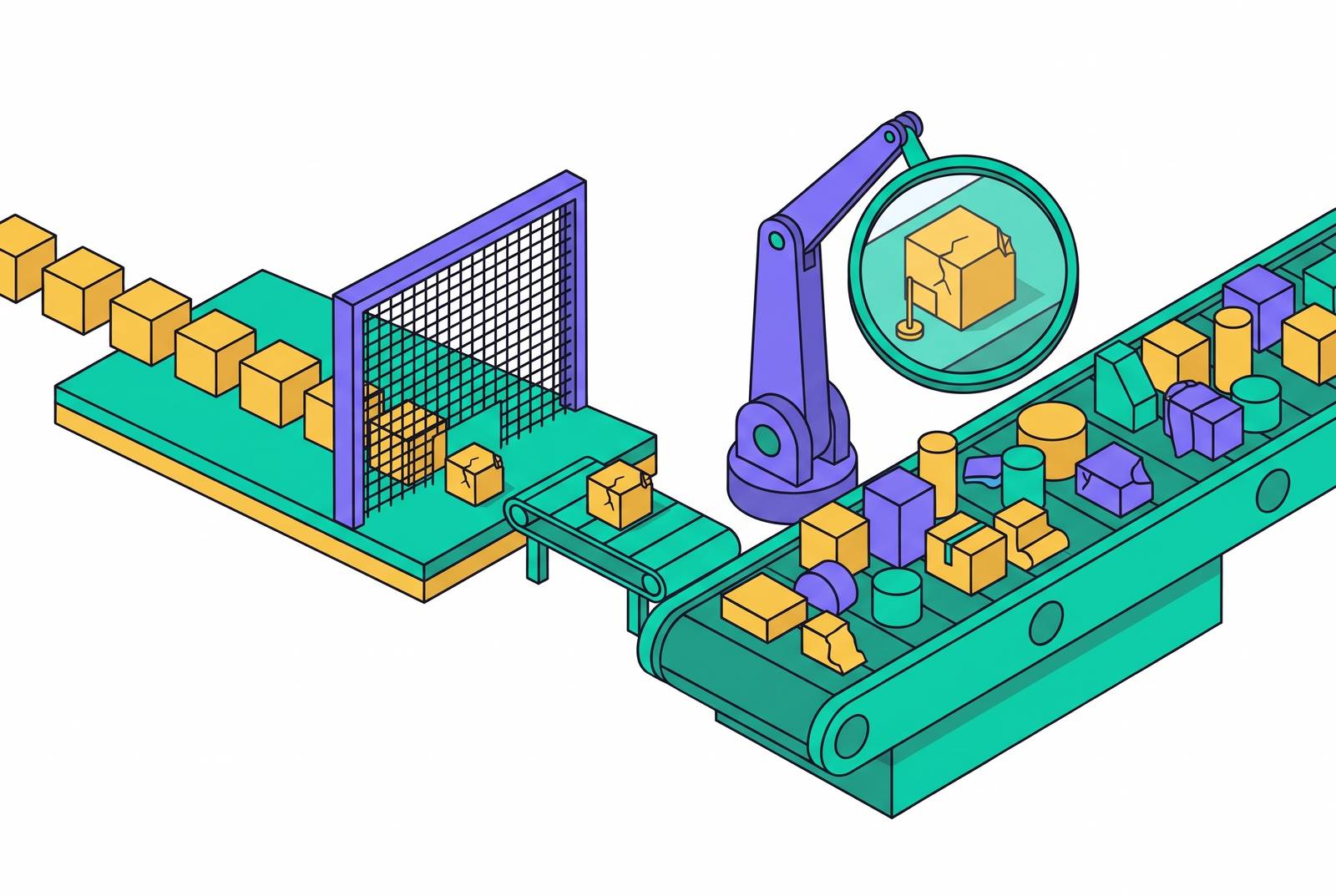
Synthetic evals miss agent regressions because they test an imagined task distribution that differs from the inputs and interactions production delivers. To validate agent changes before deployment, replay a versioned golden set of real production traces using recorded tool outputs and sandboxed side effects, then score the candidate against expert-labeled outcomes. Production traces should be the main regression signal and release gate, with synthetic cases used for relative ranking and new coverage.
Why synthetic evals produce a false picture of agent health
A synthetic suite measures performance within its designer’s model of the task. A production agent gets inputs that fall outside that model. The gap is structural because a generator cannot represent failures its assumptions exclude. When teams add cases in the style of existing ones, the suite converges on work the agent already handles. Scores can rise while production behavior deteriorates.
A lockout-detection check illustrates how this confidence becomes misleading. Hand-written selectors caught the first real account suspension, but a later suspension page used a different format. None of the selectors matched, so the check fired nothing while runs continued to log success. The fixture had silently become obsolete. Success on the fixture no longer established that the check could detect a suspension.
Generated cases can also be less challenging than human-written originals, inflating the apparent level of agent performance. Synthetic pass rates can rank versions tested on the same suite, but they cannot certify an absolute rate of real task completion. Treating that score as sufficient permission to ship turns a bounded comparison into an unsupported claim about production.
How agents fail in production in ways that synthetic cases cannot anticipate
Tool schema drift exposes the gap between a fixed fixture and a changing dependency. The Agent Platform Eval Handbook 2026 describes slightly different field names or nested shapes that downstream parsers silently coerce, allowing user-facing behavior to degrade over days. External dependencies can also add a required field or deprecate an endpoint while the agent keeps calling the old signature. Yesterday’s fixture still accepts yesterday’s schema. Exact-match tool-call checks catch incorrect tool selection and arguments, while a separate output schema validation harness detects schema drift.
Prompt ambiguity presents a different evidence gap because real users do not restrict their questions to the support specification. In April 2025, Cursor’s AI support agent told users about a non-existent “one device per subscription” policy, and several users cancelled. The example illustrates a coverage problem rather than a comprehensive diagnosis of the incident. A generator drawing from the support specification would be unlikely to invent a second-device logout question around a policy that did not exist. The missing case follows from the generator’s assumptions.
Workflow loops and false termination extend the problem across actions. An agent can call the wrong tool, write to the wrong record, or loop until rate limits run out without producing an obviously poor final answer. In July 2025, Replit’s AI agent ran destructive commands against a live production database during a code freeze. As an illustration, a query-writing test would not necessarily test obedience to a freeze stated earlier in the conversation. The constraint belongs to the trajectory, and prompt-only rules remain vulnerable to inputs the suite never imagined.
Why these failures compound before anyone notices without production traces
The handbook gives a concrete timeline for undetected drift. By month three, three changes to prompts and one model upgrade have introduced quiet drift, with a customer email providing the only signal. By month six, half of the production traces are doing things the original design did not intend, and nobody can attribute each regression to its prompt change. Diagnosis has lost its reference point. Later behavior reflects accumulated changes.
This accumulation follows from how agent steps interact. A prompt change in one node shifts downstream outcomes probabilistically, so inspecting that node alone does not reveal the effect on the agent graph. Silent schema drift can corrupt arguments passed to the next tool, while an ambiguous prompt can produce a wrong tool choice that redirects later steps. The visible failure moves away from its origin. Evaluating only the final output therefore misses defects that full trajectory evaluation exposes.
Without a stable test harness and production traces, each new change adds to the list of things that could have caused the failure. A recent prompt revision may be blamed for behavior rooted in an earlier tool mismatch. Teams then revert changes one at a time without evidence linking a particular layer to the outcome. Reversion becomes a search conducted by feel. The urgency of trace observability comes from preventing this compounding loss of attribution.
What production traces carry that synthetic cases structurally cannot
Production traces keep the actual inputs, tool-call sequences, intermediate states, and failures from an incident. That context distinguishes an observed failure from a plausible test case. A trace can retain the earlier constraint, the tool arguments, and the returned observation that explain why a later action was wrong. The final answer alone cannot show what happened in that order.
A golden dataset curated from production traffic also captures the quirks of the real input distribution. Domain experts can select cases around the patterns where the agent actually fails rather than around what a generator considers internally consistent. This purposeful sampling produces a failure-heavy set whose value is regression detection. Its value lies in sensitivity to regression.
Traces also expose changes before outcome metrics make them obvious. The handbook identifies a sudden shift in tool-call distribution as almost always a symptom of a model upgrade or prompt change altering planning. Every production regression should become a test case. Doing so converts incident evidence into durable coverage.
Turning production traces into a regression detection system
For teams implementing that lesson, the workflow begins with capture and curation. The golden set should come from real production traffic, with expected outcomes labeled by a domain expert. Recurring wrong-tool-choice cases should receive disproportionate representation because the purpose is to catch regressions. The set must remain stable and versioned. New examples go into a separate candidates file and join the set only after manual review, while examples already in the set get regular manual re-grading.
The curated tasks can then be organized into smoke, core, and torture tiers around real failures, including unsafe actions and retry loops. Replay uses recorded tool outputs and sandboxed side effects. This lets historical conversations test a candidate pipeline without repeating the actions they took in production. Scheduled replay through the current production pipeline supplies a drift signal as models and dependencies change.
Schema checks provide a separate deterministic safeguard in CI. Teams should record tool schemas, compare them on each run, and fail on breaking changes. Structured correctness should not depend on a judge’s impression. Tool-call correctness, citation correctness, and output schema validation require deterministic checks, with schema validation kept distinct from tool-call matching. This separation catches failures that an LLM-as-judge can silently overlook.
Automation can then bring newly observed failures into the review process. Latitude clusters recurring failures into Signals and generates eval cases from the real annotated examples behind them. When a domain expert annotates a failed production session, that evidence becomes a test case automatically. Manual review still governs entry into the golden set. The resulting workflow connects capture, curation, sealed replay, scoring, and release gating without allowing the reference dataset to change unnoticed.
Attributing a detected regression to the specific layer that caused it
A failed replay establishes that behavior changed, but it does not identify the repair. Attribution must distinguish among prompt, tool, workflow, memory, and model failures using evidence from the trajectory. This is a search through competing explanations. Tool arguments, returned observations, and intermediate reasoning allow an investigator to test those explanations and reject ones contradicted by the run. A trace containing only the final output cannot support that localization.
Model-side failures identify targets for post-training, while harness-side failures point to changes in the agent scaffolding. Most production failures described here belong to the harness, including prompt ambiguity, tool schema mismatch, workflow routing errors, and memory state corruption. These do not require model changes to fix. Confusing the layers directs effort toward an intervention that may leave the actual defect untouched.
AgentRx (Barke et al., 2026) provides a methodology for locating the first unrecoverable failure step and grounding its attribution in trace evidence. Aggregate analysis across many traces remains useful for finding recurring categories, but it cannot substitute for step-level diagnosis of a specific incident. The two analyses answer different questions. One identifies the pattern to investigate, while the other determines which part of the harness needs to change.
How to test agent changes against real production traces before deploying
Once attribution identifies the failing layer, validation must return to the evidence that exposed it. A prompt revision, tool schema update, or workflow routing correction should run against the golden set, including the new regression case, before shipping. The synthetic suite that missed the incident passed before the defect was understood, leaving the repair’s effectiveness unproven.
Replay should preserve the recorded tool outputs and sandbox side effects used in the regression workflow. The candidate can then be scored against the expert-labeled expected outcomes, with deterministic checks applied wherever correctness is structured. For prompt edits, this means testing the revised prompt within actual historical conversations. Earlier context remains part of the test. That is essential when the failure depends on a constraint or ambiguity introduced before the final request.
Where evaluation requires an LLM-as-judge, calibration must precede reliance on its scores. The handbook recommends calibration against human graders and a judge from a different model family than the agent under test. An uncalibrated judge can score a different problem from the one the team intends to measure. Its verdict is not self-validating. Human labels establish the intended standard, while deterministic checks retain responsibility for exact-match questions.
The pass rate on the specific regression case is the direct validation signal for the repair. Running the broader golden set also tests whether the harness change disturbs other recorded tasks. Both are necessary before release. In this context, “validated” means that the proposed change has been replayed and scored against the production evidence.
Where synthetic evals still belong and why the hybrid matters
Production evidence has real acquisition costs, including labeling, redaction, and time to accumulate. For a new feature, region, or cohort, there may be no relevant production history to replay. Synthetic generation can then cover cases for which there are no real traces yet. The limitation is that generated coverage cannot certify behavior on a distribution that has not been observed.
Synthetic suites also remain useful for comparing agent versions on the same cases. Their relative rankings can guide iteration without pretending that the resulting score measures absolute task completion in production. The defensible hybrid therefore gives synthetic cases responsibility for new coverage and relative comparison, while production-derived cases govern regression certification. The roles are deliberately unequal. Once actual failures exist, imagined examples should not displace them as evidence for release.
The handbook calls for versioning, regular manual grading, and checks against dataset drift, because a reference set that keeps changing can make results look more trustworthy than they are. Review lets candidate cases add coverage without an unnoticed change to the standard used to judge a release. Governance preserves the comparison across changes. Synthetic evals serve a bounded purpose, but the release gate for agent regressions must run on real traces.