Scorecard for Selecting Replay Eval Tools When Production Trace Fidelity Is Non-Negotiable
A four-point checklist for choosing replay tools that actually prevent regressions.
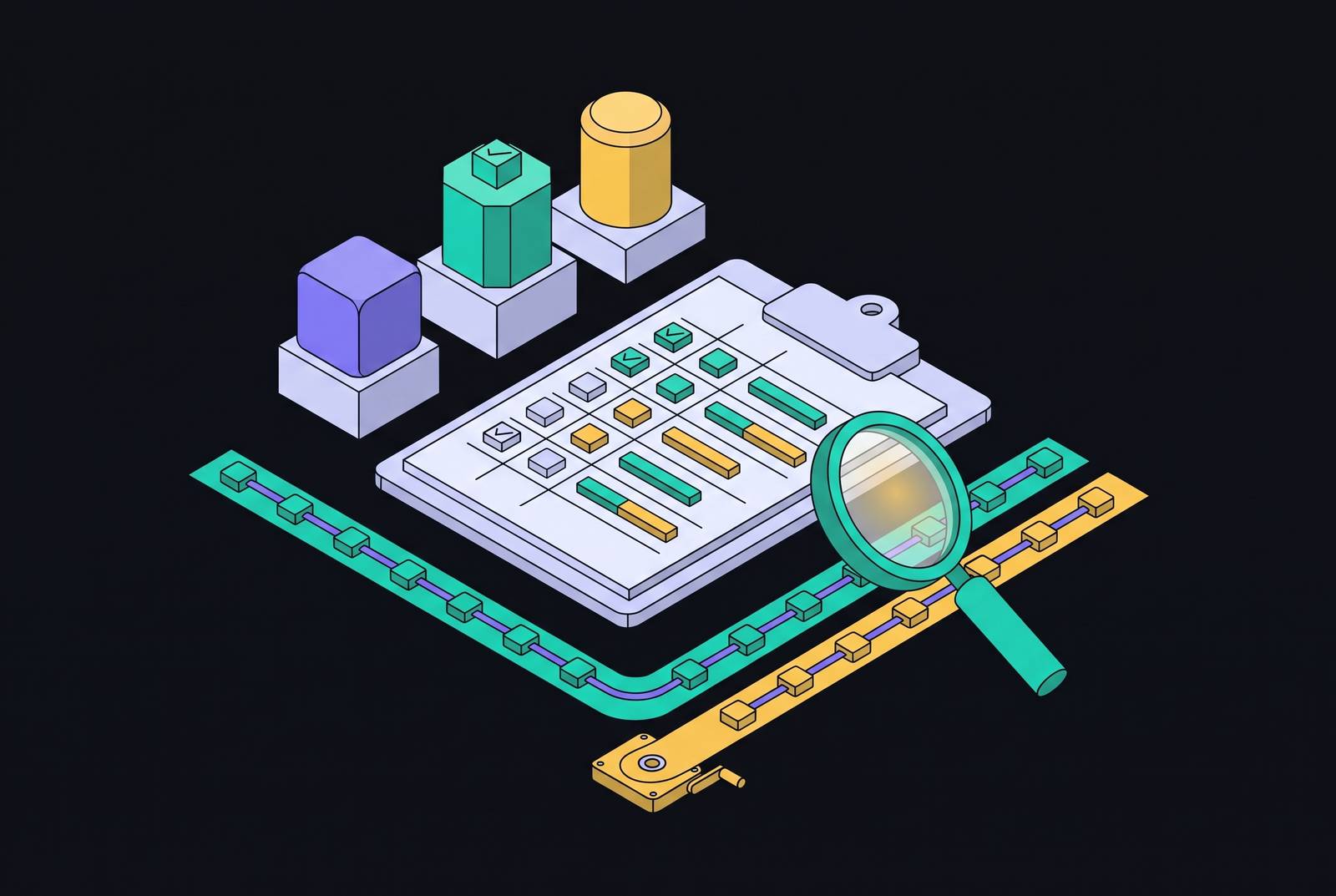
Replay-based evaluation tests changes to an agent against recorded production traces before the changes go live. A useful scorecard requires four capabilities, namely complete traces, deterministic boundary control, specific root-cause attribution, and validated-before-ship workflows. The practical sequence is to capture production runs, curate regression cases, replay with controlled boundaries, score the results, and gate releases. Without all four capabilities, replay may give teams a costly way to view traces without a way to make releases more reliable.
Why replay eval is a distinct discipline from tracing and from offline evals
Tracing shows what happened during a production run. Offline evaluation asks whether one version beats another on a dataset. Replay evaluation asks whether a recorded incident can be re-executed under changed code or harness conditions, scored consistently, and used to block a regression. A trace can expose every step of a failure without proving that a proposed fix changes its outcome.
Dataset-driven evaluation has a different limit. It can compare outputs but miss the tool trajectories, side effects, and state contamination that production runs reveal. An evaluation harness joins task runs to production trace and span IDs, serves recorded tool outputs in a sandbox, applies explicit scoring rubrics, and enforces CI gates. That connection makes a historical incident usable as evidence about a future release.
Why production trace fidelity is the foundation every other criterion rests on
A replay inherits every gap in its recording. If a memory read or tool response is missing, the replay is a reconstruction rather than a reproduction, and its validation result inherits that uncertainty. In multi-step agents, a missing event can obscure the cause of later reasoning errors even when the final-output check reports success. Completeness therefore precedes replay, attribution, and validation. None can recover causal evidence that was never captured.
Complete capture requires structured records at every layer the agent touches. Every model invocation needs prompt tokens, cached tokens, completion tokens, and reasoning tokens. Each tool call needs a record of the payload it returned, and memory reads and writes need records of their own. Decision branches need their causal antecedents. Step-level timing and parent-child span relationships must preserve the execution structure across the workflow, rather than flattening it into disconnected log entries.
The scorecard should require span-per-tick tracing with stable, portable identifiers. The trace ID must connect the production incident to its offline replay run as a join key. Portability is part of that requirement. Teams should look for OpenTelemetry GenAI export as a baseline so evidence about an incident can move between tooling layers and keep its identity.
Deterministic replay at non-deterministic boundaries — the hardest requirement to satisfy
Running a trace again against a live model does not test a code change on its own. Model responses vary, tools read changing state, and a different intermediate result can redirect the remaining trajectory. A changed outcome is therefore ambiguous. It may come from the proposed fix or from a change in the execution environment. Rigorous replay records non-deterministic boundaries as immutable envelopes and serves selected boundaries from that record.
Chronicle’s paper, “Chronicle: Cut-Point Replay for Regression Testing of LLM Agents,” presented at REALM 2026, describes a mechanism for this separation. Cut-point replay serves a chosen subset of boundaries from the recording while the complementary subset executes live against new code. Its full replay is bit-stable across 20 repetitions and issues zero model calls. Cut-point tests fail when the code is faulty and pass when it has guarded fixes.
However, the paper evaluates deterministic simulated boundaries. It does not establish that truly non-deterministic production LLM calls have been controlled in the same way. Vendors should demonstrate that capability rather than invoke deterministic replay as a general assurance. A tool that serves every boundary from storage proves that the recording is stable, but it cannot test what a prompt edit changes. The changed behavior must actually execute for its effect to be evaluated.
Workload replay addresses a separate engineering question. Replaying captured LLM traffic against different serving configurations or hardware requires full output fidelity from the record, rather than selective execution for code-change regression. Teams should identify which problem they are evaluating. Evidence for one does not establish fitness for the other.
Root-cause attribution specificity — why knowing a run failed is not enough
Reproducing a failure does not identify its cause. The error may become visible in the trajectory several actions after the defect, and the evidence that explains it may be spread across the trajectory. Useful attribution must name the originating layer, such as prompt, tool, workflow, memory, model, or product logic. It must also provide evidence, confidence, and a proposed fix direction. A pass/fail verdict alone leaves that investigation to the engineer.
Tool schema drift shows why detecting exceptions is not enough. A call can execute, return data, and be logged as successful while its response is semantically wrong. Attribution must compare the returned schema with the expected schema. Prompt ambiguity creates a different diagnostic trap. An underspecified instruction can look like model incapability, leading a team toward a model upgrade when a prompt correction is needed.
Workflow loops require another distinction within identical symptoms. An agent that cannot recognize task completion and a harness with a buggy exit condition can both continue indefinitely. Their fixes belong to different layers. One-shot LLM judges can settle on an early plausible diagnosis and leave later evidence unexamined, which motivates multi-turn or structure-guided investigation. The scorecard should therefore test a failure whose cause precedes its symptom by three steps and require attribution to the originating step.
How to test agent changes against production traces before deploying
A validated-before-ship workflow begins with a failed production run captured in full and tagged for replay. It then produces a concrete, reviewable change to a prompt, tool schema, workflow exit condition, or memory read. Diagnosis alone does not close the loop. The proposed change must run against the historical incident through cut-point or equivalent replay, with its result compared against the recorded failure and checked for regressions.
The validated change must then become enforceable in CI. Converting the failed trace into a permanent regression case protects later releases from the same defect. Accuracy is only part of that gate. Agent validation also needs step budgets, tool error rates, latency, cost caps, and safety constraints, because a correct answer can still exceed the conditions under which the agent is fit for production.
Reviewability applies to every change entering this workflow. Engineers need to inspect prompt edits, schema corrections, and workflow logic changes before they are applied. An unauditable auto-fix cannot support a defensible postmortem or maintenance across team members. The scorecard should distinguish a report from a closed loop. A generated fix qualifies only when historical replay supplies evidence for it and CI preserves that evidence as a release constraint.
How to run a structured evaluation of candidate tools against the four criteria
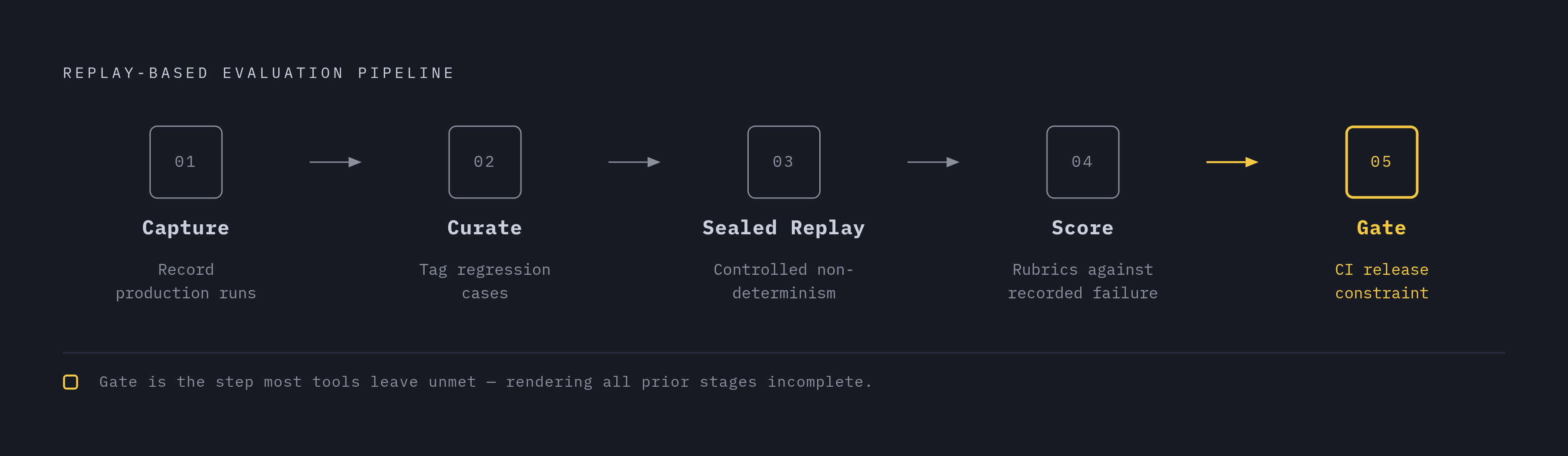
For the practical evaluation, start with a production incident the team has already investigated. Use that incident to test each criterion against a known causal chain. Keep the exercise bounded enough to run in a day. The working sequence is capture, curate, sealed replay, score, and gate, with explicit checks at each transition.
For trace completeness, feed the candidate a multi-step run containing at least one tool call, one memory operation, and one branching decision. Inspect every span and its parent-child relationship, then check the trace ID’s stability and portability through OpenTelemetry GenAI export. Check that every model invocation has the required token detail. Missing memory spans are a failure. So are tool payloads collapsed into a log line that cannot support faithful replay.
For deterministic boundary control, record the incident and replay it twice without changing code. Outputs should be bit-stable when boundaries come from the recording. Then mutate one tool and replay again. The test should fail on the mutant and pass on the original, demonstrating a regression signal beyond snapshot comparison. Ask which boundaries run live and which return recorded outputs, especially when testing prompt changes.
For root-cause attribution, present a case whose error appears at step N but originates at step N-3. Require the originating layer, supporting trace evidence, a confidence level, and a fix direction. A symptom label is not enough. Schema drift and prompt ambiguity are useful cases because neither necessarily produces an exception at its source. Judge whether the evidence establishes the causal chain.
For the validated-before-ship workflow, follow the case beyond diagnosis. Require a fix that can be inspected, replay validation against the historical trace before the fix is recommended, and a CI gate built from the validated case. Check that engineers can review generated changes before application. An auditable change log is the minimum bar. If the demonstration ends with a report or recommendation document, this criterion remains unmet.
Where the leading tools land on the scorecard today
The named tools focus on different parts of this workflow. Their described capabilities support a shortlist by requirement. A missing capability description is an evidence gap. It should prompt a demonstration during evaluation rather than a claim that the product cannot provide it.
Langfuse emphasizes trace completeness, open-source self-hosting, online evaluations, and prompt management. ClickHouse acquired it in January 2026, adding columnar storage for high-volume trace retention. Native validated-before-ship CI gating needs separate evidence before receiving credit on the scorecard.
Arize Phoenix / AX requires a tier-sensitive assessment. Teams need the commercial tier for advanced attribution and validated-before-ship workflows, so those testing the open-source tier should expect gaps on those criteria. Confident AI takes an evaluation-first approach to observability. It is strong in production-to-eval pipelines, quality workflows that span teams, quality-aware alerts, and a production-to-development feedback loop. Deterministic replay at non-deterministic boundaries is not described as a core capability.
Latitude turns production failures that keep happening into Signals and uses a connected coding agent to open fix PRs. Its Agent Dispatch feature uses Claude Code or Cursor for those PRs. But the description does not show whether replay validation against historical traces takes place before the PR opens. That distinction separates a proposed correction from a recommendation already supported by replay evidence.
What to do when no single tool covers all four criteria
The field divides broadly between trace-first and eval-first approaches. Trace-first tools focus on looking into failed runs one at a time, while eval-first tools focus on quality drift and production-to-development feedback. Few of the described tools demonstrate all four criteria in one workflow. A two-tool composition is therefore a legitimate short-term approach, provided its join mechanism is explicit. The trace ID must remain stable across the tracing and replay layers.
To make that composition workable, instrument span-per-tick tracing from the start and tag spans with business-level metadata, including user ID, workflow ID, and session ID. Those tags preserve context as traces cross tooling boundaries. Cost control then depends on selecting appropriate regression tasks. Smoke tasks run on every pull request for critical cases, core tasks run on merges and nightly for main trajectories, and torture tasks run daily or weekly for adversarial cases and compound failures.
The tier appropriate to a change should determine its replay workload. Coverage must follow trajectories because failures build on one another across agent steps, which broad use-case categories do not capture. There must be a golden task for each tool-selection boundary, multi-tool composition, unsafe tool denial case, and recovery path. Corrections must also become shared team knowledge. A prompt fix that stays with one engineer, rather than entering the golden task set and CI gate, leaves the same failure available for rediscovery.
Using the scorecard as an ongoing engineering standard, not a one-time purchase decision
Tool selection establishes capability, while the discipline to use it requires ongoing engineering work. Trace completeness requires maintained instrumentation, while deterministic replay requires deliberate recording of non-deterministic boundaries. Attribution requires a shared taxonomy of prompt, tool, workflow, and memory failures. Validated-before-ship workflows require durable CI gates.
The ongoing standard is evidence of changed behavior. Every diagnosed production failure should strengthen the regression set, and every correction should be available to the team beyond an incident report. Gates should never disappear without an explicit team decision. For every resolved failure, the team should be able to show the trace, the reviewable fix, the replay result, and the CI gate that prevents recurrence.