When Your Agent Is Down and the Workflow and Memory Layers Are Both Suspects
Trace backward from the visible failure to tell workflow faults from memory faults.

AI agent failure attribution by harness layer means telling apart an error that starts in a workflow step and one that comes through memory. The method is to work backward from the visible failure, compare each step’s context with upstream writes and instructions, and test its action against those inputs. A plausible diagnosis becomes actionable only when competing origins have been challenged and a replay validates the targeted fix.
Why workflow and memory failures look identical from the outside
An incorrect tool output, a stalled loop, a contradictory response, or a premature completion claim can implicate either workflow or memory. The symptom does not identify the responsible layer. A workflow step consumes memory context, so stale context can make otherwise correct execution look broken. Conversely, a broken workflow step can write bad state into memory, making a later read appear to be the origin.
AgentDebugX identifies this separation between where an error starts and where it becomes visible. A stale retrieval, invalid intermediate assumption, or incorrect handoff can precede many apparently reasonable actions before producing a wrong answer. Changing the wrong layer can obscure that history. A supposed repair may alter the execution path and make the original failure harder to reproduce.
Why root-cause attribution across layers is harder than it looks in a trace
LongRCA Bench found that reference root-cause steps in its annotated failed trajectories precede task completion by a median of 48 recorded steps. More than a quarter contain over 100 subsequent steps. Across that distance, an early error can persist while the evidence explaining it disperses across instructions, observations, and handoffs. An action tied to the failure may thus pass on an error that started elsewhere.
TelemetrySuffBench exposes a separate limit in the evidence available to the diagnostician. Its Metadata, telemetry-standard-compatible, and inference-standard-compatible views detect failures almost perfectly, but their origin-step accuracy is at most 0.5%. Detection and localization require different evidence. When decision content is removed, origin-step accuracy falls to zero for every model tested, while removing provenance causes large drops that vary by model.
Scale AI’s RCA research treats attribution as a search problem in which competing explanations must survive contradictory evidence. A single reading is not enough. One-shot LLM judgments can settle on a plausible explanation while leaving critical evidence in longer traces unexamined. For an engineer, the first plausible origin is a hypothesis that requires further upstream inspection before changing the implicated layer.
What workflow layer failures actually look like in a trace
A workflow-origin failure starts when a step transition, tool call, or routing decision adds an error even though the context it receives is internally consistent. In a trace, the memory read immediately before the candidate step is correctly formed and current. The next action breaks that consistency. The agent may generate an argument that does not exist in the tool registry or API surface, or route execution to the wrong sub-agent or conditional branch.
In schema drift, the tool’s response structure has changed since the harness was built to work with an older version. The agent keeps making calls against the old schema without an error signal. The decisive comparison is between the expected schema and the actual response. A loop can also fail to stop because its guard expects something missing from the tool response or environment observation.
TRAJDEBUG distinguishes critical errors from local errors that are repaired or remain harmless. The first anomaly is not necessarily the origin. Nor is the error closest to the final failure necessarily responsible for it. Silent continuation makes this distinction especially important, because an LLM can improvise around a broken tool response and continue with corrupted context. By the time the failure surfaces, the workflow fault may already have seeded a memory problem.
What memory layer failures actually look like in a trace
A memory-origin failure is already present before the candidate step acts. The context it receives is malformed, stale, or poisoned, but its tool call or routing logic is well-formed for those inputs. For stale retrieval, the engineer compares the returned value with a later tool result or environment observation that the agent already processed. The read timestamp or retrieval key helps expose the mismatch.
Context accumulation creates a related signal when an outdated or conflicting entry displaces a more recent one during retrieval. Poisoned observations require a different backward search. An untrusted document, webpage, or repository file may have entered memory earlier and now be steering behavior, although the original write looks innocuous in isolation.
Handoff corruption places that investigation at an agent boundary. A context packet omits required state, and the receiving agent operates on an incomplete view. Its apparent reasoning failure is an information-loss error. The packet before consumption is therefore central evidence, as is the link between a memory read and the value bound into context. Without that provenance, a corrupt retrieval cannot reliably be distinguished from a correct retrieval followed by a bad decision.
A trace-driven isolation procedure for separating the two suspects
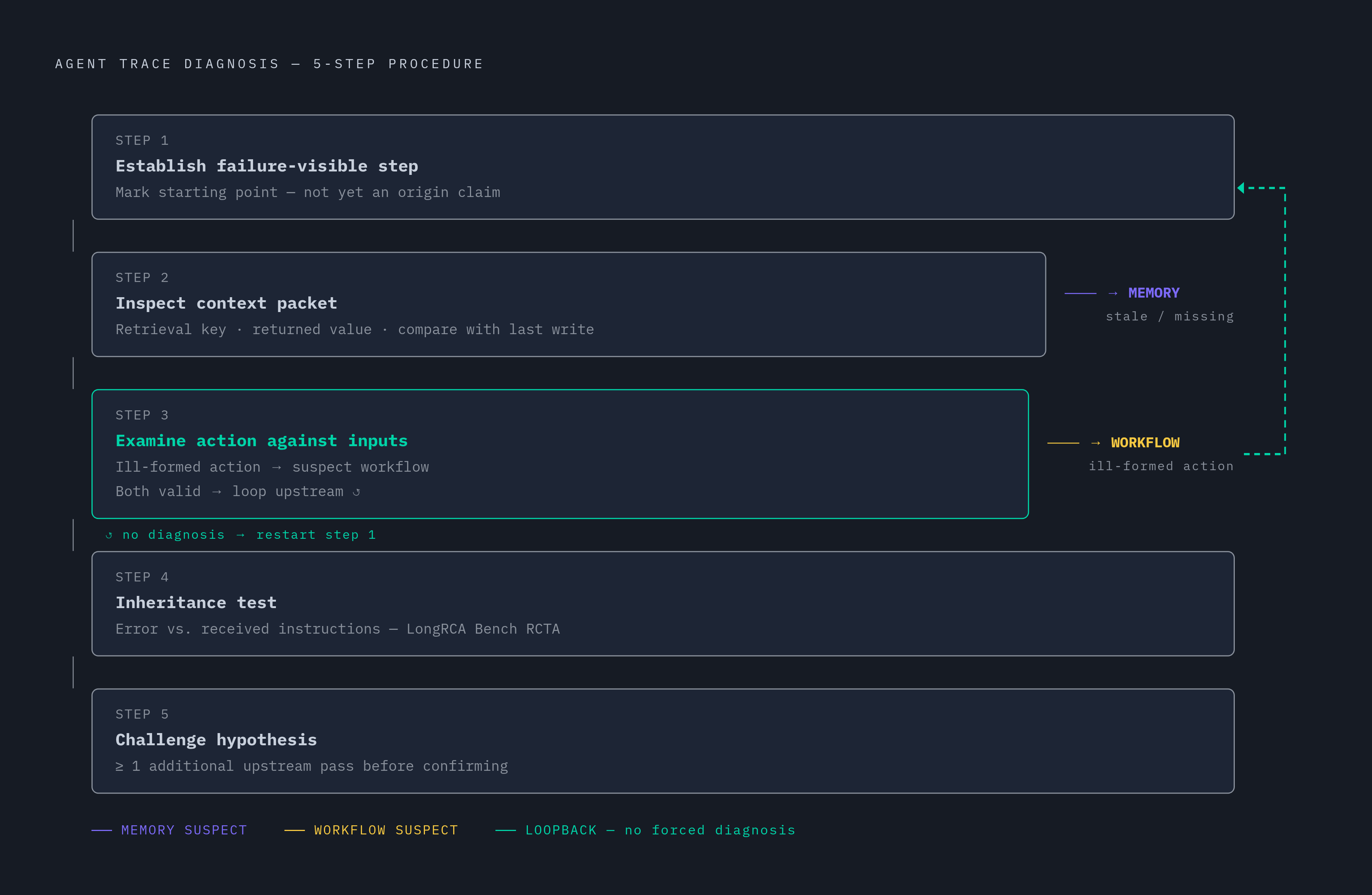
Step 1 establishes the failure-visible step. The engineer identifies where the wrong output or stall first became observable and marks it as the starting point of the backward search. This is not yet an origin claim. The distinction keeps a downstream symptom from becoming the default diagnosis merely because it is easy to locate.
Step 2 inspects the context packet that step received. The memory read must be examined for its retrieval key and returned value, then compared with the most recent earlier write to that key. Well-formed, current context provisionally clears memory at this point. If the context is stale, missing, or inconsistent, memory is the suspect, and the engineer must fully check the memory layer before changing workflow logic.
Step 3 examines the action against those inputs. The engineer checks whether the tool argument follows correctly from the cleared context, whether the response matches the expected schema, and whether routing or loop guards evaluate the actual output correctly. An ill-formed action or malformed response implicates workflow at that step. If both action and response are valid, the search moves upstream by one step and repeats rather than forcing a diagnosis at the current location.
Step 4 applies the inheritance test to the candidate origin. The engineer compares the error with the instructions that the step received: execution either introduced the error or followed an error already present in those instructions. LongRCA Bench’s RCTA method makes this distinction explicit. This test keeps workflow from taking the blame for a wrong action when the error was already in an upstream handoff instruction.
Step 5 challenges the standing hypothesis with at least one additional upstream pass. The engineer searches for evidence that contradicts the candidate origin rather than stopping once the trace seems explainable. Decision content and links between retrieved values and bound context are prerequisites throughout this procedure, because missing causal evidence cannot be supplied by confidence in the diagnosis.
When the trace alone is not enough to close the diagnosis
Some traces cannot support a unique attribution. The evidence may be sparse, spread across distant steps, or genuinely symmetric between candidate origins. TelemetrySuffBench constructs exact-equal ambiguous origin pairs and finds that most evaluated models still answer confidently. Evidence gating reduces that behavior but does not eliminate it for all models. LongRCA Bench also reports that, even with RCTA, fewer than one quarter of reference root-cause steps are recovered exactly.
AgentDebugX’s DeepDebug component addresses difficult cases through multi-turn diagnosis. It combines global trajectory understanding, structure-guided investigation, and cross-examination to produce an auditable root-cause report with evidence and a recommended fix. Scale AI’s Continual Search similarly pushes the diagnostic judge to keep investigating unresolved evidence over successive turns. The framework shows that lower-tier models using iterative search can surpass higher-tier models using single-pass judgment.
When the available evidence remains symmetric, the correct output is “insufficient evidence to attribute,” accompanied by the additional trace fields needed to resolve the ambiguity. The missing evidence might concern the handoff input, the retrieved value, or its provenance, depending on the unresolved comparison.
What the trace must record for this procedure to work in practice
For teams instrumenting a new agent or auditing an existing one, the procedure defines a focused pre-incident requirement. Every step needs decision content, including what the model decided and why, alongside the resulting action. Every memory read also needs provenance that links the retrieved value to the context it fed into. Action logs alone leave that comparison incomplete. Standard telemetry views can still detect failures, but a trace with those views may lack what is needed for layer attribution.
At each agent boundary, a shared trace ID must continue across the handoff. The trace must also capture the full context packet before the downstream agent consumes it, so the inheritance test can compare received instructions with subsequent behavior. Memory reads need their retrieval key, returned value, and a timestamp or version marker for comparison with the latest earlier write in the session. These fields make input integrity directly testable. AgentDebugX provides a framework-agnostic trace format that supports re-analysis and comparison across runs, rather than tying that evidence to its originating framework.
Recording full decision content adds overhead, so the notes separate cheap triage fields from the richer evidence needed to find the cause. Status codes, schema validation results, and retrieval keys should always be recorded. Full decision content can be sampled or gated to runs already flagged as failures. That trade-off has a diagnostic limit, however. A run without the required decision evidence cannot support the same attribution procedure as a fully recorded run, and sampling does not remove that constraint.
Closing the loop from diagnosis to validated fix
A confirmed layer diagnosis narrows the repair but does not complete it. Schema drift, bad routing, or a loop guard error calls for a scoped harness change. Stale retrieval, poisoned context, or handoff loss calls for a targeted memory policy or write-ordering fix. Neither necessarily requires changing the model itself.
Replay is the test of that targeted change. A workflow repair should be tested against the original failing trace with the corrected harness and recorded tool results, without live API calls or side effects. A memory repair should replay the session with corrected retrieval logic and verify that the previously failing step now receives well-formed context. AgentDebugX’s Detect–Attribute–Recover–Rerun loop connects diagnosis to this validation. Recovery produces a concrete retry directive, and rerun tests the changed execution path for resolution of the attributed failure.
The resulting change must also be reviewable against its evidence. Engineers need to inspect what changed, why that layer was selected, and what the replay established before approving or rolling back the repair. This is especially important when both layers are implicated. A correction in one can expose or alter a latent issue in the other, so validation must preserve the distinction between the original cause and its downstream effects. A defensible fix closes that causal chain, from the context a step received to the behavior the corrected harness produces.
Sources
- Root-Cause Attribution Is a Search Problem: Continual Search for Long-Horizon Agent Failures
- TelemetrySuffBench: Is Agent Telemetry Sufficient for Failure-Origin Diagnosis?
- LongRCA Bench: Root-Cause Localization in Long-Horizon Agent Trajectories
- TRAJDEBUG: Tracing Error Lifecycle to Identify Critical Failures in Long-Horizon Agent Trajectories
- AgentDebugX: An Open-Source Toolkit for Failure Observability, Attribution, and Recovery in LLM Agents