Prompt and Tool Definition Change Detection Using Trace Diff Signals
Trace diffs reveal prompt and tool regressions that final answers hide.
To test agent changes against real production traffic before deploying, replay a corpus of recent production traces against the candidate harness and current tool APIs, then compare route-aligned cohorts with a stable baseline. Prompt and tool definition change detection depends on trace diffs because final answers hide changes in the steps that produced them. Evaluator score distributions drive alerts, and a fix still needs human review before it ships.
Why final-output monitoring fails to detect harness-layer regressions
The incident pattern begins with a 4pm deploy. A prompt changes, responses get slightly worse, and support tickets arrive before monitoring shows trouble. HTTP status is 200, latency looks normal, and answers remain well-formed. Nothing raises an exception because the failure is in the agent’s decisions. In one observed deployment, agent groundedness fell by 12% after a prompt change without raising exceptions.
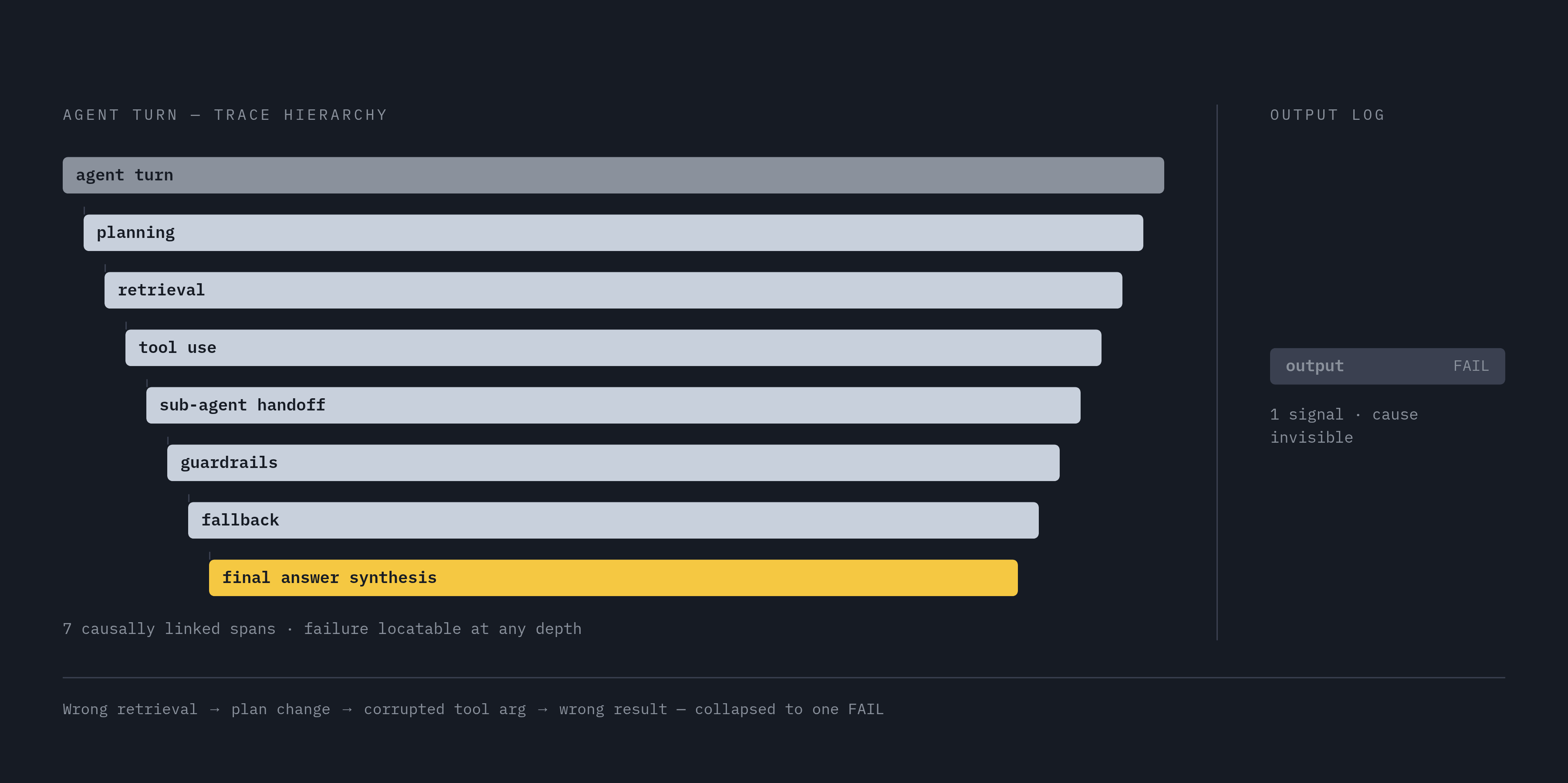
Final-output monitoring collapses a multi-step decision chain into a single pass/fail signal. An agent turn may include planning, retrieval, tool use, sub-agent handoff, guardrails, fallback, and final answer synthesis. An answer diff cannot locate which step changed. Even when an output evaluator detects lower quality, it cannot show whether the agent retrieved the wrong material, chose the wrong tool, or misread a valid result. That gap makes quality drift a monitoring problem rather than something a team can discover by waiting for a stack trace.
What a trace actually contains that an output log does not
A production trace records harness decisions as spans linked by parent-child relationships. Those relationships preserve causality as well as sequence. A wrong retrieval can change a plan, which changes a tool argument, which corrupts the result. Wall-clock timestamps show when these events happened, and the span hierarchy shows how they connect. A flat output log loses the chain needed to distinguish an initiating failure from its downstream effects.
Each span also preserves the evidence relevant to its layer. LLM spans contain model and prompt information, token counts, latency, and finish reason, while tool spans contain the tool name, arguments, return value, and timeout or error information. Retrieval spans record queries, returned chunks, and sources. Planner steps, sub-agent handoffs, guardrails, and fallback paths extend that record beyond model calls.
OpenTelemetry GenAI semantic conventions define attributes for model, prompt, response, tokens, and finish reason. These conventions remain at Development, or experimental, status. They provide a shared vocabulary for making LLM traces portable across backends and comparable across deployments, but they are not yet stable. That distinction is important when a team relies on consistent attributes to compare harness versions.
What trace diffs actually surface when a prompt changes
A prompt edit first changes the instructions presented in an LLM span. Its effects then propagate through downstream decisions. The agent may select another tool because the revised instructions change which tool appears appropriate for the task. It may form different arguments, issue different retrieval queries, or take more steps before answering. Comparing span names, arguments, and relationships exposes those changes separately from the final response.
Span-shape drift captures changes in count, order, or nesting. A narrower prompt may eliminate a retrieval step, while an ambiguous instruction may introduce a clarification request. Token and latency deltas add another diagnostic dimension. Growth in input tokens can point to too much context, growth in output tokens can point to a change in reasoning style, and a change in p99 latency can flag a fallback path that has just come into use. None of these changes alone establishes that quality declined.
Changes in evaluator scores link changes in what the agent does to changes in its results. TrajectoryScore, TaskCompletion, and step-level faithfulness scores attached to spans can decline before user-facing quality metrics move. Correlation makes the signal stronger than any isolated field. A changed span, higher cost or latency, and lower evaluator scores in the same cohort together identify a more credible regression. Escalation rates or abandoned workflows can provide a corresponding user proxy when the change reaches production.
What trace diffs surface when a tool definition changes
Tool schema drift changes a different part of the contract. The agent reasons from a tool’s schema without knowing whether the API behind it has changed. When that description no longer matches live behavior, the tool call may still succeed while the outcome becomes wrong. Individual spans can therefore appear healthy despite the failure. An upstream API change can happen without a team deployment, so deploy-correlated monitoring can miss it, unlike a tracked prompt edit.
Argument-structure diffs expose discrepancies between what the agent sends and what the live API expects. These include field-name mismatches, missing required fields, and type coercions the agent invents to compensate. A successful HTTP response does not resolve those discrepancies. Comparing pre-change and post-change cohorts shows whether the argument pattern shifted, while the live API contract establishes whether the fields remain valid. This separates a schema mismatch from a prompt-induced change in tool choice.
Return values require a separate comparison because an unchanged call can deliver semantically different data. A response-shape change alters the content entering the LLM span that processes the result, potentially contradicting what the system prompt described. Embedding distance across tool-output cohorts can flag that shift.
Three workflow loop signatures that trace diffs catch before anything else does
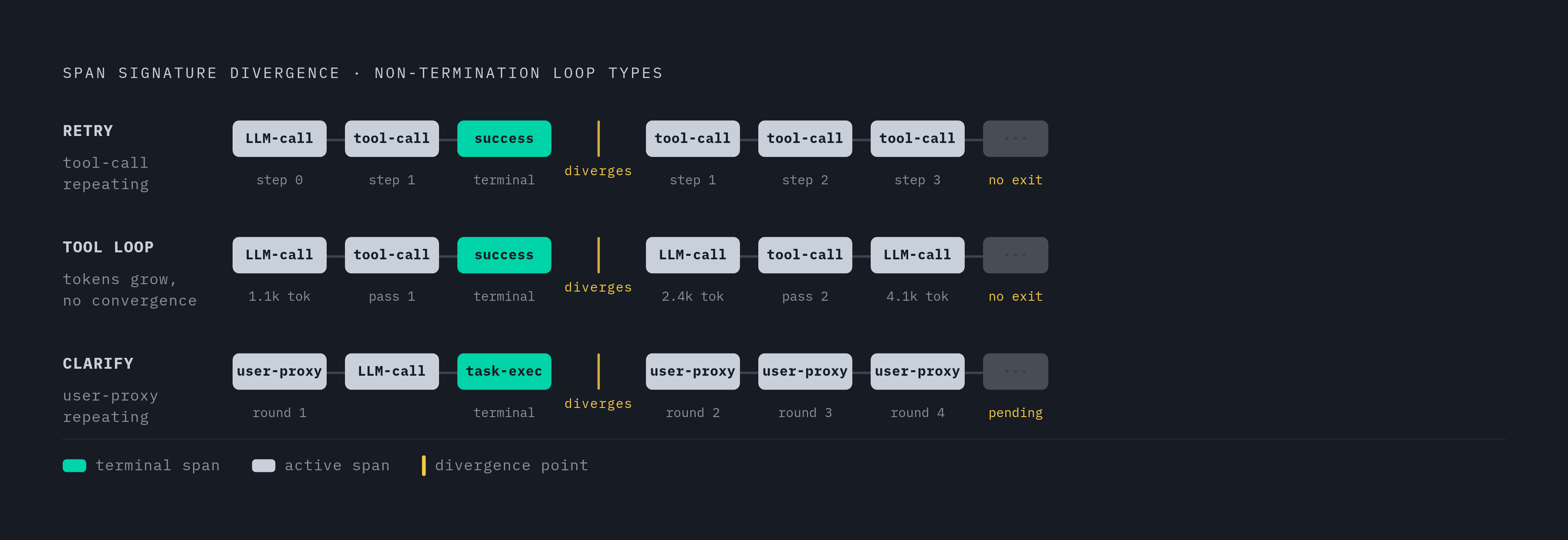
A retry loop appears as repeated tool-call spans with incrementing step indices and no terminal success span. A test fails, the agent edits a file, and the failing test prompts another edit. The repeated sequence is the diagnostic evidence. An output log cannot show where the run should have stopped, especially when the workflow never reaches a final answer. A known-good trace of the same task supplies that missing termination point.
A tool loop instead alternates LLM-call and tool-call spans without converging toward a final answer. This can follow an instruction to use tools when needed that never defines “needed.” Context grows with each pass through the loop. Prior tool outputs accumulate, increasing input tokens as the agent continues calling tools. A clarification loop has a different signature, repeating user-proxy interaction spans in which the agent asks another question after receiving an answer and leaves task action pending.
These distinctions prevent an expensive category error during diagnosis. A harness control-flow bug and a model that cannot recognize completion can both produce non-termination, but treating one as the other wastes a diagnosis-fix-validate cycle. The structural divergence identifies where investigation should begin. Where the successful trace ends, the looping trace starts another iteration. Comparing that divergence across versions shows whether the loop followed a specific harness change or already existed on the workflow path.
Why comparing cohorts rather than individual traces is what makes the signal reliable
A single trace diff supplies a hypothesis of regression that requires further evidence. Non-determinism produces differences even on the same input. To detect regressions, teams need to align cohorts by route, intent, or tenant before comparing baseline and candidate behavior. A model swap can improve simple chats while degrading high-value workflows, so an overall average can conceal both effects. Segmentation preserves the distinction between changed traffic composition and changed behavior within a task.
A stable pre-change cohort is the reference for those comparisons. Retrieval-query embedding distance measures changes in content, span-sequence metrics measure changes in behavior, and LLM-as-judge scores measure changes in output. Score distributions are more useful than isolated bad outputs. Alert thresholds tied to evaluator scores linked to service-level objectives distinguish harmful changes from expected changes caused by caching, routing, or prompt versioning. The stronger alert combines evaluator movement with a structural change in the same segment.
Sampling must preserve the runs most likely to reveal failure. Tail-based sampling that keeps all failures and some successful runs saves the evidence needed for debugging while limiting how many traces are kept. Failed and canceled traces remain in scope. Dropping them would remove precisely the runs needed to detect non-termination or a broken workflow path.
How to test agent changes against production traffic, from versioned harness to diff-triggered alert
The implementation sequence starts with versioning every harness artifact. Every prompt edit needs an immutable version, and every tool schema change needs an identity that can be tracked. Each trace must resolve to those exact versions. Without that link, an alert identifies deteriorating behavior but gives the engineer no specific revision to inspect. Versioning also provides the address needed to connect a flagged cohort to a rollback or targeted fix.
The next control is instrumentation across every harness layer. LLM calls, tool calls, retrievals, planner steps, sub-agent handoffs, guardrails, and fallback paths each need typed spans with consistent attributes. Coverage determines what the diff can explain. Recording only model calls leaves out steps where routing, tool execution, or fallback behavior may have changed. The conventions provide the development-status attribute vocabulary for LLM spans, while mature implementations also support agent-native span types for tools, retrievers, and planners.
With that record available, capture a stable baseline and curate recent production traces into route-aligned evaluation cohorts. Before shipping, supplement the static prompt set by replaying those cases against the candidate harness and current tool APIs. The live contract is part of the test. Past conversations give the test real task context, and current APIs reveal description rot when a call succeeds but behaves differently from what the tool description says. A replay limited to old tool outputs would not test that current contract.
Compare baseline and candidate spans using parent-child relationship and span type as the alignment criteria. The comparison covers span shape, token deltas, tool-argument structure, retrieval-query distributions, and evaluator scores. Continue the same comparison after every deploy. Post-deploy cohorts show whether the candidate’s behavior holds under production traffic, and ongoing comparisons can reveal upstream schema drift even when there has been no deployment.
The final control links alerts to score distributions by route segment. Trajectory scores and task-completion rates set the thresholds, and the prompt and tool schema versions in use show exactly where each alert points. The engineer then opens the flagged cohort’s diff. Changes in span types and evaluator scores show where to look, and version history shows which harness change they line up with. Rollback or a targeted fix can then proceed against a known-good baseline, with review of the proposed change before it ships.
What trace diffs cannot catch on their own, and where human review remains load-bearing
Trace diffs reliably expose structural regressions, token and latency changes, argument mismatches, and evaluator declines where baseline history exists. They cannot establish correctness for every new input distribution. A prompt may produce confidently wrong answers on tasks absent from the baseline, and a structurally valid tool schema may still be semantically misleading. An aggregate score can also improve while an unrepresented high-value segment deteriorates. A comparison of structure alone cannot catch policy violations that need human judgment.
A harness that learns from new failure patterns can improve rapidly while destabilizing behavior that previously worked. Automated validation alone cannot resolve that trade-off. Proposed prompt and schema changes must remain reviewable and inspectable. Human review supplies the judgment needed when a technically valid change alters the meaning of a tool result or the acceptability of an answer.
Trace-to-dataset loops reduce part of this exposure over time. Risky production traces flagged while looking into a failure become evaluation cases for future CI, so the tests cover input types the baseline missed before. A diff-triggered alert opens an investigation in which the engineer reviews the specific prompt or tool schema change and decides whether the proposed correction is safe to ship.